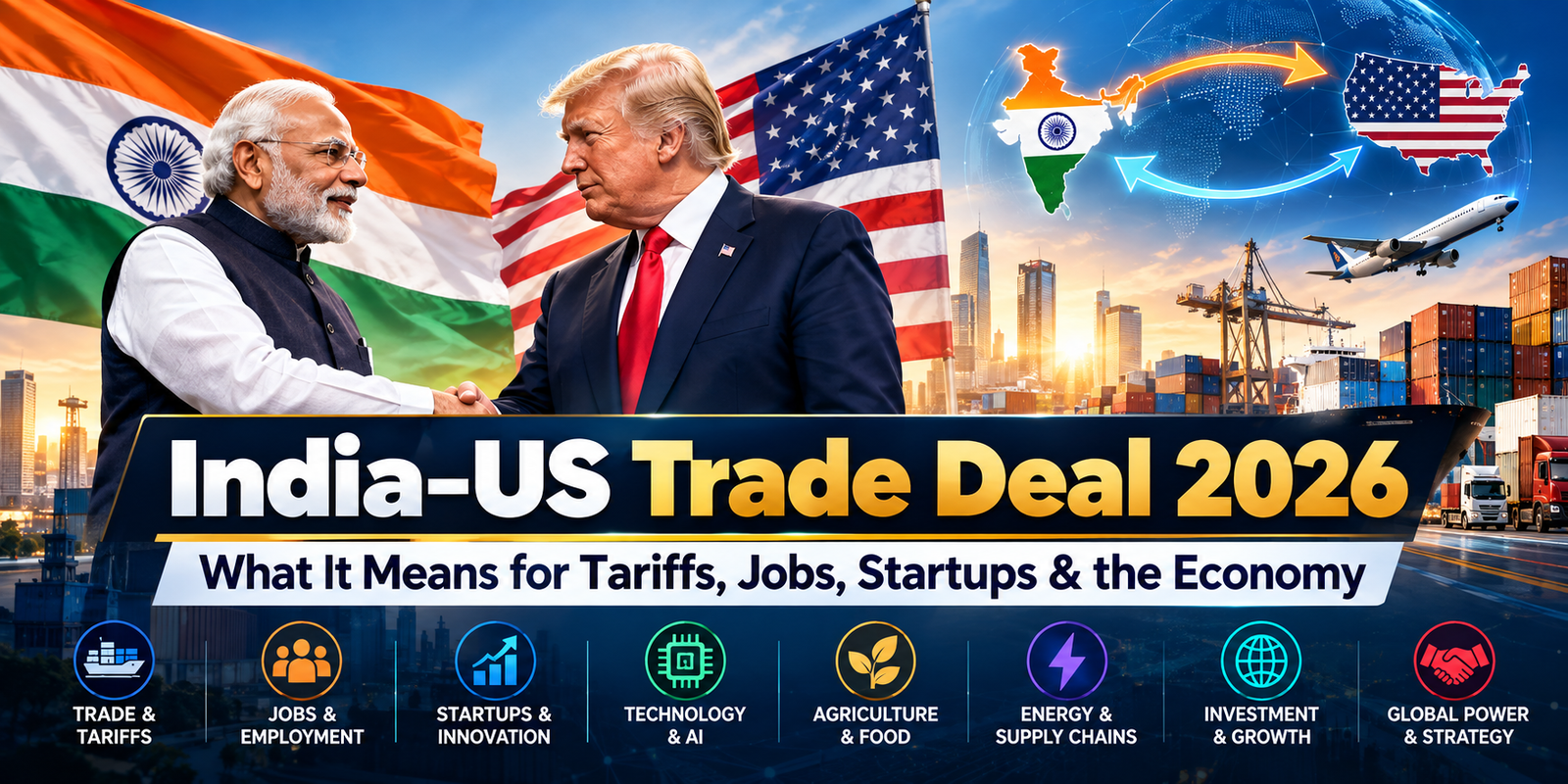
India–US Trade Deal 2026: What It Means for Tariffs, Jobs, Startups & the Economy
Updated: October 2026 | Smart Paisa Bharat
The India–US trade relationship entered a new phase in 2026. What began as negotiations over tariffs and market access has expanded into a much broader conversation involving technology, energy, supply chains, manufacturing, agriculture, digital trade and investment.
But there is an important distinction that is easy to miss: the February 2026 announcement was a framework for an Interim Agreement within the larger India–US Bilateral Trade Agreement negotiations. It should not be described as a completed, comprehensive free trade agreement.
That distinction matters for businesses, exporters, investors and ordinary consumers because the final economic impact depends on how the commitments are implemented and how the remaining negotiations develop.
India–US Trade Deal 2026: What Actually Happened?
On February 6, 2026, India and the United States announced a framework for an Interim Agreement on reciprocal and mutually beneficial trade. The framework was connected to the broader Bilateral Trade Agreement, or BTA, negotiations that began in 2025.
The proposed framework covers more than traditional customs duties. It also addresses market access, non-tariff barriers, rules of origin, digital trade, technology cooperation and economic security.
In other words, this is not simply a story about one tariff number. It is about how two large economies are trying to make trade between them more predictable while protecting sensitive sectors and expanding commercial opportunities.
India–US Trade in Numbers: Why the Relationship Matters
The scale of the relationship explains why even a relatively small policy change can attract global attention.
According to the U.S. Trade Representative, total U.S. goods and services trade with India was estimated at approximately $239.6 billion in 2025. U.S. goods trade alone was about $149.1 billion.
| Indicator | 2025 estimate |
|---|---|
| U.S.–India goods & services trade | $239.6 billion |
| U.S.–India goods trade | $149.1 billion |
| U.S. goods exports to India | $45.4 billion |
| U.S. goods imports from India | $103.8 billion |
The figures also show why the negotiations are commercially significant for both countries. India is an important market for American goods and services, while the United States is a major destination for Indian exports.
What Does the 2026 Interim Framework Cover?
The framework covers several areas that could affect companies and consumers on both sides of the relationship.
1. Lower Trade Barriers
India agreed to eliminate or reduce tariffs on a range of U.S. industrial products and selected agricultural and food products. The framework also contains commitments concerning market access and non-tariff barriers.
This could create additional opportunities for American exporters, while Indian businesses may gain from easier access to selected U.S. markets if the negotiated commitments are implemented as intended.
2. Indian Exporters and U.S. Market Access
The framework identified several Indian export sectors that could benefit from improved market conditions, including textiles and apparel, leather and footwear, chemicals, machinery, home-related products and other manufactured goods.
However, exporters should not assume that every Indian product automatically receives the same treatment. Actual tariff treatment can depend on product classification, rules of origin, implementation measures and subsequent U.S. trade policy.
3. Technology and Data-Centre Supply Chains
One of the most interesting parts of the framework is its focus on technology.
India and the United States said they intend to increase trade in technology products, including products used in data centres, and expand technology cooperation.
That brings areas such as artificial intelligence infrastructure, semiconductors, cloud computing and advanced electronics into the wider trade discussion.
For India’s technology ecosystem, the opportunity is not limited to exporting finished products. A deeper supply-chain relationship could also influence investment, component manufacturing, engineering services and specialised talent.
4. Digital Trade
Digital commerce is another important part of the negotiations.
The two countries committed to work toward digital trade rules covering barriers and practices affecting cross-border digital commerce.
For Indian IT companies, software businesses, digital platforms and technology startups, this area may eventually matter as much as traditional customs duties.
What About Agriculture?
Agriculture is one of the most sensitive parts of any India–US trade negotiation.
The February framework included selected U.S. agricultural products, but India also maintained protections for sensitive agricultural interests. India’s own published explanation of the framework says sensitive products such as rice, wheat, poultry, dairy, soyameal, maize, millets, groundnuts, honey and tobacco were kept outside the tariff-concession category.
This is important because headlines about “lower tariffs” can make the agreement sound much broader than it actually is. Trade concessions are product-specific, and sensitive sectors can receive different treatment from industrial goods.
For Indian consumers, greater access to selected imported products could increase choice or competition. For Indian farmers, the key question is how imports, quotas and domestic production interact over time.
What Does the Deal Mean for Indian Jobs?
Trade agreements do not create a fixed number of jobs overnight. Their employment impact usually develops through changes in exports, investment, production and demand.
Labour-intensive Indian industries could be particularly sensitive to changes in U.S. market access. Textiles, apparel, leather, footwear, engineering products and selected manufacturing businesses all depend on their ability to remain competitive in international markets.
A more predictable trade environment could help exporters plan capacity and investment. At the same time, greater import competition could pressure some domestic producers.
The real employment outcome will therefore depend on implementation, competitiveness, exchange rates, global demand and how quickly Indian companies convert market access into additional production.
What Could the India–US Deal Mean for Startups?
Startups are an important part of this story because modern trade is no longer limited to containers moving through ports.
Indian companies increasingly sell software, professional services, digital products and technology solutions to international customers. Better digital-trade rules and stronger technology cooperation could therefore influence businesses that do not export traditional physical goods.
The biggest potential areas include:
- Artificial intelligence and AI infrastructure
- Cloud computing and data-centre technology
- Software and IT services
- Semiconductor and electronics supply chains
- Cybersecurity and enterprise technology
- Fintech and digital payments
- Advanced manufacturing
- Clean-energy and industrial technology
For founders, the important question is not simply whether tariffs fall. It is whether the agreement makes it easier to build a product in India, sell it internationally and participate in global supply chains.
Energy Could Become a Bigger Part of the Relationship
Energy is another major component of the framework.
India stated an intention to purchase $500 billion of U.S. energy products, aircraft and aircraft parts, technology products, precious metals and coking coal over five years, according to the February joint statement.
Such a commitment is significant because energy and industrial inputs affect India’s manufacturing costs, infrastructure development and broader economic security.
It also demonstrates that the trade negotiations extend beyond the simple question of Indian exports to America. Imports from the United States are part of the equation too.
The Tariff Story Changed After February 2026
This is one area where older articles can quickly become misleading.
The February framework originally referred to an 18% U.S. reciprocal tariff rate for qualifying Indian-origin goods under the then-existing U.S. tariff framework. However, the U.S. Supreme Court ruled on February 20, 2026, in Learning Resources, Inc. v. Trump and the related case, addressing whether the International Emergency Economic Powers Act authorized the president to impose those tariffs.
India’s Ministry of Commerce subsequently noted that the reciprocal tariffs were no longer in force following the Supreme Court judgment and that the United States had imposed a separate 10% tariff on certain products for all countries through later executive actions.
Therefore, readers should not treat the original “18% tariff” figure as a permanent description of India’s current tariff treatment. Tariff policy can change through subsequent U.S. actions and implementation decisions.
Is the India–US Trade Deal Actually Final?
Not in the sense of a completed comprehensive bilateral free-trade agreement.
The February 2026 announcement established a framework for an Interim Agreement and reaffirmed the broader Bilateral Trade Agreement negotiations.
Official discussions continued later in 2026. In June, U.S. Trade Representative Jamieson Greer travelled to India for discussions with Indian officials concerning the Interim Agreement and the broader BTA negotiations.
That means the most accurate way to describe the situation is:
A 2026 framework for an Interim Agreement exists, while the broader bilateral trade negotiations continue. The final shape of the long-term agreement depends on further negotiations and implementation.
India–US Trade Deal: Who Could Be Affected?
| Group | Potential impact |
|---|---|
| Indian exporters | Potentially improved access to the U.S. market in covered sectors. |
| Manufacturers | Potential opportunities from deeper global supply-chain integration. |
| Technology companies | Potentially greater technology trade and cooperation. |
| Startups | Digital-trade and cross-border business opportunities could expand. |
| Farmers | Impact depends heavily on which agricultural products receive concessions and how quotas are structured. |
| Consumers | Some imported products could face different prices or greater availability. |
| Investors | Trade-policy changes can influence sectors exposed to exports, imports and global supply chains. |
Why This Matters Beyond India and America
The India–US economic relationship has implications beyond bilateral trade.
Companies are increasingly trying to diversify manufacturing and sourcing networks. India is seeking a larger role in global production, while the United States is looking to strengthen supply-chain resilience and technology partnerships.
That creates an overlap between trade policy and industrial policy.
Semiconductors, electronics, artificial intelligence infrastructure, pharmaceuticals, aviation, energy and advanced manufacturing are all areas where supply-chain decisions can have consequences far beyond customs duties.
What Should Businesses Watch Next?
- Final text of the Interim Agreement: Headlines are not a substitute for the final legal and implementation documents.
- Product-specific tariff schedules: Businesses should check their exact product classification instead of relying on a headline tariff number.
- Rules of origin: These determine which products qualify for preferential treatment.
- Non-tariff barriers: Licensing, standards and regulatory requirements can be just as important as customs duties.
- Digital trade rules: These could become increasingly important for India’s technology and services sectors.
- Technology supply chains: Data centres, GPUs, electronics and advanced manufacturing could become major areas of cooperation.
- Agricultural protections: Sensitive Indian farm products remain an important part of the negotiations.
India–US Trade Deal 2026: The Bigger Picture
The easiest way to understand the India–US trade story is to look beyond the headline tariff number.
The real issue is whether the two countries can build a more predictable commercial relationship while balancing domestic industries, farmers, consumers and strategic interests.
For India, the opportunity lies in using access to the U.S. market to expand exports, attract investment and move higher in global value chains. For the United States, greater access to India’s large and growing market is a major commercial objective.
Neither side gets everything it wants automatically. The final outcome will depend on the details of implementation, future negotiations and changes in global trade policy.
For readers, exporters and investors, the most useful approach is therefore to follow the actual policy documents rather than relying on dramatic “deal signed” headlines.
Frequently Asked Questions
Is there an India–US Free Trade Agreement in 2026?
India and the United States announced a framework for an Interim Agreement in February 2026 as part of broader Bilateral Trade Agreement negotiations. It should not automatically be described as a completed comprehensive FTA.
What is the India–US trade deal about?
The negotiations cover tariffs, market access, non-tariff barriers, rules of origin, digital trade, technology, supply chains, energy and other areas of economic cooperation.
Will the deal create jobs in India?
It could influence employment through exports, investment and manufacturing, but the number of jobs cannot be determined simply from the agreement. The effect will depend on implementation and business response.
Will Indian farmers be affected?
Agriculture is one of the most sensitive areas. India’s published framework explanation says several sensitive agricultural products were protected from tariff concessions, while selected products could receive limited or quota-based treatment.
Is the 18% U.S. tariff still the complete story?
No. The tariff framework changed after the February 20, 2026 U.S. Supreme Court decision concerning IEEPA tariffs and subsequent U.S. tariff actions. Readers should check the latest product-specific rules before making business decisions.
What happens next?
The two governments continue to work through the Interim Agreement and the wider Bilateral Trade Agreement negotiations. The final commercial impact will become clearer as detailed commitments and implementation measures are established.
Final Takeaway
The India–US trade relationship is becoming much bigger than a traditional tariff negotiation. It now touches manufacturing, technology, energy, digital commerce, agriculture and global supply chains.
The February 2026 framework was an important step, but it is only one stage in a wider negotiation. For businesses and consumers, the details will matter more than the headline.
Smart Paisa Bharat will continue to track major developments in India–US trade, tariffs, global markets and the wider economy.