Budget 2026 STT Hike: New F&O Tax Rates Explained
Updated: October 2026
For Indian F&O traders, one of the most important tax changes announced in Union Budget 2026 was not hidden in the income-tax slabs. It was sitting directly inside the trading cost structure: Securities Transaction Tax (STT).
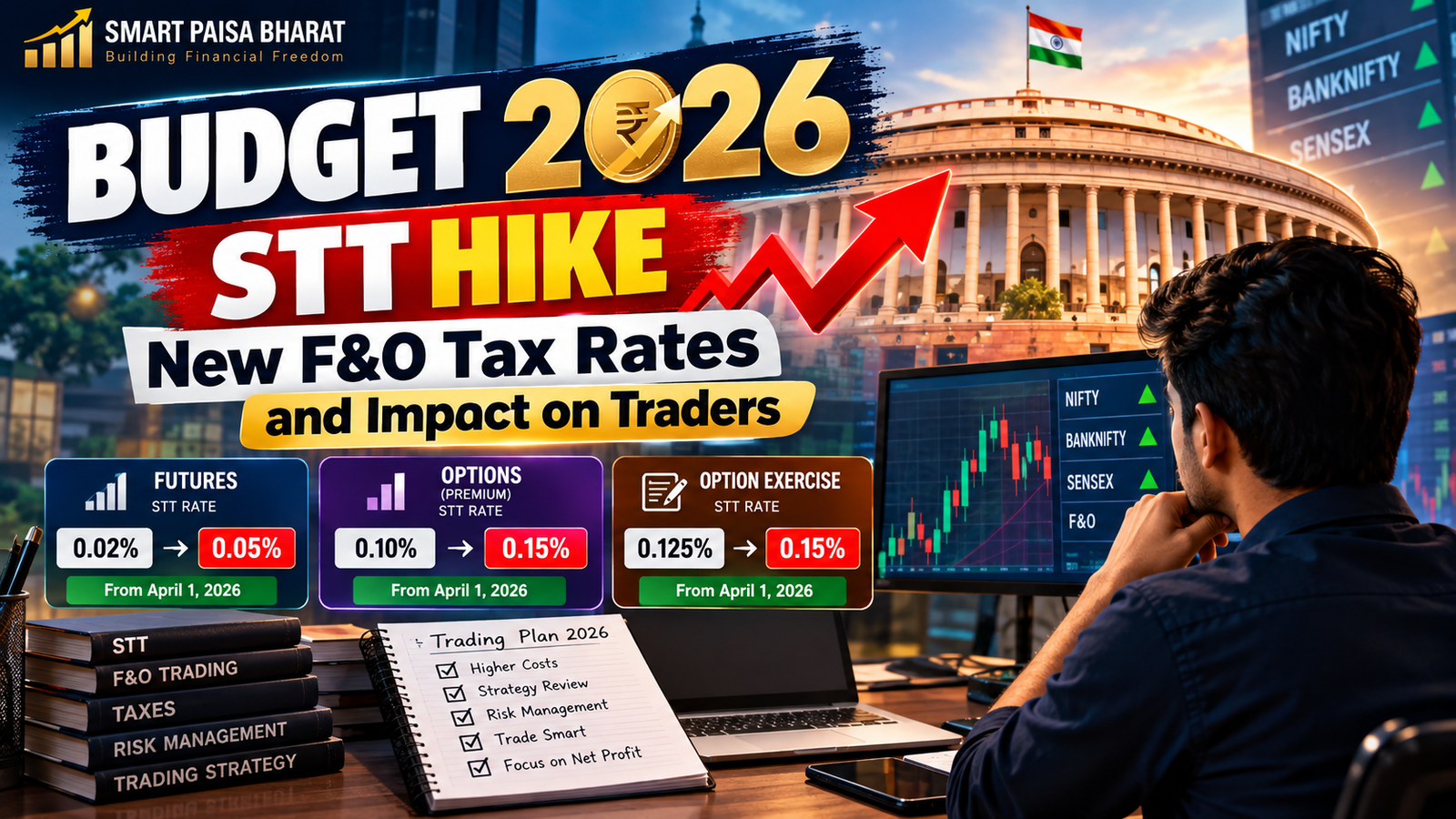
From April 1, 2026, the STT applicable to selected futures and options transactions increased. The change may look small when expressed as a percentage, but for traders who execute a large number of transactions, costs can accumulate quickly.
The bigger question is not simply, “How much did STT increase?” The more useful question is: What does the new STT structure mean for an active F&O trader’s actual trading economics?
Budget 2026 STT Hike: What Actually Changed?
Securities Transaction Tax is a transaction-based tax associated with specified securities transactions carried out through recognised market infrastructure. It is collected through the securities-market system rather than being something most traders manually calculate and pay separately.
In Budget 2026, the government proposed a calibrated increase in STT for the derivatives segment. The official Budget documents describe the move as a course correction for the F&O market and a revenue measure.
The revised rates are particularly important for frequent traders because trading costs do not depend only on whether a trade is profitable. A trader can have a profitable strategy on paper and still see a meaningful reduction in net returns after brokerage, exchange charges, STT, GST and other applicable costs.
New STT Rates From April 1, 2026
| Transaction | Earlier Rate | New Rate | Change |
|---|---|---|---|
| Sale of Futures | 0.02% | 0.05% | 2.5× the earlier rate |
| Sale of Option in Securities | 0.10% | 0.15% | Higher transaction cost |
| Option exercised | 0.125% | 0.15% | Higher applicable rate |
The important point is that the percentages are applied to the relevant taxable base specified under the STT framework. For example, the Finance Bill specifies the futures rate on the sale of futures and the options rate on the option premium; where an option is exercised, the applicable base is the intrinsic price.
Why Is the STT Hike Important for F&O Traders?
At first glance, an increase of a few hundredths of a percentage point may not look significant. But active derivatives trading works differently from long-term investing.
A long-term investor may buy a stock and hold it for months or years. An F&O trader can enter and exit several positions in a single session.
That means the same small cost can be repeated again and again.
Imagine a trader who focuses on very short-term opportunities. The trader may have a strategy with a small average profit per trade. If transaction expenses rise, the strategy’s break-even point also moves higher.
Futures Trading: Why the Change Can Be Noticeable
Futures traders need to pay particular attention because the STT rate on futures moved from 0.02% to 0.05%.
In percentage terms, the new rate is 2.5 times the previous rate. That does not mean a trader’s entire trading cost becomes 2.5 times higher because STT is only one component of the overall cost of trading.
However, for high-turnover traders, the increase can become meaningful when accumulated across a large number of transactions.
A Simple Futures Example
Suppose the relevant value of a futures sale for STT purposes is ₹10,00,000.
At 0.02%, the STT component would be:
₹10,00,000 × 0.02% = ₹200
At the revised 0.05% rate:
₹10,00,000 × 0.05% = ₹500
That is a difference of ₹300 on this illustrative taxable value.
Now imagine similar transactions being repeated throughout the month. The individual difference may look manageable, but the cumulative figure can become much more relevant to a high-frequency or high-turnover trader.
Note: This is an educational illustration, not a calculation of every charge appearing on a broker contract note.
Options Trading: The Impact Is Slightly Different
Options traders need to look at the change differently because the STT treatment depends on the type of transaction.
For the sale of an option, the STT rate on the option premium increased from 0.10% to 0.15%.
The rate applicable where an option is exercised also increased from 0.125% to 0.15%.
Example: Selling an Option
Suppose an option premium involved in a transaction is ₹50,000.
Under the earlier 0.10% rate, the STT component would be:
₹50,000 × 0.10% = ₹50
At the new 0.15% rate:
₹50,000 × 0.15% = ₹75
The difference in this simple illustration is ₹25.
Again, the important issue for an active trader is repetition. A single transaction may not materially change the economics of a strategy, but hundreds of transactions can create a very different picture.
Does the STT Hike Mean F&O Trading Is No Longer Profitable?
No. That would be an oversimplification.
The STT increase changes the cost side of the equation. It does not determine whether an individual trader will make or lose money.
A strategy with a strong statistical edge may continue to work after the tax increase. On the other hand, a strategy that was already producing very small profits per trade may become less attractive once all trading expenses are included.
This is why traders should stop looking only at their gross profit and start measuring net profit after all applicable costs.
Think About Trading This Way
Net Trading Result = Gross Trading Result − Trading Costs − Taxes − Other Applicable Charges
The exact charges vary according to the instrument, transaction and broker. Traders should therefore use their actual contract notes and broker charges when calculating strategy profitability.
Who Could Feel the Impact More?
The effect of the STT increase will not be identical for every market participant.
1. High-Turnover Traders
Traders who generate substantial turnover may notice the cumulative effect sooner because the higher rate is repeated across transactions.
2. Very Short-Term Strategies
Strategies that depend on capturing tiny price movements can be more sensitive to transaction costs. If the expected profit per trade is small, even a modest increase in costs deserves attention.
3. Traders With Frequent Entries and Exits
A strategy that repeatedly opens and closes positions needs to be evaluated on its complete cost structure rather than on individual winning trades.
4. Traders With Large Position Sizes
When the applicable taxable value is larger, a percentage-based charge naturally produces a larger rupee amount.
5. Traders Operating With a Thin Strategy Edge
If a strategy was already close to its break-even point, higher transaction costs can make the difference between a sustainable strategy and one that needs adjustment.
How Should F&O Traders Respond to the STT Hike?
The wrong reaction is to trade more aggressively just to “recover” higher costs. A better response is to understand where money is actually being made and where it is leaking.
1. Calculate Your Real Cost Per Trade
Do not judge a strategy using the entry and exit prices alone. Review your broker contract notes and calculate the complete cost of trading, including STT and other applicable charges.
Once you know your average cost per trade, you can compare it with your average gross profit per trade.
2. Review Overtrading
More trades do not automatically mean more profit.
If five high-quality trades produce the same result as twenty low-quality trades, the lower-turnover approach may be more efficient after costs.
This does not mean traders should blindly reduce their activity. The objective should be to eliminate trades that do not have a clear risk-reward or statistical reason behind them.
3. Focus on Quality, Not Just Quantity
The new STT structure is another reason to become more selective.
Before entering a trade, ask:
- What is my actual setup?
- Where is the invalidation level?
- What is the expected reward relative to the risk?
- How much will the complete trade cost?
- Does the expected edge remain attractive after costs?
4. Recalculate Your Break-Even Point
A strategy that previously required a certain price movement to cover costs may now require a slightly larger movement.
Traders should therefore update their backtests and spreadsheets instead of relying on historical results generated under an older cost structure.
5. Separate Gross Profit From Net Profit
This is one of the most important habits for any serious trader.
A trading strategy can show a beautiful gross-profit curve while producing disappointing net returns after expenses.
Your performance report should ideally track:
- Total trades
- Winning trades
- Losing trades
- Gross profit
- Gross loss
- STT
- Brokerage
- Exchange-related charges
- GST and other applicable charges
- Net profit or loss
- Average profit per trade
STT Hike vs Other Trading Costs: Don’t Look at One Number
One mistake traders can make after the Budget is to focus entirely on STT.
STT is important, but it is not the only cost associated with F&O trading. Depending on the transaction, a trader may also encounter brokerage, exchange transaction charges, GST, stamp duty and other applicable statutory or broker-level charges.
Therefore, the correct question is not:
“How much STT am I paying?”
Instead, ask:
“How much does my complete trading activity cost me, and is my strategy generating enough edge to justify that cost?”
Will the STT Hike Reduce F&O Trading in India?
It is too early to assume that the STT increase will dramatically reduce derivatives participation across the entire market.
Market activity depends on many factors, including volatility, liquidity, institutional participation, investor behaviour, index movements, interest rates and broader economic conditions.
What can reasonably be said is that higher transaction taxes increase the cost of participating in the derivatives market. The effect is likely to be more noticeable for strategies where margins are already thin.
The government’s Budget documents described the measure as a calibrated revision in view of the scale and depth of the derivatives market, while the Budget speech referred to a course correction in the F&O segment.
What Retail Traders Should Do Differently in 2026
The biggest lesson from the STT change is not “stop trading F&O.”
It is trade with better cost awareness.
Retail traders should know exactly how much they are spending to generate their returns. That means keeping a proper trading journal and reviewing performance over a meaningful sample of trades.
If a strategy has a genuine edge, the objective should be to protect that edge. If the edge disappears after costs, the trader needs to investigate the strategy rather than simply increasing position size.
Frequently Asked Questions About Budget 2026 STT Hike
What is the new STT rate on futures in 2026?
The STT rate on the sale of futures increased from 0.02% to 0.05% from April 1, 2026.
What is the new STT rate on option premiums?
STT on the sale of an option in securities increased from 0.10% to 0.15% of the option premium.
What is the STT rate when an option is exercised?
The STT rate for an option where the option is exercised increased from 0.125% to 0.15%. The applicable provision refers to the intrinsic price as the relevant base.
When did the new STT rates become applicable?
The revised STT provisions took effect from April 1, 2026.
Does the STT hike mean F&O trading is illegal or restricted?
No. The STT increase is a tax change. It does not make legitimate F&O trading illegal.
Will every F&O trader lose money because of the STT hike?
No. The impact depends on the trader’s strategy, turnover, position size, profitability and total transaction costs. A profitable strategy may remain profitable after the change, although its net returns can be affected.
Is STT the only cost traders should consider?
No. Traders should consider the complete cost structure, which can include brokerage, exchange charges, GST, stamp duty, STT and other applicable charges.
Should traders stop trading options because of the higher STT?
There is no universal answer. Traders should evaluate their own strategy using actual historical and current trading costs rather than making a decision based only on the tax rate.
Final Takeaway: The Real Cost of an F&O Trade Matters More Than the Headline
The Budget 2026 STT hike is important, but it should not be viewed in isolation.
Futures STT moved from 0.02% to 0.05%, while STT on option premiums moved from 0.10% to 0.15%. The rate applicable when an option is exercised also moved to 0.15%. These changes apply from April 1, 2026.
For a casual investor, the impact may be relatively limited. For a high-turnover derivatives trader, however, repeated transaction costs can have a much bigger effect on net returns.
That is why 2026 is a good time for traders to move beyond simply asking, “Did I make money today?”
The better question is:
“After every applicable cost and tax, does my trading strategy still have a genuine edge?”
That is the number worth watching.
Disclaimer: This article is for educational and informational purposes only. It is not investment, trading, tax or financial advice. STT and other market charges can depend on the nature of the transaction and applicable rules. Traders should verify the latest applicable charges with their broker, exchange and qualified tax professional before making financial decisions.