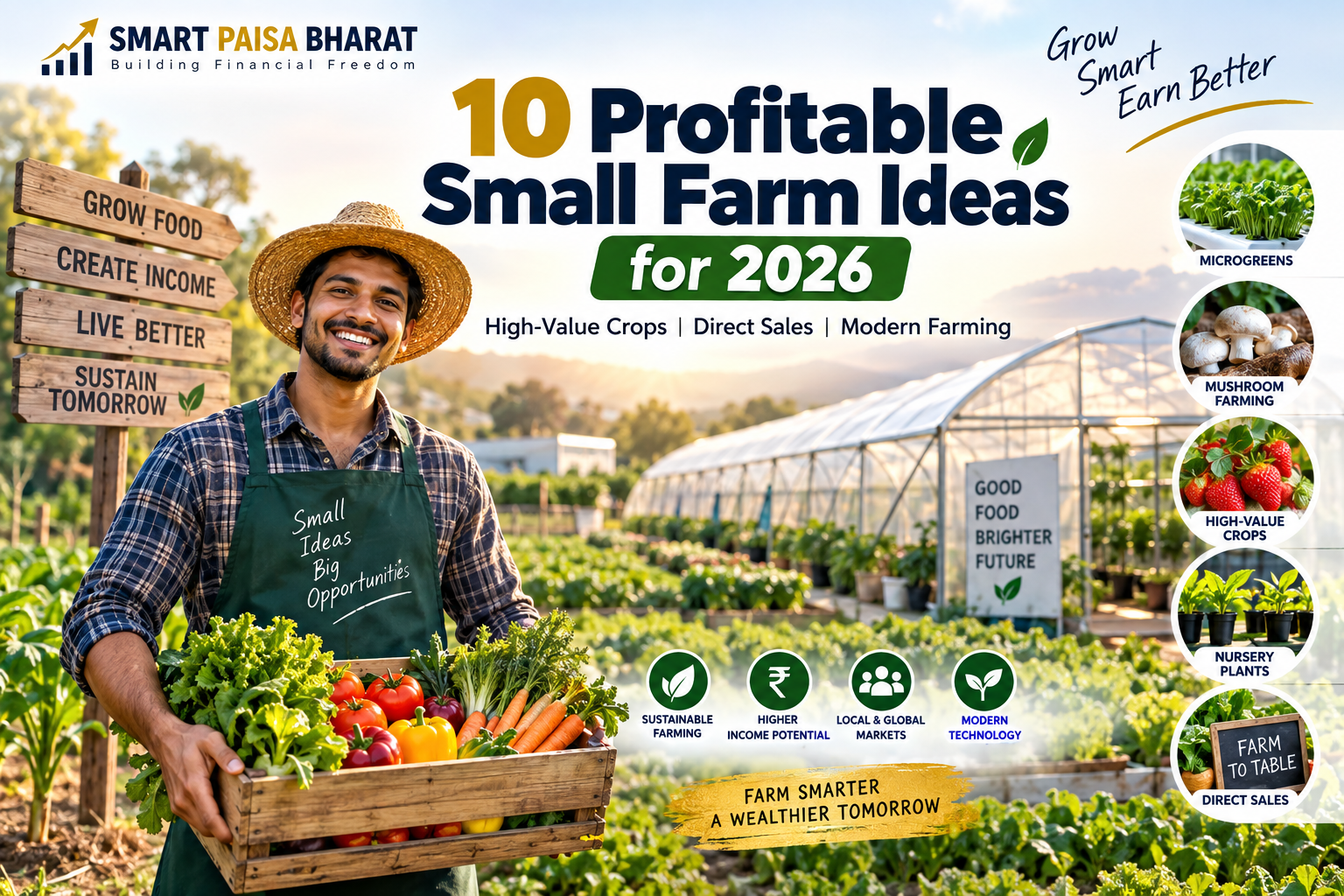
Profitable Small Farm Ideas in 2026: 10 High-Value Agriculture Businesses to Explore
Profitable Small Farm Ideas in 2026: High-Value Crops, Direct Sales & Modern Farming
A small piece of land does not automatically mean a small business.
Walk through a traditional farming village and you may still see the familiar picture: large fields, seasonal crops, local traders and income that rises and falls with the harvest.
But another kind of farming business is quietly developing.
Some small growers are concentrating on specialty vegetables, protected cultivation, nursery plants, mushrooms, microgreens, flowers and direct-to-consumer sales. Others are adding simple processing, packaging or subscription models instead of selling everything immediately after harvest.
The difference is not simply the crop.
It is the business model surrounding the crop.
In 2026, a small farm can be approached as a production business, a local food brand, a nursery, a specialty supplier or a combination of several activities.
This guide explores practical small-farm opportunities, what makes them commercially interesting, where the risks sit and how a new farmer can test an idea before committing substantial capital.
Why Small Farming Is Becoming More Business-Oriented
Traditional farming often focuses on one central question:
What crop should I grow?
A commercially minded farmer asks several additional questions:
- Who will buy the produce?
- What price can realistically be achieved?
- How quickly does the product need to reach the customer?
- Can quality be maintained consistently?
- How much water and labour does the crop require?
- What happens if the market price falls?
- Can some of the produce be sold directly?
- Can the farm earn from more than one product?
That shift in thinking can change the economics of a small holding.
National Horticulture Board material on protected cultivation highlights the importance of crop selection, market demand, production planning, packaging and marketing alongside cultivation itself. 2
In other words, a profitable farm is not created simply by planting something expensive.
It is created by connecting production with a real customer and controlling the numbers in between.
1. High-Value Vegetables Under Protected Cultivation
Protected cultivation is one of the more interesting options for farmers who have suitable land, reliable water and access to a market that rewards consistent quality.
Instead of exposing the entire crop to open-field conditions, farmers can use structures such as polyhouses, greenhouses, shade nets or other protected systems to create a more controlled growing environment.
Depending on the location and structure, crops such as coloured capsicum, cucumber, tomato and selected specialty vegetables can be considered.
ICAR research and field examples continue to document protected cultivation as an approach for improving production conditions and accessing higher-value or off-season markets. 3
Why the model is interesting
- Greater control over growing conditions
- Potential for more consistent quality
- Possibility of targeting off-season supply windows
- Better use of limited land in suitable situations
- Opportunity to develop relationships with institutional or retail buyers
However, this is not a shortcut to guaranteed profit.
Structures, irrigation, planting material, labour, maintenance and crop management can require significant investment. A farmer should calculate the complete project cost before construction rather than beginning with the assumption that a high selling price will automatically produce a high return.
A recent ICAR case involving coloured capsicum illustrates the point: a 3,000-square-metre polyhouse generated substantial gross and net income during the reported season, but the result was tied to production quality, market realization and an established buyer network. It should be treated as a case study, not a universal income promise. 4
2. Microgreens: Small Space, Short Production Cycles
Microgreens have attracted attention because they can be grown in relatively small spaces and harvested much earlier than many conventional field crops.
They can be supplied to:
- Restaurants
- Hotels
- Cafes
- Health-focused consumers
- Specialty grocery stores
- Direct subscription customers
The real opportunity is not simply growing microgreens.
It is finding customers who value freshness and are willing to purchase repeatedly.
A small producer could begin with a limited range of varieties, measure demand and gradually expand only when repeat orders become predictable.
This model is particularly interesting for someone near a large urban market because transportation time can be short.
The hidden challenge
Microgreens are perishable.
Growing a beautiful tray is only half the job. Harvest timing, hygiene, packaging, temperature management, delivery and customer retention all influence the economics.
A farmer who produces more than the local market can absorb may discover that a high-value crop can still become a low-value business.
3. Mushroom Farming as a Controlled-Environment Business
Mushroom cultivation is another option worth investigating where local climate, technical knowledge and market access make the model suitable.
Unlike conventional field crops, mushroom production can be structured around controlled growing environments.
This can make the model interesting for people who have limited agricultural land but access to an appropriate growing space.
Potential customers include:
- Local vegetable retailers
- Restaurants
- Hotels
- Wholesalers
- Direct household buyers
But mushroom farming has its own technical risks. Contamination, temperature, humidity, hygiene and inconsistent demand can affect the business quickly.
That is why a small pilot is generally more sensible than constructing a large facility before understanding the production process.
4. Nursery Plants: Selling the Beginning of the Farm
One of the most overlooked agricultural businesses is the plant nursery.
Instead of waiting months for a crop to mature, a nursery business sells planting material at an earlier stage.
Depending on local demand, this can include:
- Vegetable seedlings
- Fruit plants
- Flowering plants
- Ornamental plants
- Herbs
- Kitchen-garden plants
- Specialty planting material
The customer base can extend beyond farmers.
Home gardeners, landscapers, housing societies, schools, restaurants and small commercial growers may also become customers.
The National Horticulture Board currently highlights quality planting material and nursery-related development within its horticulture ecosystem, reflecting the importance of reliable planting material in commercial horticulture. 5
Why a nursery can be attractive
A nursery can create repeat business when customers return for new planting cycles.
It can also allow a farmer to specialize in varieties that are difficult to find locally.
The important point is to choose plants based on actual local demand rather than producing whatever happens to be popular online.
5. Specialty Herbs and Culinary Crops
Not every profitable agricultural idea needs hundreds of acres.
Some businesses work by supplying a narrow customer group with a product that is difficult to source consistently.
Examples can include specialty herbs, culinary greens and selected premium vegetables.
Restaurants and premium food businesses may value:
- Consistent quality
- Reliable weekly supply
- Uniform sizing
- Fresh harvesting
- Traceability
- Predictable delivery
That creates an important lesson for small farmers:
A smaller market with repeat customers can sometimes be more useful than a large market where the farmer has no pricing power.
6. Flowers and Specialty Floriculture
Flowers can provide another route into higher-value horticulture, particularly where there is strong demand from events, temples, decorators, florists or local markets.
The business, however, is highly dependent on timing.
Demand around weddings, festivals and major events can differ substantially from ordinary weeks.
A farmer therefore needs to understand:
- Local seasonal demand
- Harvest timing
- Post-harvest handling
- Transport requirements
- Buyer relationships
Commercial floriculture can also require more specialized production practices than ordinary field crops.
For that reason, training and local market research should come before large-scale investment.
7. Direct-to-Consumer Farm Sales
Sometimes the biggest improvement does not come from changing the crop.
It comes from changing the route to the customer.
A farmer who sells everything through a wholesale chain may receive one price at the farm gate. A farmer with the ability to package and sell directly may capture more of the final consumer value.
Possible channels include:
- Weekly vegetable boxes
- WhatsApp ordering
- Local subscription plans
- Farm-gate sales
- Apartment-community deliveries
- Restaurant supply
- Local grocery partnerships
Direct selling does introduce additional work: packaging, customer service, delivery and payment collection.
So the right question is not:
“Can I sell directly?”
It is:
“Will the additional margin justify the additional work and delivery cost?”
8. Farm Processing Can Change the Economics
Fresh produce has a limitation: it often has a short selling window.
Simple processing can sometimes create another product with a longer shelf life.
Depending on local regulations, infrastructure and demand, examples may include:
- Dried herbs
- Dehydrated vegetables
- Pickles
- Jams
- Spice blends
- Flour and grain products
- Packaged farm products
This does not mean every farmer should immediately start a food-processing unit.
Food safety, labelling, licensing, packaging and shelf-life requirements need to be understood before selling processed food commercially.
But as a business concept, value addition deserves consideration because the farmer is no longer selling only raw agricultural output.
9. Vertical Farming: Interesting, but Not for Everyone
Vertical farming often appears in discussions about the future of agriculture.
It can make efficient use of indoor space and may be suitable for selected crops and markets.
But the technology should not be confused with easy money.
Electricity, climate control, equipment, maintenance and technical expertise can materially affect operating costs.
For a small farmer, a simpler protected-cultivation system may sometimes make more commercial sense than a highly automated indoor farm.
The best technology is not necessarily the most advanced technology.
It is the technology that fits the crop, climate, budget and customer.
10. Farm-to-Restaurant Supply
Restaurants can become valuable recurring customers for farmers who can deliver the right product consistently.
A chef may care about qualities that are different from those of a wholesale buyer:
- Specific varieties
- Freshness
- Uniform size
- Reliable delivery
- Small-batch availability
- Seasonal specialties
This creates an opportunity for small farms to specialize.
Instead of competing purely on volume, a farmer can build a reputation around a particular product or quality standard.
The relationship can become especially useful when both sides communicate regularly about upcoming demand.
How to Choose the Right Small-Farm Business
Do not choose a farming business because someone on social media claims that it can generate a particular monthly income.
Start with your own circumstances.
| Factor | Question to Ask |
|---|---|
| Land | How much usable land is actually available? |
| Water | Is the supply reliable throughout the production cycle? |
| Climate | Does the crop suit the local growing conditions? |
| Capital | How much can be invested without creating excessive financial pressure? |
| Labour | Who will handle daily farm operations? |
| Market | Who will purchase the harvest? |
| Transport | How quickly can the product reach buyers? |
| Risk | What happens if the selling price drops? |
A Better Way to Start: Test Before You Scale
This is perhaps the most important lesson in modern small-farm entrepreneurship.
Do not build the entire business before proving that customers exist.
Suppose you are considering specialty vegetables.
Before investing heavily in infrastructure, speak with restaurants, retailers and local households.
Ask what they currently buy, how frequently they purchase it, what quality they expect and what problems they experience with existing suppliers.
Then run a small production trial.
Record everything:
- Seed or planting material cost
- Fertilizer and crop-input expenses
- Water and electricity
- Labour
- Packaging
- Transportation
- Crop losses
- Actual selling price
- Unsold produce
- Net margin
After one or more production cycles, the numbers will tell you much more than an attractive social-media success story.
Revenue Is Not Profit
This distinction is essential.
Imagine a farm sells produce for ₹5 lakh during a season.
That does not mean the farmer earned ₹5 lakh.
There may have been expenses for:
- Seeds or seedlings
- Fertilizers
- Crop protection
- Labour
- Water
- Electricity
- Packaging
- Transport
- Rent or land costs
- Equipment depreciation
- Interest or financing costs
- Crop losses
The amount left after these costs is much closer to the figure that matters.
That is why headlines such as “₹10 lakh income from one acre” should always be examined carefully.
Ask whether the number refers to sales, gross income, operating profit or actual net income.
Technology Can Make a Small Farm Smarter
Modern farming does not necessarily require expensive automation.
Even basic technology can improve decision-making.
- Weather forecasting for crop planning
- Digital expense tracking
- Soil testing
- Drip irrigation
- Moisture monitoring
- Digital inventory records
- Online customer ordering
- Simple farm accounting
- Digital marketing
For larger protected systems, sensors and automated controls can become useful, but they should be introduced when the economics justify them.
Technology should solve a problem rather than simply make the farm look modern.
Farmer Producer Organizations Can Also Matter
Small farmers do not always have to operate entirely alone.
Collective models can help producers work together around purchasing, marketing, aggregation, grading, packaging and market access.
ICAR has documented examples where farmer organizations combined high-value horticulture with marketing support to strengthen commercial farming activity. 6
For a small producer, the ability to combine output with neighbouring farms can sometimes improve bargaining power and make larger buyers more accessible.
What About Government Support?
Farm infrastructure and horticulture projects may qualify for support under applicable government schemes, depending on the activity, state, applicant category and current guidelines.
The National Horticulture Board currently publishes operational guidelines and assistance-related information for commercial horticulture and protected cultivation, with guidelines subject to revisions. 7
Do not build a business plan around an assumed subsidy.
First verify the current eligibility requirements, eligible components, application process, financing conditions and applicable limits through the relevant official authority.
Three Small-Farm Models Worth Comparing
Model A: Production-Focused Farm
You grow a crop and sell mainly through wholesalers or local markets.
Advantage: simpler sales structure.
Challenge: limited control over the final selling price.
Model B: Specialty Direct-Sale Farm
You grow selected products and sell directly to households, restaurants or retailers.
Advantage: closer relationship with the customer.
Challenge: marketing, packaging and delivery require additional effort.
Model C: Farm + Value Addition
You produce agricultural goods and convert some output into packaged or processed products where legally permitted.
Advantage: additional product possibilities and potentially longer selling windows.
Challenge: processing, compliance, packaging and distribution become part of the business.
What I Would Avoid as a New Farmer
There are a few common mistakes worth avoiding.
Chasing the Highest Price
The crop with the highest market price is not automatically the most profitable crop for your location.
Copying Another Farmer’s Numbers
Two farms can grow the same crop and achieve very different results because of climate, labour costs, water availability, market access and timing.
Building Infrastructure Too Early
Expensive infrastructure should follow a tested business case rather than replace one.
Ignoring the Buyer
Growing first and searching for customers later can create avoidable losses with perishable produce.
Confusing Sales With Profit
Always calculate the complete cost structure.
The Small Farm of the Future May Look More Like a Business
The image of farming is changing.
A modern small farm can involve cultivation, technology, logistics, branding, digital marketing, customer relationships and financial management at the same time.
The farmer may still spend the morning in the field, but the afternoon could involve checking orders, reviewing costs, speaking with buyers or planning the next production cycle.
That is not a departure from farming.
It is farming becoming more commercially organized.
Final Takeaway
There is no single crop that guarantees wealth.
There is no universal “one-acre millionaire formula.”
And there is no farming model that eliminates weather, market or operational risk.
What does exist are opportunities to make smaller agricultural operations more focused, more market-aware and more efficient.
High-value vegetables, protected cultivation, mushrooms, microgreens, nurseries, specialty herbs, flowers, direct farm sales and value-added products can all be explored where local conditions support them.
The smartest starting point is not a large investment.
It is a small experiment with real customers, careful records and honest numbers.
Start with the market. Choose the crop. Test the model. Measure the result. Then scale.
That is a much more realistic path toward building a profitable modern farm business.
Frequently Asked Questions
What is the most profitable small farm business?
There is no universally most profitable option. Profitability depends on local demand, climate, water, labour, capital, crop choice, selling price and operating costs. Specialty horticulture and direct-market models can be attractive in suitable locations.
Can a small farm make good money?
Yes, but income varies considerably between farms. A small operation can improve its commercial potential through specialty crops, efficient production, direct sales and value addition, but profitability is never guaranteed.
Is protected cultivation suitable for small farmers?
It can be, particularly where the selected crop, climate and market support the investment. However, infrastructure and operating costs should be evaluated carefully before construction.
Are microgreens a good farming business?
Microgreens can suit certain urban and peri-urban markets because of their short production cycles and premium positioning. The business depends heavily on repeat buyers, hygiene, freshness and reliable delivery.
Which is better: wholesale or direct farm sales?
Neither is automatically better. Wholesale can simplify distribution, while direct sales may provide greater control over customer relationships and pricing. The additional selling and delivery costs must be considered.
Should I take a loan to start a farm business?
Borrowing should be considered only after preparing a realistic business plan that includes production costs, market risks, repayment obligations and a reserve for unexpected losses. Never assume that a projected crop income will automatically cover repayments.
Where can farmers check current horticulture schemes?
Farmers should verify current schemes, eligibility and assistance conditions through official government agriculture and horticulture departments or the National Horticulture Board rather than relying on old social-media posts or promotional claims.
Smart Paisa Bharat — Building Financial Freedom