Hidden Human Labor Behind AI: Who Trains Artificial Intelligence?
Artificial intelligence has become part of our everyday routine. We use it to write emails, summarize documents, create images, learn new skills, and solve problems that once required hours of work.
Yet there is an important question that rarely comes up when we open an AI application: who did the work that made this technology possible?
Behind the smooth conversations and instant results, there is a much larger story involving software engineers, researchers, data specialists, content reviewers, and countless other people who contribute to the development and maintenance of artificial intelligence.
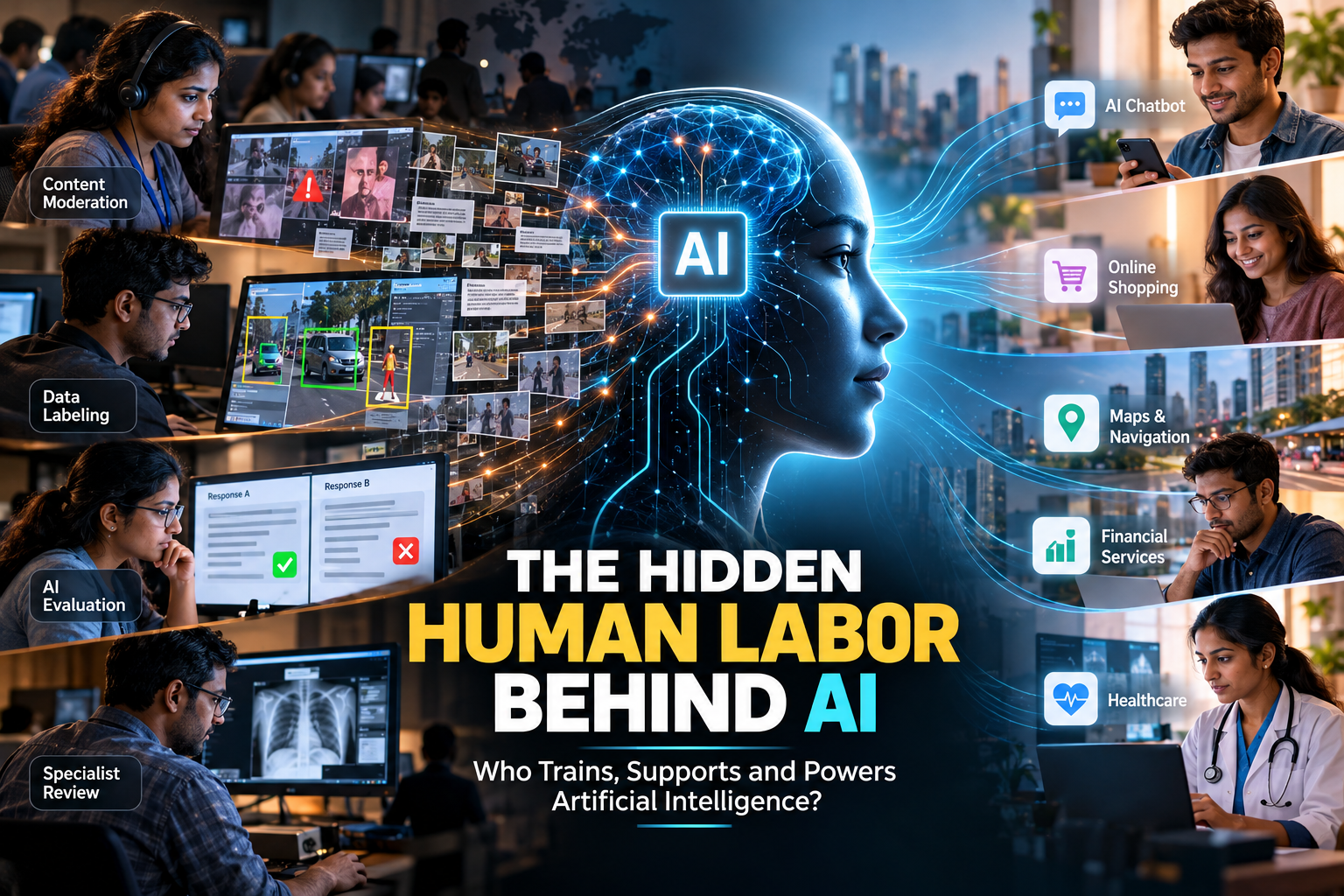
Some of these workers build the underlying technology. Others organize information, label images, evaluate computer-generated answers, and identify mistakes that automated systems may overlook. Their contributions can be essential, even though most users never see them.
This article explores the hidden human labor behind AI, how the work is performed, why it matters, and what the growing use of artificial intelligence could mean for workers and businesses around the world.
1. What Is Hidden Human Labor Behind AI?
Hidden human labor refers to the work people perform behind the scenes to develop, train, test, supervise, and improve artificial intelligence systems.
Think about an AI assistant that answers questions about personal finance. A user types a question and receives an answer within seconds. The process appears simple, but building a useful system involves much more than writing a few lines of software.
Developers need suitable data, computing resources, training methods, testing procedures, and ways to evaluate the quality of the system’s responses. Human specialists can contribute at several of these stages.
Who are the people working behind AI?
- AI engineers: Develop models, software, and technical systems that support AI applications.
- Data annotators: Add labels or descriptions to text, images, audio, and other information.
- Content moderators: Review material that may violate platform policies or create safety concerns.
- AI evaluators: Assess the quality, relevance, and usefulness of AI-generated responses.
- Researchers and subject experts: Study model behavior and help evaluate systems in specialized fields.
- Quality assurance teams: Test applications, identify problems, and check whether systems meet requirements.
These jobs require different skills and do not all involve the same working conditions. Some require advanced technical education, while others focus on language, data organization, or careful review.
The International Labour Organization has examined the role of invisible digital workers in the AI supply chain, including the people who help prepare data and support automated systems.
Read more about invisible workers in the AI economy.
Why is this work difficult to see?
Technology companies generally present their products through simple interfaces. A chatbot displays a response, a navigation application shows a route, and a recommendation system suggests a product.
The user does not normally see the people who prepared the data, tested the feature, or reviewed difficult cases during development.
This creates a gap between the experience of using AI and the work required to make many AI services function reliably.
2. How Humans Help Train AI Systems
AI models learn patterns from data through computational training methods. The process varies depending on the type of model, its purpose, and the data used to develop it.
Human involvement can be important before, during, and after training. Here is a simplified explanation of how that contribution works.
Step 1: Preparing useful data
A model needs information relevant to the task it is expected to perform. This information might include text, photographs, audio recordings, videos, or structured datasets.
People may help organize the information, identify duplicates, correct formatting problems, remove unsuitable records, and check whether the data meets project requirements.
Data preparation is important because errors, missing information, or unsuitable examples can affect the quality of a training dataset.
Step 2: Creating examples that machines can learn from
Imagine a company developing an AI system that identifies road signs in photographs. A dataset might contain thousands of road images.
Human annotators can identify stop signs, traffic lights, pedestrians, and other objects in those images. The resulting labels provide examples that can be used in model training or evaluation.
The model learns statistical patterns from the examples. It does not automatically gain human understanding simply because an object has been labeled.
Step 3: Evaluating AI-generated answers
After an AI system generates responses, evaluators may review them using defined quality criteria.
For example, an evaluator might compare two answers to the same question and determine which one follows the instructions more closely. Other tasks may involve checking clarity, identifying factual errors, or flagging potentially harmful responses.
Some AI development approaches use human preference data as part of the process of improving model behavior.
Human review can improve AI systems, but it cannot guarantee that every answer will be accurate. Models may still produce errors, misunderstand context, or generate information that sounds convincing but is incorrect.
3. The People Behind AI Content Moderation
One of the more sensitive areas of digital work is content moderation.
Online platforms and AI companies need ways to identify content that violates rules or creates safety risks. Automated systems can detect certain patterns, but some situations require a human being to examine the context.
A sentence may be harmless in one conversation and threatening in another. A photograph might be part of legitimate news reporting, while a similar image could be shared to promote violence or abuse.
Human moderators may be asked to consider language, context, platform policies, and the circumstances surrounding a particular piece of content.
What does a content moderator do?
- Reviews content flagged by automated systems or users.
- Checks whether material follows the platform’s rules.
- Identifies harmful content that may require additional review.
- Escalates complex cases to specialized teams.
- Provides feedback that can help improve moderation processes.
The human cost of reviewing disturbing material
Some moderation assignments involve repeated exposure to graphic violence, abuse, hateful material, or other disturbing content.
Depending on the nature of the work and the support available, this exposure can create psychological stress and other well-being concerns.
Workers may need reasonable workloads, appropriate breaks, access to professional support, and clear procedures for handling difficult cases.
A 2025 report by Equidem examined working conditions in content moderation and data labeling. Its findings reflect the workers, locations, and research methods covered in that report, rather than every AI workplace worldwide.
Read Equidem’s research on the human cost of content moderation.
4. What Is AI Data Labeling?
AI data labeling, also called data annotation, is the process of adding useful labels or descriptions to information so it can be used in machine learning projects.
A label might identify an object in a photograph, classify a sentence, describe an audio recording, or indicate whether an AI-generated response follows certain guidelines.
Although some labeling tasks are straightforward, others require attention to detail, language skills, specialist knowledge, or careful interpretation of instructions.
| Type of work | What it involves | Example |
|---|---|---|
| Image annotation | Identifying objects or regions in images. | Labeling vehicles and pedestrians. |
| Text annotation | Categorizing or describing text. | Classifying customer messages. |
| Audio transcription | Converting speech into written text. | Transcribing a voice recording. |
| Response evaluation | Assessing AI-generated responses. | Comparing two chatbot answers. |
| Data quality review | Checking data for errors or inconsistencies. | Correcting inaccurate labels. |
Why accuracy matters
Consider a system designed to recognize road signs. If a significant number of training examples contain incorrect labels, the dataset may become less useful.
The impact depends on the task, the model, the quality of the remaining data, and the testing procedures used by developers.
This is why data quality teams and human reviewers can play an important role in AI development.
Their work may seem small when viewed one task at a time. Across a large project, however, thousands of carefully reviewed examples can contribute to a much larger technical process.
5. The Global AI Labor Supply Chain
AI development is an international activity. A single product may involve researchers, engineers, data providers, cloud computing companies, and digital workers operating in different locations.
Some workers are employed directly by technology companies. Others work through outsourcing businesses, specialist service providers, or online platforms.
This arrangement allows businesses to access different technical skills, language expertise, and specialist knowledge. It can also make the employment relationship less visible to the end user.
Why is AI work distributed across countries?
- Language expertise: Local speakers can help evaluate regional language and cultural context.
- Specialized skills: Different projects require engineers, researchers, translators, and subject experts.
- Remote access: Digital platforms can connect businesses with workers outside their immediate location.
- Outsourcing: Companies may contract external providers for data preparation, testing, or other services.
Research by the International Labour Organization has examined digital labor and AI-related work in countries including India and Kenya.
Digital work can create opportunities to participate in international projects. At the same time, research has identified concerns involving income security, employment protections, and working conditions in some forms of platform work.
Explore the ILO’s research on AI and work.
Why transparency is important
When multiple organizations contribute to an AI product, it may be difficult for customers to understand who performed particular tasks and what standards applied to those workers.
Businesses can improve oversight by understanding their suppliers, establishing clear expectations, and examining how data and labor are handled throughout the development process.
6. AI Human Labor in Everyday Life
You do not need to work in a technology company to encounter AI systems that involve human contributions.
Many services people use every day depend on data, software, evaluation, and quality control processes.
AI chatbots and virtual assistants
Human specialists may prepare language examples, evaluate responses, test conversational behavior, and identify answers that fail to follow safety or quality requirements.
Online shopping and recommendations
Product categorization, catalog organization, data cleanup, and review analysis can involve human work that supports digital shopping and recommendation services.
Maps and navigation applications
Mapping systems may use geographic information, photographs, road records, and verification processes. People can help check or correct certain types of map infor
Financial technology and fraud detection
Financial institutions may use automated systems to identify unusual transactions or prioritize cases for review. Human specialists can help investigate alerts, review disputed transactions, and assess whether a system is producing inappropriate results.
An automated alert does not automatically establish that a transaction is fraudulent. Appropriate investigation and customer protection procedures remain important.
Healthcare and medical technology
Medical AI development can involve clinicians, researchers, data specialists, and technical teams. Depending on the application, professionals may help annotate medical images, evaluate performance, and assess whether a tool is suitable for its intended purpose.
7. Challenges Faced by AI Workers
AI-related work can provide access to new projects and flexible employment arrangements. However, the quality of the working experience depends on the employer, contract, payment structure, and type of task.
1. Uncertain earnings
Some digital workers receive payment for individual tasks or completed assignments. Their actual income may depend on the amount of available work, the time needed to complete it, and the rules used to accept or reject submissions.
The advertised payment for a task may not reflect all the time spent finding work, understanding instructions, or correcting rejected tasks.
2. Limited employment benefits
Workers classified as independent contractors or hired through platforms may have different protections from traditional employees. Access to paid leave, insurance, retirement contributions, and other benefits varies by country and contract.
3. Psychological pressure
Repeated exposure to disturbing content and demanding review targets can create well-being concerns in some moderation roles.
Appropriate safeguards may include professional support, reasonable workloads, regular breaks, and clear procedures for escalating difficult cases.
4. Limited recognition
People who contribute to an AI system may not receive public recognition or may not know how their work fits into the final product.
Outsourcing can create additional distance between the workers and the companies that benefit from their contributions.
5. Automated performance management
Some digital platforms use automated systems to assign tasks, monitor productivity, or evaluate completed work. When the rules are unclear or difficult to challenge, workers may struggle to understand decisions affecting their income or access to future assignments.
These issues do not apply equally to every employer. They are considerations that businesses and workers can examine when evaluating the quality of digital work.
8. Can AI Create New Job Opportunities?
AI can automate certain tasks, support existing occupations, change the skills required for a job, and create demand for new services.
The International Labour Organization’s research on generative AI and employment emphasizes that the effects vary by occupation and task.
Read the ILO’s research on AI adoption and jobs.
Skills that can be useful in an AI-enabled workplace
| Skill | Potential application |
|---|---|
| Data literacy | Organizing, interpreting, and checking data. |
| AI evaluation | Testing responses and identifying errors. |
| Programming | Developing and maintaining AI-enabled applications. |
| Domain knowledge | Reviewing AI outputs in specialized fields. |
| Communication | Writing instructions and evaluating language. |
| Cybersecurity | Identifying security risks and protecting information. |
Students, professionals, and people exploring remote work can benefit from learning how AI systems are developed, used, and evaluated.
However, learning one AI tool or completing a short course does not guarantee employment or a particular income. Opportunities depend on actual skills, experience, employer requirements, and market demand.
9. The Future of AI and Human Employment
As AI systems become more capable, some existing tasks may become faster or require less manual effort. Other tasks may change or require new types of human involvement.
It would be premature to assume that every job will disappear. It would also be misleading to suggest that technological progress will automatically benefit every worker.
Three changes to watch
More automation: Repetitive activities may increasingly be handled by software, allowing businesses to redesign certain roles.
Greater oversight: High-impact applications and unusual cases may continue to require human review, investigation, and accountability.
Changing skill requirements: Workers may need to combine their existing professional knowledge with the ability to use and evaluate AI tools.
Research by the ILO and World Bank has highlighted that the effects of generative AI can vary across countries and occupations.
Read the ILO and World Bank research summary on AI and jobs.
Digital infrastructure, access to education, professional training, and workplace policies can influence how workers experience these changes.
10. How Businesses Can Build Responsible AI Systems
Companies developing or purchasing AI services have a responsibility to consider how their systems are created, operated, and maintained.
Responsible AI is not only about whether a model produces a useful answer. It also involves privacy, security, accountability, data quality, and the people affected by the technology.
Practical steps for businesses
- Understand the supply chain: Identify the organizations and service providers involved in AI development.
- Set clear labor standards: Establish expectations for fair payment, working hours, and appropriate protections.
- Protect worker well-being: Provide safeguards and support for people assigned to sensitive content review.
- Maintain data quality: Check for inaccurate labels, incomplete information, and inappropriate data use.
- Respect privacy: Handle personal and confidential information carefully and follow applicable requirements.
- Provide accountability: Define who is responsible for investigating errors, addressing complaints, and managing risks.
Businesses can also create clear channels through which workers can report problems and provide feedback about the systems they use.
A human-centered approach does not mean avoiding automation. It means considering the people affected by technological decisions alongside productivity, reliability, and business objectives.
Conclusion: The Human Story Behind Artificial Intelligence
Artificial intelligence is changing how people write, research, communicate, learn, and conduct business. Its rapid development can make it easy to focus entirely on the technology and overlook the people behind it.
Yet many AI systems involve people collecting data, labeling images, evaluating language, testing software, reviewing difficult content, and improving digital services.
Their contributions are not identical, and the conditions under which they work can vary widely. Understanding these differences is more useful than assuming AI is either completely autonomous or entirely dependent on manual work.
One question worth remembering
The next time an AI tool produces an impressive result in seconds, take a moment to consider the people, research, data, and infrastructure that helped make it possible.
The future of artificial intelligence will depend not only on how powerful machines become, but also on how responsibly people choose to develop, use, and govern them.
Frequently Asked Questions (FAQs)
1. What is hidden human labor in AI?
Hidden human labor is the work people perform behind AI systems, including data preparation, annotation, content moderation, software development, testing, and model evaluation.
2. Does artificial intelligence need human workers?
Many AI systems rely on human contributions during development, training, evaluation, and maintenance. The level of involvement varies by model and application.
3. What is AI data labeling?
AI data labeling is the process of adding labels or descriptions to text, images, audio, or other information. These labels can help prepare training datasets and evaluate AI systems.
4. Why do AI companies use content moderators?
Content moderators review material that may violate platform policies or create safety concerns. Human review can help when context and unusual cases make automated decisions difficult.
5. Is AI replacing human jobs?
AI can automate some tasks, change existing occupations, and create demand for new skills. Employment effects vary by industry, country, occupation, and how the technology is introduced.
6. Can beginners work in AI data annotation?
Some projects have entry-level requirements, while others require language proficiency, technical knowledge, or specialist expertise. Applicants should verify eligibility, payment terms, and the reputation of the platform.
7. What is ethical AI?
Ethical AI involves developing and using AI systems with attention to fairness, privacy, transparency, safety, and accountability. It can also include appropriate treatment of the people involved in AI development.
8. Why is human oversight important in AI?
Human oversight can help identify errors, assess difficult cases, investigate unexpected behavior, and establish accountability. The appropriate level depends on the risks and intended use of the system.
9. What skills are useful for AI-related jobs?
Useful skills may include data literacy, programming, communication, AI evaluation, cybersecurity, and subject expertise. Requirements vary considerably by role.
10. How can businesses make AI more responsible?
Businesses can improve AI responsibility by checking data quality, protecting privacy, understanding their supply chains, supporting workers, and establishing clear accountability procedures.
References and Further Reading
These sources provide additional information about AI-related labor, digital work, and employment research.
- International Labour Organization — The Artificial Intelligence Illusion: How Invisible Workers Fuel the Automated Economy.
- International Labour Organization — Artificial Intelligence Adoption and Its Impact on Jobs.
- Equidem — Scroll. Click. Suffer: The Hidden Human Cost of Content Moderation and Data Labelling.
- International Labour Organization — ILO and World Bank Research on Generative AI and Employment.
Editorial disclaimer: This article is intended for general educational and informational purposes. AI capabilities, employment conditions, and applicable laws vary across organizations and jurisdictions. Consult relevant original research and official sources when evaluating specific claims or making decisions.