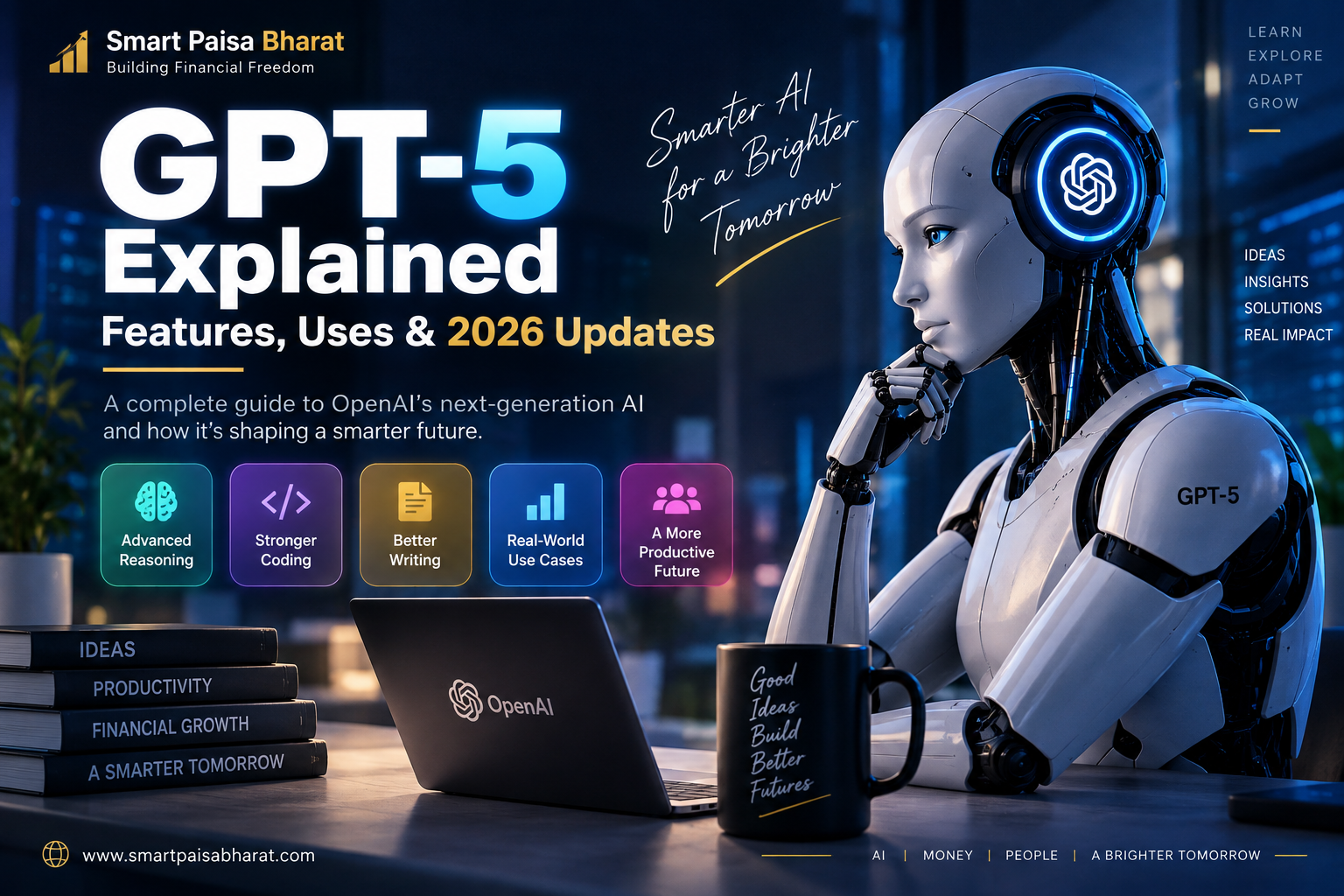
GPT-5 Explained: Features, Uses & 2026
Updated: September 21, 2026
Artificial intelligence has changed rapidly since OpenAI introduced GPT-5 in August 2025. What began as a major step forward in reasoning, coding and everyday AI assistance has since become part of a much broader generation of AI models.
In this guide, we look back at what GPT-5 introduced, why it mattered, how people used it, and how OpenAI’s model family has evolved since its original launch.
What Is GPT-5?
GPT-5 is a generative artificial intelligence model family introduced by OpenAI on August 7, 2025. OpenAI described GPT-5 as a major advancement over its previous models, with improvements in reasoning, coding, writing, instruction following and factual reliability.
One of the important ideas behind GPT-5 was combining faster responses with deeper reasoning. Instead of requiring users to understand different technical model choices for every task, GPT-5 was designed to determine when a question needed more reasoning.
This made GPT-5 useful for a wide range of activities, from everyday writing and research to software development and complex problem-solving.
GPT-5 at a Glance
| Detail | Information |
|---|---|
| Launch | August 7, 2025 |
| Developer | OpenAI |
| Major focus | Reasoning, coding, writing, research and problem-solving |
| Important concept | Unified AI system with automatic reasoning |
| API versions | GPT-5, GPT-5 mini and GPT-5 nano at launch |
| 2026 context | Newer GPT-5.x and GPT-6 models now exist |
Why Was GPT-5 Important?
GPT-5 represented more than another chatbot upgrade. Its launch reflected a broader movement toward AI systems that could reason through complicated tasks instead of simply generating a quick response.
OpenAI highlighted improvements in coding, mathematics, writing, visual perception, health-related questions and general problem-solving. The company also reported progress in reducing factual errors and improving instruction following.
These improvements helped move AI assistants closer to being practical tools for work, education, software development and research.
Key Features Introduced With GPT-5
1. More Advanced Reasoning
GPT-5 was designed to handle tasks that benefit from additional reasoning. This includes multi-step problems, technical questions, planning and complex analysis.
The important change was not simply producing longer answers. The system was designed to spend more effort on difficult tasks while responding more efficiently to simpler ones.
2. Better Instruction Following
A useful AI assistant needs to understand not only the question but also the user’s instructions, formatting requirements and intended outcome.
GPT-5 introduced improvements in following detailed instructions, making it more useful for structured writing, coding tasks, research and business workflows.
3. Stronger Coding Capabilities
Coding was one of the major areas highlighted during the GPT-5 launch. The model was designed to help developers write code, identify bugs, modify existing projects and work through larger programming tasks.
It could also generate front-end interfaces and help developers turn ideas into working prototypes with fewer iterations.
4. Improved Writing Assistance
GPT-5 was also designed as a stronger writing collaborator. It could help with articles, reports, emails, explanations, summaries, brainstorming and editing.
For content creators, one of the biggest advantages was the ability to provide a clear structure while adapting the tone and level of detail to the intended audience.
5. Better Handling of Complex Questions
Many real-world questions do not have a simple one-line answer. They require context, comparison, calculations or several connected steps.
GPT-5 was designed to perform better on these types of tasks, although users should still verify important information before relying on AI-generated answers.
GPT-5 and AI Hallucinations
One of the biggest challenges in generative AI is the possibility of a model producing information that sounds convincing but is incorrect.
OpenAI reported that GPT-5 was less likely to produce factual errors than some previous models in its evaluations. However, improved reliability does not mean that every response is guaranteed to be correct.
How People Can Use GPT-5
For Students
- Understanding difficult concepts
- Creating study plans
- Summarizing learning material
- Practicing questions and explanations
- Brainstorming project ideas
For Content Creators
- Blog topic research
- Article outlines
- Headline ideas
- Content editing
- Social media drafts
- SEO content planning
For Developers
- Writing and reviewing code
- Debugging
- Creating prototypes
- Understanding unfamiliar code
- Building front-end interfaces
- Automating repetitive development tasks
For Businesses
- Research and analysis
- Drafting reports
- Customer-support workflows
- Document summarization
- Internal knowledge assistance
- Business brainstorming
GPT-5 vs Older OpenAI Models
GPT-5 was introduced as a unified system that could combine fast responses with deeper reasoning. This was different from the experience of choosing between several specialized models for different types of tasks.
OpenAI also reported improvements in coding, instruction following, factuality and reasoning compared with earlier generations.
However, AI development did not stop with GPT-5. The GPT model family continued to evolve after its 2025 launch.
What Changed After GPT-5?
This is especially important when reading a GPT-5 article in 2026.
GPT-5 should now be viewed as an important stage in OpenAI’s model evolution rather than the current endpoint of AI development.
OpenAI introduced the GPT-5.6 family in July 2026, including Sol, Terra and Luna capability tiers. OpenAI describes GPT-5.6 as being designed for areas including coding, knowledge work, research, science, cybersecurity, computer use and design.
OpenAI’s current materials also reference GPT-6, meaning claims that GPT-5 is currently the company’s newest or most powerful model should no longer be used without a specific date or context.
GPT-5 Pricing: What You Should Know
GPT-5 was offered across ChatGPT and was also released through the OpenAI API in different model sizes.
API pricing and ChatGPT access can change as OpenAI introduces newer models, so historical GPT-5 launch pricing should not be treated as the current price of using OpenAI’s latest models.
Developers should check OpenAI’s current pricing information before choosing a model for production applications.
Is GPT-5 Still Relevant in 2026?
Yes, but its relevance should be understood in context.
GPT-5 was an important milestone in the development of reasoning-focused AI systems. Understanding what it introduced helps explain why later models have become increasingly capable at coding, research, computer use and other complex workflows.
For someone researching the history of ChatGPT and OpenAI models, GPT-5 remains an important reference point. For someone choosing an AI model today, however, it makes sense to compare the current models and their availability rather than assuming GPT-5 is still the newest option.
GPT-5: Advantages and Limitations
| Potential Advantages | Important Limitations |
|---|---|
| Advanced reasoning capabilities | AI can still make mistakes |
| Strong coding assistance | Generated code requires testing |
| Useful writing support | Output still needs human review |
| Better instruction following | Important facts should be verified |
| Useful for many professional tasks | Model availability and pricing can change |
What Does GPT-5 Mean for the Future of AI?
GPT-5 helped demonstrate how AI assistants could move beyond simple question-and-answer interactions toward more structured reasoning and task completion.
The larger trend is even more significant. Modern AI systems are increasingly being used to write software, analyze information, interact with tools, work with documents and support longer workflows.
As newer models arrive, the important question is no longer simply how many parameters or features an AI model has. Users increasingly care about accuracy, speed, cost, reliability, privacy and how effectively the model can help complete real-world tasks.
Frequently Asked Questions About GPT-5
What is GPT-5?
GPT-5 is an OpenAI generative AI model family introduced on August 7, 2025, with a focus on reasoning, coding, writing, research and problem-solving.
When was GPT-5 launched?
OpenAI introduced GPT-5 on August 7, 2025.
Is GPT-5 still the newest OpenAI model?
No. OpenAI has continued releasing newer models after GPT-5, including the GPT-5.6 family in 2026, and its current materials also reference GPT-6.
Can GPT-5 write code?
Yes. Coding was one of the major capabilities highlighted when GPT-5 was introduced. It can assist with writing, debugging, explaining and modifying software.
Can GPT-5 replace human writers and developers?
AI can automate and accelerate many writing and programming tasks, but human review, judgment and verification remain important, particularly for high-impact work.
Is GPT-5 free?
GPT-5 was made available through ChatGPT with access depending on the product and usage conditions. Availability and model access can change over time, so users should check OpenAI’s current ChatGPT and API information.
What is the difference between GPT-5 and GPT-5.6?
GPT-5.6 is a later generation within the GPT-5 family. OpenAI introduced GPT-5.6 in 2026 with different capability tiers designed for different levels of performance, speed and cost.
Final Takeaway
GPT-5 was a major milestone in OpenAI’s AI development when it launched in 2025. Its emphasis on reasoning, coding, writing and more reliable responses helped shape the next stage of generative AI.
But technology moves quickly. In 2026, GPT-5 should be understood as an important part of AI’s recent history rather than described as OpenAI’s current most powerful model.
For users and businesses, the practical lesson is simple: choose an AI model based on the task, accuracy requirements, available features and current pricing rather than relying only on the model name.
Sources & Further Reading
- OpenAI’s official GPT-5 announcement
- OpenAI’s official GPT-5 information page
- OpenAI’s GPT-5.6 announcement and current model information