Global AI Leaders 2026: Top Countries, Investments & Future Trends
Artificial Intelligence | Global Technology | AI Economy
Artificial intelligence is no longer just a technology experiment happening inside research laboratories. It is becoming part of how businesses operate, how governments deliver services, how people learn, and how companies compete in the global economy.
What you will learn: Which countries are leading artificial intelligence in 2026, where AI investment is flowing, why computing infrastructure matters, how India fits into the global AI landscape, and which long-term trends businesses and individuals should understand.
From American AI companies to China’s technology ecosystem, European research institutions, India’s digital services industry and the expanding ambitions of Gulf economies, different countries are building their AI capabilities in different ways.
But there is an important point that often gets lost in discussions about AI rankings: there is no single measurement that tells us everything about a country’s artificial intelligence capability. Investment, research, talent, computing power, adoption and responsible governance all matter.
This guide uses published data where available and explains the limitations of comparing countries. It is designed as an evergreen resource that readers can use to understand the AI economy beyond a single news headline.
1. What Makes a Country a Global AI Leader?
A country can be strong in artificial intelligence without leading every category. One nation may develop advanced AI models, another may manufacture essential chips, while a third may use AI extensively in banking, manufacturing or public services.
To understand the global AI landscape, it helps to look at six connected areas.
AI research and advanced models
Research institutions, universities and technology companies develop the algorithms, training methods and systems behind modern AI. Research output, model performance, scientific publications and independent evaluations provide different ways to understand progress.
Investment and business activity
Venture capital, corporate funding, research budgets and infrastructure spending help companies develop and deploy new technology. Private investment is useful for comparing business activity, but it does not capture every government programme or the full economic value of AI.
Semiconductors and computing infrastructure
Powerful AI systems require advanced processors, memory, data centres, reliable electricity and high-speed networks. Countries with access to these resources can support AI training and deployment at scale.
Skilled people and education
AI engineers, researchers, data specialists and domain experts are essential. Universities, technical training, international research partnerships and the ability to retain skilled workers all influence long-term capability.
Real-world adoption
The value of AI is not limited to developing a new model. It also depends on whether hospitals, banks, factories, schools and smaller businesses can use the technology effectively.
Governance, safety and public trust
Clear rules, privacy protections, cybersecurity, accountability and reliable evaluations help determine whether AI systems can be used responsibly. Countries are developing different approaches to these issues.
Taken together, these factors explain why a simple country ranking should never be treated as a complete measurement of AI leadership.
2. Global AI Investment: What the Latest Data Shows
Investment provides one measurable way to compare activity across countries. The Stanford Institute for Human-Centered Artificial Intelligence’s 2026 AI Index reports private AI investment data for 2025.
According to the report, the United States attracted approximately $285.9 billion in private AI investment in 2025. China recorded approximately $12.4 billion, while the United Kingdom recorded approximately $5.9 billion.
| Country | Private AI investment in 2025 | What the figure measures |
|---|---|---|
| United States | About $285.9 billion | Reported private AI investment |
| China | About $12.4 billion | Reported private AI investment |
| United Kingdom | About $5.9 billion | Reported private AI investment |
| France | About $4.4 billion | Reported private AI investment |
| Canada | About $4.3 billion | Reported private AI investment |
| India | About $4.1 billion | Reported private AI investment |
| Germany | About $3.9 billion | Reported private AI investment |
Data note: Figures are rounded from the Stanford AI Index 2026 report, based on private investment data for calendar year 2025. They are not total national AI budgets, government expenditure, GDP contributions or forecasts for 2026. Investment methodologies and company locations can affect country comparisons.
The gap between the United States and other countries is substantial in this particular measurement. However, private funding alone cannot establish which country has the most capable AI research, the best public services or the broadest adoption.
A country with lower venture funding may still contribute important research, semiconductor technology, specialised applications or skilled professionals.
For readers who want to follow these numbers over time, the Stanford AI Index provides an ongoing research resource covering AI investment, technical performance, adoption and policy.
3. Countries Shaping the Global AI Race in 2026
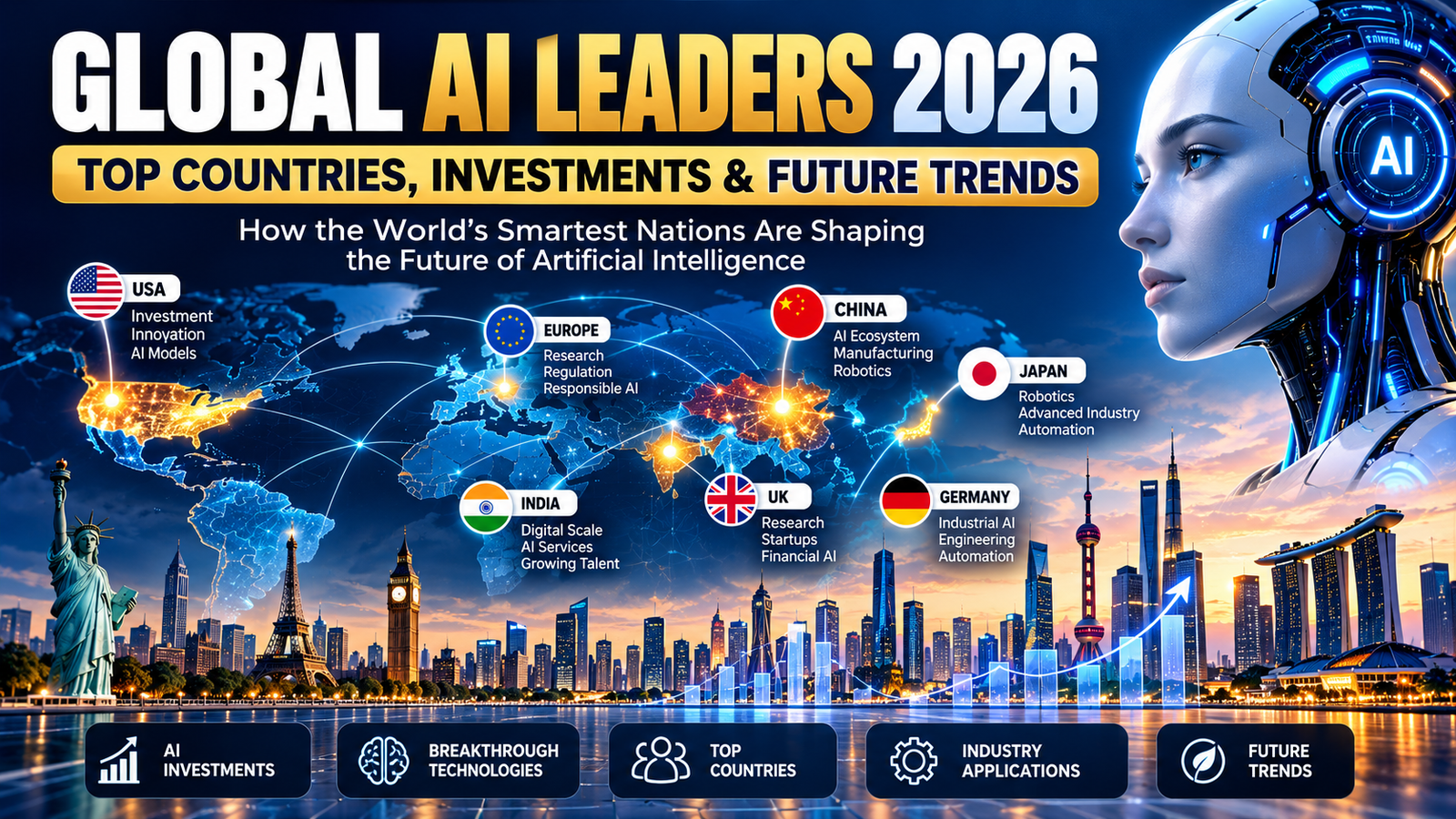
The following country profiles explain important areas of AI activity. They are not a universal ranking of national capability. Each country has a different combination of research, investment, industrial capacity, talent and policy priorities.
United States: AI companies, research and private investment
The United States has a large ecosystem of AI developers, cloud computing providers, research universities, investors and technology businesses. Its private investment total in 2025 was substantially larger than that of any other country in the Stanford comparison.
American technology firms participate in foundation-model development, cloud-based AI services, enterprise software, robotics and AI infrastructure. The country’s large business market also provides opportunities to commercialise AI products.
At the same time, continued expansion requires substantial computing infrastructure, electricity, skilled workers and careful attention to safety and data protection.
Areas to understand: AI model development, cloud computing, enterprise applications, research and private investment.
China: AI research, manufacturing and domestic applications
China is an important participant in AI research, industrial automation, consumer technology, robotics and digital services. Its large domestic market gives companies opportunities to develop and deploy AI across a wide range of applications.
Chinese firms and research institutions work on language models, computer vision, autonomous technologies and industrial AI. The country’s manufacturing base is also relevant to the broader development of technology supply chains.
Access to advanced computing hardware, international technology restrictions, domestic demand and policy choices are among the factors that influence China’s AI development.
Areas to understand: Manufacturing, research, robotics, computer vision and large-scale commercial applications.
United Kingdom: Research, finance and AI services
The United Kingdom has an established technology and financial services sector, leading research universities and AI-focused companies. London and other research centres connect AI development with investment, professional services and enterprise demand.
Its recorded private AI investment in 2025 placed it among the leading countries in the Stanford data. Research, startup activity, financial technology and AI safety are relevant parts of its wider ecosystem.
Areas to understand: AI research, financial technology, startup development and enterprise services.
France: Research, mathematics and AI development
France has a strong scientific and mathematical research tradition, engineering institutions and an active AI startup community. Its technology ecosystem includes work on language models, industrial applications and AI infrastructure.
French and wider European AI initiatives also operate within discussions about data protection, competition, safety and the development of AI systems in Europe.
Areas to understand: AI research, engineering, language technology and European AI development.
Canada: Research institutions and AI talent
Canada has research centres and universities that have contributed to machine learning and deep learning. Its AI ecosystem connects academic research with startups, technology companies and applications in healthcare, finance and business software.
The availability of computing resources, commercial investment and opportunities for researchers to turn scientific work into widely used products remain relevant to its long-term development.
Areas to understand: Machine learning research, AI talent, healthcare applications and startup activity.
India: Digital scale, services and emerging AI infrastructure
India has a large technology services sector, a substantial pool of technical professionals and a growing market for digital products. These strengths create opportunities to apply AI in business operations, education, agriculture, financial services and public-facing digital systems.
India’s AI development is not limited to creating large language models. It also includes adapting technology to local languages, building practical business tools and helping organisations use data more effectively.
The country’s longer-term progress will depend partly on access to computing infrastructure, quality datasets, research funding, skilled professionals and effective implementation.
Areas to understand: AI services, digital applications, language technology, enterprise adoption and technology talent.
Germany: Industrial AI and engineering
Germany’s manufacturing and engineering industries provide opportunities for AI in industrial automation, predictive maintenance, quality inspection, logistics and robotics.
For manufacturers, the practical value of AI often comes from reducing downtime, identifying production problems earlier and improving the use of equipment and materials.
Areas to understand: Industrial AI, manufacturing, engineering and automation.
Japan and South Korea: Robotics, electronics and advanced industry
Japan and South Korea have established electronics, automotive, manufacturing and robotics industries. Their industrial capabilities are relevant to AI hardware, intelligent machines, automation and embedded AI systems.
AI adoption in these sectors can involve quality control, factory automation, logistics, customer services and systems that combine software with physical equipment.
Areas to understand: Robotics, electronics, semiconductors, automotive technology and industrial automation.
Israel, Singapore and the Gulf economies
Several smaller economies also have roles in the global AI ecosystem. Israel has technology and cybersecurity companies alongside AI research and startup activity. Singapore serves as a regional technology and business hub with an emphasis on digital services and AI adoption.
Saudi Arabia and the United Arab Emirates are pursuing AI-related infrastructure, digital transformation and technology investment. Their future impact will depend on implementation, talent, computing capacity and the development of sustainable commercial applications.
These examples demonstrate why national AI leadership is better understood as a collection of different capabilities rather than a single permanent league table.
4. India’s Position in the Global AI Economy
India’s AI opportunity is closely connected to the country’s digital economy. A large population, a growing online market, technology services companies and a wide range of languages create demand for AI systems that solve practical problems.
AI in financial services
Banks, insurers and financial technology businesses can use AI to help analyse documents, support customer service, identify unusual transaction patterns and assist with administrative tasks.
Such systems need appropriate data protection, human oversight and testing. AI-generated financial information should not automatically be treated as personalised investment advice or a guarantee of returns.
AI for Indian languages
Language technology can help people access information in languages they use every day. Speech recognition, translation, text-to-speech and conversational interfaces may make digital services easier to use for people who are less comfortable with English-language software.
Quality remains important. Systems need to be evaluated across accents, regional expressions, scripts and different real-world conditions.
AI in agriculture and small businesses
Agricultural applications may include crop monitoring, weather-related information, image-based plant analysis and support for farm management.
Small businesses can use AI to draft product descriptions, organise customer enquiries, translate material, analyse documents and prepare basic reports.
These applications can be useful when they solve a real business problem at a reasonable cost. They still require human review, particularly when decisions affect money, safety or people’s rights.
What could shape India’s next phase?
- More accessible and reliable computing infrastructure.
- Investment in research, education and technical skills.
- Useful datasets that reflect India’s languages and industries.
- Adoption by small businesses as well as large companies.
- Responsible data use and clear accountability.
India’s progress should therefore be assessed through several measures, including research output, deployment, productivity, workforce development and access to technology—not simply through one investment figure.
5. Major Artificial Intelligence Trends to Watch
AI technology continues to evolve. The following trends are useful areas to monitor over the coming years because they connect technical development with business and economic use.
1. AI agents and workflow automation
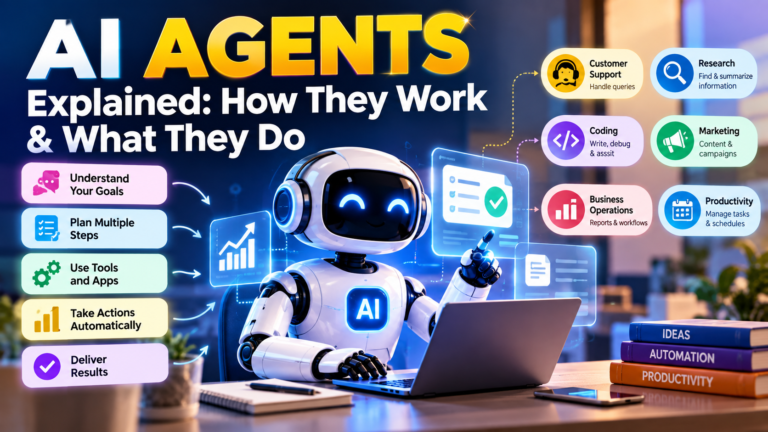
AI agents are systems designed to perform sequences of tasks, sometimes using external tools, business software or data sources. Instead of answering one question, a system may help organise a workflow from beginning to end.
Businesses are exploring applications in customer support, document processing, research assistance and internal administration.
Reliable permissions, clear limits and human approval for consequential actions are essential when deploying these systems in real operations.
2. Smaller and specialised AI models
Not every task needs the largest available AI model. Smaller models can sometimes provide useful performance with lower computing costs, reduced latency or deployment on local devices and private infrastructure.
Organisations may combine general-purpose models with specialised systems designed for particular industries, languages or workflows.
3. AI infrastructure, chips and energy
AI growth depends on more than software. Data centres, processors, memory, networking equipment, cooling and electricity are central to training and operating large systems.
As deployment expands, businesses and governments will continue to consider the cost of computing, power availability, infrastructure efficiency and the environmental impact of large-scale systems.
4. Multimodal AI
Multimodal systems can work with combinations of text, images, audio and video. This creates possibilities for applications such as visual assistance, document understanding, media production, accessibility and industrial inspection.
The practical usefulness of these tools will depend on accuracy, speed, privacy and the ability to handle unfamiliar situations.
5. AI in healthcare and scientific research
Researchers are using AI to assist with analysing scientific data, identifying patterns and exploring possible solutions in areas such as biology, materials science and medicine.
AI can support research and clinical workflows, but it does not remove the need for scientific validation, professional judgement, clinical testing or regulatory requirements.
6. AI governance, privacy and safety
Governments and organisations are working on ways to address privacy, security, transparency, bias and accountability in AI systems.
The OECD’s AI policy resources document initiatives across many jurisdictions. Countries differ in their legal systems, policy priorities and approaches to implementation.
Readers can explore the OECD AI Policy Navigator to review national AI initiatives and policy developments.
6. AI Opportunities for Businesses, Professionals and Creators
The growth of AI creates opportunities for people who understand how to use the technology to solve practical problems. Learning to operate an AI tool is useful, but understanding the underlying business need is equally important.
| Area | Potential application | Skills to develop |
|---|---|---|
| Content and publishing | Research assistance, editing and content planning | Writing, fact-checking, SEO and editorial judgement |
| Finance and accounting | Document processing and report preparation | Financial knowledge, spreadsheets and data privacy |
| Customer service | Drafting replies and organising enquiries | Communication, workflow design and quality control |
| Software development | Code assistance, testing and documentation | Programming, debugging and security |
| Education | Practice material and personalised learning support | Subject knowledge and critical thinking |
| Small businesses | Inventory analysis, marketing drafts and customer insights | Business operations and responsible AI use |
A practical starting point is to choose one repetitive task, test whether AI can improve it, compare the result with the existing process and measure the time, quality and cost involved.
AI tools should support human work rather than encourage people to publish unverified information or hand over sensitive customer data without permission.
7. Challenges That Could Shape the Future of AI
Artificial intelligence offers opportunities, but it also creates challenges that individuals, businesses and governments need to understand.
Data privacy and security
AI systems may process personal, financial or business information. Organisations should understand how data is stored, used and protected before sharing sensitive information with an AI service.
Incorrect or misleading outputs
AI systems can produce confident answers that are inaccurate, incomplete or unsupported. Important information should be checked against reliable sources, particularly in financial, legal, medical and other high-impact situations.
Employment and changing skill requirements
AI can automate portions of some jobs while creating new tasks and changing existing responsibilities. The effects differ across industries, occupations and countries.
Workers and employers can prepare by developing adaptable skills, learning to evaluate AI outputs and identifying where human expertise remains essential.
Infrastructure and unequal access
Access to computing resources, reliable electricity, quality education and capital is uneven across countries and communities. This can influence who develops AI and who benefits from it.
Wider access to training, infrastructure and practical applications will be important if AI’s benefits are to reach more people.
Copyright, accountability and trust
Questions about training data, intellectual property, accountability and the reliability of generated content remain important. Businesses and publishers should respect applicable laws, licences and the rights of content creators.
8. How to Follow Global AI Developments Reliably
AI news changes quickly, and investment announcements can be difficult to compare. Readers can develop a clearer picture by checking the original source of a claim and identifying exactly what it measures.
- Research and benchmarks: Review the Stanford AI Index and published research papers for measurement methods and technical context.
- Government policies: Check official government publications and the OECD AI Policy Navigator.
- Investment announcements: Distinguish announced funding from completed investment and private investment from public spending.
- AI product claims: Look for independent evaluations, stated limitations and evidence of real-world performance.
- Business adoption: Look for measurable changes in productivity, cost, reliability and customer experience rather than relying only on promotional claims.
A useful habit is to record the publication date, measurement period and methodology whenever comparing countries or AI companies.
Conclusion: The Global AI Race Is About More Than Rankings
The global AI landscape in 2026 is shaped by a combination of research, capital, computing infrastructure, industrial expertise, skilled people and responsible adoption.
The United States leads the 2025 private AI investment figures reported by Stanford. China, the United Kingdom, France, Canada, India and other countries contribute different strengths to the international AI ecosystem.
For India, the opportunity extends beyond building AI models. Digital services, language technology, financial applications, agriculture, education and enterprise adoption can all contribute to the country’s developing AI economy.
Ultimately, the long-term impact of artificial intelligence will depend not just on who invests the most, but on how effectively technology is used to solve real problems, improve productivity and serve people.
At Smart Paisa Bharat, we will continue to explore the intersection of artificial intelligence, finance, technology and the global economy to help readers understand developments that matter to their work and financial decisions.
Frequently Asked Questions (FAQs)
1. Which country is leading AI in 2026?
There is no single universal AI leadership ranking. The United States led the private AI investment measure in Stanford’s 2026 AI Index using 2025 data. Other countries have important strengths in research, manufacturing, computing hardware, industrial applications and AI adoption.
2. Which country invested the most in AI in 2025?
The United States recorded approximately $285.9 billion in private AI investment in 2025 in the Stanford AI Index 2026. This figure refers to private investment, not total government and private spending.
3. Is China a major competitor in artificial intelligence?
Yes. China is an important participant in AI research, industrial applications, robotics, digital services and technology development. Its capabilities should be assessed across multiple measures rather than investment alone.
4. What is India’s role in the global AI race?
India contributes through technology services, AI talent, digital applications, language technology and business adoption. Its future development will also depend on computing infrastructure, research, skills and responsible deployment.
5. Which industries are using AI the most?
AI is used in areas such as information technology, finance, manufacturing, healthcare research, customer service, marketing and logistics. Adoption varies between organisations and countries, and not every use case produces the same benefits.
6. Will artificial intelligence replace human jobs?
AI can automate some tasks and change the responsibilities of many jobs. Its overall employment impact will vary by occupation, industry, location and the way businesses adopt the technology. Learning adaptable skills and using AI responsibly can help workers respond to changing requirements.
7. How can beginners start learning AI?
Beginners can start with basic digital skills, learn how AI tools work, practise writing effective instructions and verify AI-generated answers. People interested in technical careers can gradually add programming, mathematics, data analysis and machine learning.
Sources and Further Reading
The following primary resources provide supporting data and further information about AI investment, national strategies and policy developments.
- Stanford Institute for Human-Centered Artificial Intelligence — AI Index
- Stanford AI Index 2026 — Full Report
- OECD.AI — National AI Policies and Initiatives
- OECD.AI — AI Policy Observatory
Editorial note: This article is intended for general informational and educational purposes. AI investment figures refer to the stated reporting period and source. They should not be interpreted as a guarantee of future economic performance or investment returns.