AI in Healthcare: Startups, Trends & Opportunities
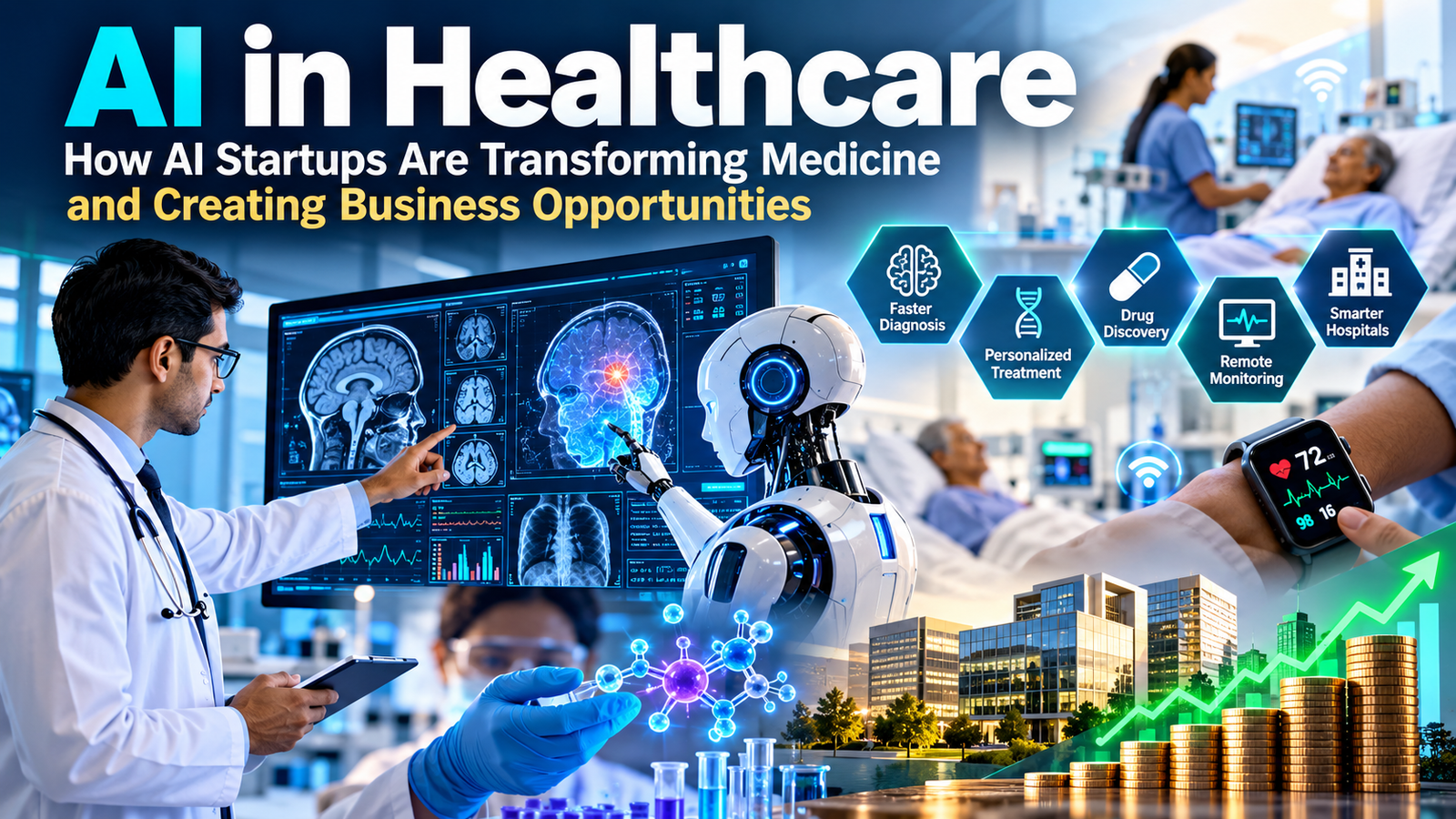
AI in Healthcare: How AI Startups Are Transforming Medicine and Creating Business Opportunities
Imagine a doctor reviewing hundreds of medical images, a researcher searching for a promising new drug, or a patient living far away from a specialist. What if intelligent software could help each of them work with better information and less wasted time?
That is the real promise of artificial intelligence in healthcare. AI is no longer just an idea discussed in technology conferences. It is being incorporated into medical imaging, clinical decision support, hospital operations, drug research, remote monitoring and other parts of the healthcare system.
For entrepreneurs, technology companies and investors, this change is opening up an entirely new area of business. But there is an important distinction: a technology that could improve healthcare is not automatically a profitable company, and a promising health-tech business is not automatically a good investment.
In this guide, Smart Paisa Bharat explores how healthcare AI works, where it is already being used, how startups make money, which business opportunities are emerging, and what readers should understand before investing in this sector.
AI in healthcare refers to the use of artificial intelligence technologies, including machine learning, computer vision and language models, to analyse medical information, support clinical decisions, improve healthcare operations and assist research. These tools can help medical professionals work more efficiently, but they do not replace the need for qualified healthcare professionals, clinical validation or patient safety safeguards.
1. What Is Artificial Intelligence in Healthcare?
Artificial intelligence in healthcare means using computer systems that can recognise patterns, process information, generate predictions or assist with specific tasks involving health and medicine.
Traditional software usually follows rules written in advance. Machine-learning systems, on the other hand, can learn patterns from examples and use those patterns to produce an output. More advanced AI systems can process different types of information, such as medical images, text, laboratory results and sensor readings.
Consider a simple example. A radiologist may need to examine a large number of medical images during a busy working day. An AI-assisted imaging system can flag certain patterns or suspicious areas for closer examination. The radiologist then reviews the findings and makes the clinical decision.
The technology is not independently declaring that every flagged area represents a disease. It is providing additional information within a defined medical workflow.
How does healthcare AI work?
A typical healthcare AI system follows a process involving several stages:
- Data collection: Relevant medical images, laboratory results, clinical records or sensor readings are collected under appropriate privacy and consent requirements.
- Model development: Developers train or configure an AI model to perform a specific task using suitable data.
- Testing and validation: The system is evaluated to determine whether it performs reliably for its intended use and patient population.
- Clinical integration: The tool is incorporated into a medical or administrative workflow, with appropriate human oversight.
- Monitoring: Performance, safety, accuracy and potential changes in real-world conditions are monitored over time.
This last step is particularly important. A system that performs well in a laboratory or a controlled study may behave differently in a hospital with different equipment, patient characteristics or medical practices.
The US Food and Drug Administration explains that AI-enabled medical devices are assessed according to their intended use, technological characteristics and applicable medical-device regulatory requirements.
Official reference: FDA: Artificial Intelligence-Enabled Medical Devices.
2. Why Is Healthcare Becoming a Major AI Industry?
Healthcare is a field where information is abundant but time, specialised expertise and access to services can be limited. Medical professionals work with images, patient histories, test results, research papers, insurance records and constantly changing clinical information.
The challenge is not simply collecting more data. It is turning that information into useful, timely and reliable decisions.
Growing demand for healthcare services
As populations age and the burden of chronic diseases grows, healthcare systems need ways to manage more patients without allowing quality of care to suffer.
AI-assisted systems may help clinicians organise information, prioritise certain cases, reduce repetitive work and identify patterns that deserve further attention.
Increasing pressure on healthcare costs
Hospitals and clinics face expenses related to staffing, equipment, administration, documentation and patient management. Software that can safely reduce unnecessary manual work may create measurable value for healthcare providers.
However, cost savings must be demonstrated in actual operations. Purchasing AI software does not automatically make a hospital more efficient.
Advances in computing and medical data
Improvements in computing power, medical imaging, cloud infrastructure and machine-learning techniques have made it possible to develop tools that were previously difficult or expensive to build.
The combination of these technologies is enabling applications ranging from image analysis to drug research and personalised treatment support.
Greater interest from healthcare businesses
Hospitals, diagnostic centres, pharmaceutical companies and medical-device manufacturers are exploring AI to solve specific operational and scientific problems.
The FDA maintains a public list of AI-enabled medical devices authorised for marketing in the United States. Its resource demonstrates that AI is already being used in regulated medical technology rather than existing only as a research concept.
The FDA’s list is updated periodically and is not a complete inventory of every AI application in healthcare.
Source: FDA AI-Enabled Medical Devices List.
3. Major Applications of AI in Healthcare
The healthcare AI industry is not one single market. It includes multiple technologies serving different customers and solving very different problems. Understanding these categories makes it easier to separate practical applications from exaggerated claims.
3.1 AI-powered medical imaging and diagnostics
Medical imaging is one of the most visible areas of healthcare AI. Systems can analyse X-rays, CT scans, MRI scans, mammograms and other medical images to identify patterns that may require medical attention.
Depending on the specific device and its authorised intended use, an AI tool may help identify suspicious findings, measure structures, improve image quality or prioritise certain examinations for review.
For example, a radiology workflow may use AI to flag a scan for urgent review. A qualified medical professional still needs to interpret the findings in the context of the patient’s symptoms, history and other tests.
This distinction matters because a screening result, an AI-generated flag and a confirmed medical diagnosis are not the same thing.
In diagnostic AI, the important question is not whether software can recognise an image pattern. It is whether the system has been adequately tested for its intended use and can provide reliable information in the clinical setting where it will be used.
3.2 Personalised medicine and precision healthcare
Two patients with the same medical condition may respond differently to the same treatment. Age, medical history, genetics, lifestyle and other factors can influence treatment outcomes.
AI can help researchers and clinicians analyse complex information to identify patterns associated with disease risk or treatment response.
In precision medicine, AI may support the interpretation of genomic information, medical records and laboratory results. These insights can assist qualified professionals in evaluating treatment options.
However, a prediction generated by an AI model does not guarantee that a particular treatment will work for an individual patient. Clinical evidence and medical judgement remain essential.
3.3 Drug discovery and pharmaceutical research
Developing a new medicine is a lengthy and uncertain process. Researchers must identify potential drug targets, study biological mechanisms, evaluate candidate compounds and conduct appropriate safety and clinical testing.
AI can assist at several stages of this process.
- Analysing biological and chemical data to identify potential drug targets.
- Helping researchers screen large libraries of chemical compounds.
- Predicting certain molecular properties that can guide laboratory experiments.
- Supporting the design of research studies and analysis of scientific literature.
- Helping pharmaceutical teams organise and interpret complex research information.
The commercial opportunity is substantial in scope, but drug development remains scientifically difficult. An AI-generated candidate still needs experimental validation, safety assessment and the clinical evidence required by regulators.
AI can support the research process. It cannot make a medicine safe or effective simply by generating a promising prediction.
3.4 Remote patient monitoring and wearable technology
Wearable devices and connected medical equipment can collect information such as heart rate, activity levels, sleep patterns and other physiological measurements.
AI systems can analyse this information to identify patterns, summarise trends or flag readings that may require review.
Remote monitoring can be particularly useful when healthcare professionals need to follow patients between hospital visits. It may also support chronic disease management when the device, clinical workflow and monitoring arrangements are appropriately designed.
Not every consumer wearable is a medical device, and not every alert represents a medical emergency. Consumers should understand the limitations and intended purpose of the technology they use.
3.5 Virtual healthcare and AI-assisted patient support
AI-powered healthcare assistants can help patients find information, prepare questions for appointments, navigate healthcare services or receive reminders about routine care.
In clinical settings, language-processing systems may also help healthcare professionals summarise records, organise documentation or prepare draft notes for review.
These applications can improve convenience, but they need safeguards against inaccurate information, inappropriate recommendations and exposure of sensitive medical data.
A general-purpose chatbot should not be treated as a substitute for a qualified doctor, a clinical examination or emergency medical care.
3.6 Hospital administration and workflow automation
Some of the most practical applications of healthcare AI are not directly involved in diagnosing or treating a disease.
Hospitals and clinics also spend considerable time on administrative tasks, including appointment scheduling, document processing, billing support, patient communication and medical record management.
AI-assisted tools can help organise information, automate repetitive steps and identify incomplete records for review.
For healthcare providers, the business case may depend on measurable improvements such as reduced administrative workload, shorter processing times or fewer documentation errors.
Administrative automation still requires privacy protections, quality controls and a process for correcting mistakes.
4. Real-World Healthcare AI Companies and Technologies
A useful way to understand healthcare AI is to look at companies working in different parts of the industry. The following examples illustrate distinct business models and technologies. They are included for educational purposes, not as investment recommendations.
PathAI: AI in pathology
PathAI develops technology for pathology, the field in which medical professionals examine tissue and other biological samples to help diagnose disease.
AI-assisted pathology tools can help analyse digitised tissue images and support research or clinical workflows. The goal is to provide useful information to pathologists and researchers, not to remove the need for professional interpretation.
Business area: pathology technology, laboratory workflows and pharmaceutical research support.
Tempus AI: Data-driven precision medicine
Tempus AI operates in the precision medicine and healthcare data space. Its work involves combining clinical and molecular information to support medical research and healthcare-related decision-making.
Companies in this category may generate revenue from diagnostic services, data-enabled research solutions and technology platforms, depending on their specific products and customer arrangements.
Business area: precision medicine, diagnostics and healthcare data technology.
Insilico Medicine: AI-assisted drug discovery
Insilico Medicine is an example of a company applying AI to drug discovery and pharmaceutical research.
AI-enabled drug discovery platforms can assist researchers in identifying targets, designing candidate molecules and prioritising laboratory work.
The scientific and commercial outcome still depends on experimental results, safety, clinical trials and regulatory review.
Business area: AI-assisted pharmaceutical research and drug development.
Butterfly Network: Digital ultrasound technology
Butterfly Network develops portable ultrasound technology and related software. Its technology illustrates how medical imaging, connected devices and digital tools can work together.
Portable imaging systems may help extend access to certain ultrasound examinations in appropriate clinical settings. Their usefulness depends on training, device capabilities, clinical context and applicable regulatory requirements.
Business area: medical imaging hardware, software and digital healthcare technology.
Aidoc: Clinical imaging workflow support
Aidoc develops AI technology used in medical imaging workflows. Such systems can help identify findings that may need attention and support the prioritisation of cases for medical review.
Their role is to assist clinical teams within defined workflows, rather than independently replacing a radiologist’s complete assessment.
Business area: clinical imaging analysis and workflow technology.
A company’s technology, regulatory status, revenue, financial condition and ownership structure
A healthcare AI company needs more than a useful algorithm to build a sustainable business. It must solve a problem that customers are willing to pay to address, meet applicable regulations, protect sensitive information and demonstrate that its technology works in practice.
Different healthcare AI businesses generate revenue in different ways. Understanding these business models helps explain where commercial opportunities may exist and why some companies take longer than others to become profitable.
These models are not equally suitable for every startup. A company developing a medical device may need significant testing, regulatory work and clinical partnerships before it can expand commercially. A software company serving administrative workflows may have a different development and sales cycle.
For software-based healthcare businesses, recurring contracts can provide more predictable revenue than one-time product sales.
However, recurring revenue alone does not establish profitability. Investors should also consider the cost of acquiring customers, implementation expenses, customer retention, operating costs and the time required to collect payments.
Hospitals and pharmaceutical companies typically evaluate new technology carefully. They may require evidence of clinical usefulness, data security, integration with existing systems, regulatory compliance and approval from internal decision-makers.
As a result, a healthcare AI startup may have a technically impressive product but still face a long path to commercial adoption.
The healthcare AI sector includes opportunities for software developers, medical professionals, entrepreneurs, researchers and investors. But each opportunity has a different level of complexity, cost and risk.
Entrepreneurs with software development or business experience may explore tools that solve specific administrative problems for clinics, laboratories or healthcare organisations.
Examples include appointment management, document organisation, patient communication and workflow automation.
A small company may find it easier to begin with a clearly defined administrative problem than to develop a diagnostic medical device requiring extensive clinical evidence and regulatory review.
Even administrative software must handle sensitive information responsibly and comply with applicable privacy, security and healthcare requirements.
Healthcare organisations generate complex information that can support research and operational analysis when it is collected, accessed and used lawfully.
Companies may develop tools that help authorised users organise medical data, analyse trends or prepare information for research.
The business opportunity depends on having lawful access to suitable data, maintaining strong privacy protections and producing results that customers can use.
Healthcare professionals, administrators and technology teams increasingly need to understand the capabilities and limitations of AI systems.
Educational services, responsible AI training and implementation support may create opportunities for people with appropriate technical, clinical or professional expertise.
Training should focus on practical use, privacy, verification and the importance of maintaining human oversight in healthcare decisions.
Investors interested in the sector can research publicly traded companies involved in medical devices, diagnostics, pharmaceutical research, healthcare software and AI infrastructure.
Not every company described as an AI healthcare business is publicly listed. Some are privately held startups, while others operate as subsidiaries or divisions of larger companies.
Before considering a listed company, examine its actual exposure to healthcare AI rather than relying only on its marketing language or the popularity of the AI theme.
Healthcare AI is a technology theme, not a guarantee of investment returns. A company can develop useful technology and still struggle financially because of competition, high costs, delayed approvals, weak customer demand or an expensive valuation.
Investors should review official financial statements, exchange filings, company disclosures and relevant regulatory records before making decisions.
The opportunities are significant, but healthcare is not an ordinary software market. An error can affect a patient’s treatment, privacy, finances or access to medical services.
Responsible development requires more than building a model that performs well in a demonstration. The technology must be suitable for the intended medical setting and supported by appropriate evidence and safeguards.
An AI system can produce incorrect results, overlook important information or flag findings that are not clinically significant.
Its performance may vary across hospitals, equipment, patient populations and clinical environments. Developers and healthcare providers need to understand these limitations and evaluate performance in relevant settings.
If training data does not adequately represent the people who will use a healthcare system, its performance may vary between groups.
For example, an algorithm developed using data from a limited patient population may not perform equally well in a different population or healthcare system.
The WHO has specifically warned that systems trained primarily on data from high-income countries may not perform well in lower-income settings. This is particularly relevant when developing healthcare AI for countries with diverse populations and different healthcare infrastructure.
Source:
WHO: Six principles for AI in health.
Medical records can contain highly sensitive information. Unauthorised access, data breaches or inappropriate data sharing can create serious consequences for patients.
Healthcare AI developers and providers need appropriate access controls, security measures, data governance and compliance with applicable privacy and data-protection requirements.
Patients should understand how their health information is collected and used, subject to applicable laws and consent requirements.
Healthcare software may fall under different regulatory requirements depending on what it does, how it is marketed and the jurisdiction in which it is used.
In the United States, the FDA uses applicable medical-device pathways, including 510(k) clearance, De Novo classification and premarket approval, depending on the product and its characteristics.
These regulatory terms are not interchangeable. A device appearing on an FDA list does not mean every product from the same company has received the same regulatory status.
In India, businesses must assess the applicable medical-device, data-protection and other healthcare requirements for their specific products and services.
AI-generated information should not be accepted without appropriate review. Excessive reliance on automated recommendations can create problems if users fail to recognise incorrect outputs or limitations.
The WHO’s guidance emphasises that people should remain in control of healthcare systems and medical decisions. Human oversight, accountability and transparency are important parts of responsible implementation.
The future of healthcare AI will depend on a combination of scientific progress, clinical evidence, healthcare infrastructure, regulation and public trust.
Some applications are already being used in defined clinical or administrative settings. Others remain in research, early development or limited deployment. These categories should not be confused.
Healthcare AI may become more closely integrated with medical records, diagnostic equipment, laboratory systems and hospital workflows.
The commercial value of such integration will depend on whether it improves the way healthcare professionals work without creating unnecessary complexity or new safety problems.
Advances in medical data analysis and biological research may support more individualised approaches to diagnosis, treatment planning and disease monitoring.
The extent to which these tools improve outcomes will depend on clinical evidence, access to suitable data and the ability to translate research findings into practical healthcare services.
AI may continue to help pharmaceutical researchers identify potential drug candidates, design experiments and analyse biological information.
The most meaningful progress will need to be measured by scientific results, safety, clinical outcomes and successful development—not by the number of molecules or predictions generated by software.
Countries such as India have opportunities to apply digital technologies to healthcare access, medical research and operational efficiency.
However, successful adoption requires attention to affordability, language, infrastructure, training, privacy and equitable access. A solution designed for a well-equipped urban hospital may need substantial adaptation before it can serve a rural clinic effectively.
The long-term value of healthcare AI will depend less on how impressive a demonstration looks and more on whether the technology delivers reliable, measurable benefits for patients, healthcare professionals and the organisations that pay for it.
AI in healthcare is the use of intelligent computer systems to analyse medical information, assist healthcare professionals, support research and improve healthcare operations. It can help with tasks such as medical image analysis, patient monitoring and administrative work.
Hospitals may use AI for medical imaging support, patient monitoring, clinical documentation, scheduling, workflow management and research. The specific uses depend on the technology, its intended purpose, regulatory requirements and the hospital’s clinical procedures.
AI can assist doctors with specific tasks, but it is not a complete substitute for qualified medical professionals. Medical decisions require clinical judgement, patient communication, examination, accountability and consideration of individual circumstances.
Companies such as PathAI, Tempus AI, Insilico Medicine, Butterfly Network and Aidoc illustrate different areas of healthcare technology, including pathology, precision medicine, drug research, medical imaging and clinical workflow support. Their current financial position, ownership, regulatory status and investment suitability should be researched separately.
Healthcare AI may offer business opportunities in software, medical technology, research, diagnostics and workflow automation. Commercial success depends on solving a genuine problem, demonstrating value, protecting sensitive data, complying with applicable regulations and building a sustainable revenue model.
Investors can research publicly listed companies with healthcare AI exposure, but the sector carries risks involving valuation, regulation, clinical development, competition and financial performance. Beginners should understand a company’s actual business, review official disclosures and consider their own financial circumstances before investing.
No. AI systems can produce incorrect results and may perform differently across patient populations and clinical settings. Their accuracy depends on the specific system, intended use, data, testing and implementation. Medical professionals must interpret results within the appropriate clinical context.
Health-tech is a broad term covering technology used in healthcare, including digital records, telemedicine, connected devices and healthcare software. Healthcare AI is a part of health-tech that uses artificial intelligence to perform or assist with specific tasks.
Artificial intelligence is creating new possibilities across healthcare, from medical imaging and research to hospital operations and remote monitoring.
For patients, the potential benefits include more accessible services, better-supported clinical decisions and more efficient healthcare processes. For businesses, opportunities may emerge in specialised software, medical technology, research services and healthcare infrastructure.
For investors, the important task is separating genuine commercial progress from promotional claims. Clinical evidence, customer adoption, financial strength, regulatory compliance and reasonable valuation all matter.
The companies that create lasting value will need to combine technological capability with medical responsibility, practical business execution and patient trust.
At Smart Paisa Bharat, our approach is to understand emerging technologies through their real-world applications, commercial models and financial implications—not simply their popularity.
The following official and institutional resources provide further information on healthcare AI, medical-device regulation, ethics and digital health.6. How Do Healthcare AI Startups Make Money?
Business model How revenue is generated Example customer Software subscriptions Recurring fees for access to AI software or a technology platform. Hospitals, clinics and healthcare networks. Enterprise licensing Contracts allowing healthcare organisations to use specialised software. Diagnostic laboratories and medical-device companies. Diagnostic services Fees for medical tests, image analysis or related diagnostic services. Patients, laboratories and healthcare providers. Research partnerships Contract payments, research agreements or milestone-based arrangements. Pharmaceutical and biotechnology companies. Medical technology Sales or leasing of medical equipment combined with software or services. Hospitals, clinics and diagnostic centres. Data and analytics services Fees for permitted, privacy-protected research and analytical services. Research institutions and life-sciences businesses. Why recurring revenue matters
Why healthcare sales can take time
7. Healthcare AI Business Opportunities and Investment Considerations
7.1 Healthcare software and workflow solutions
7.2 Medical data and analytics
7.3 Healthcare education and AI skills
7.4 Investment in publicly listed healthcare technology companies
What should investors examine?
Factor Questions to investigate Revenue quality Does the company generate revenue from commercial customers, research contracts or products that are still under development? Financial position What are its cash reserves, operating expenses, debt obligations and funding requirements? Clinical evidence Has the product demonstrated useful performance for its intended purpose in appropriate studies? Regulatory position What clearances, authorisations or approvals apply to the company’s specific product and intended market? Customer adoption Are healthcare organisations actually using the product, and are customers renewing or expanding contracts? Competition Can established medical technology companies or competing software providers offer similar services? Valuation Does the current share price reflect realistic assumptions about future revenue, profitability and execution? 8. Risks and Challenges of AI in Healthcare
8.1 Accuracy and clinical reliability
8.2 Bias and unequal performance
8.3 Patient privacy and cybersecurity
8.4 Regulatory compliance
8.5 Overdependence on automated recommendations
9. The Future of AI in Healthcare: What Could Come Next?
More integrated healthcare systems
Greater focus on personalised care
AI-assisted drug development
Responsible adoption in emerging markets
10. Frequently Asked Questions About AI in Healthcare
What is AI in healthcare in simple words?
How is artificial intelligence used in hospitals?
Can AI replace doctors in the future?
Which healthcare AI companies are worth researching?
Is healthcare AI a good business opportunity?
Can beginners invest in healthcare AI stocks?
Is AI medical diagnosis always accurate?
What is the difference between healthcare AI and health-tech?
Conclusion: Healthcare AI Is About More Than Technology
Research Sources and Further Reading
Artificial Intelligence-Enabled Medical Devices
Official information on AI-enabled medical devices, regulatory pathways and lifecycle considerations.
List of Artificial Intelligence-Enabled Medical Devices
A searchable resource for AI-enabled medical devices identified by the FDA as authorised for marketing in the United States.
Ethics and Governance of Artificial Intelligence for Health
WHO guidance on safety, accountability, privacy, human autonomy and equitable use of healthcare AI.
Six Guiding Principles for AI in Health
An overview of the opportunities, risks and principles for responsible healthcare AI.
Artificial Intelligence for Health
Similar Posts
What Is AEO? Answer Engine Optimization & AI Search Guide
Think about the last time you searched for something online. You may have typed a few words into Google, opened several websites, compared the information and finally found your answer. Today, that experience is changing. People increasingly ask complete questions and receive AI-generated summaries, explanations and links to supporting sources. For website owners, bloggers and…
How Is AI Transforming Tourism in India’s Tier 2 & 3 Cities?
AI in Indian tourism is changing how travelers discover destinations, plan journeys and experience new places. India’s travel story is no longer being written only by Mumbai, Delhi, Bengaluru and other major metropolitan destinations. A new travel map is emerging across smaller cities, heritage towns, spiritual destinations, cultural centres and lesser-known regions. At the same…
Global AI Leaders 2026: Top Countries, Investments & Future Trends
Artificial Intelligence | Global Technology | AI Economy Artificial intelligence is no longer just a technology experiment happening inside research laboratories. It is becoming part of how businesses operate, how governments deliver services, how people learn, and how companies compete in the global economy. What you will learn: Which countries are leading artificial intelligence in…
AI Agents Explained: How They Work & What They Do
AI agents are AI-powered systems that can understand a goal, work through multiple steps, use connected tools, and complete tasks within defined limits. Unlike a traditional chatbot that mainly answers questions, an AI agent can be designed to take action as part of a workflow.. But what exactly is an AI agent? How is it…
How China Is Building Its AI Ecosystem for the Future
Artificial intelligence is no longer just a technology story. It is becoming part of how countries think about productivity, infrastructure, manufacturing, software and long-term economic growth. China’s AI strategy is particularly interesting because the country is approaching artificial intelligence as a broad technology ecosystem rather than focusing only on individual chatbot products. Government policy, technology…
India AI Revolution 2030: Jobs, Economy & Investment
Updated: September 2026 Artificial intelligence is no longer a technology limited to research labs or large technology companies. AI is increasingly becoming part of everyday business, financial services, education, healthcare, agriculture, manufacturing and digital platforms. For India, this shift could become particularly important over the next few years. The country is building AI computing infrastructure,…