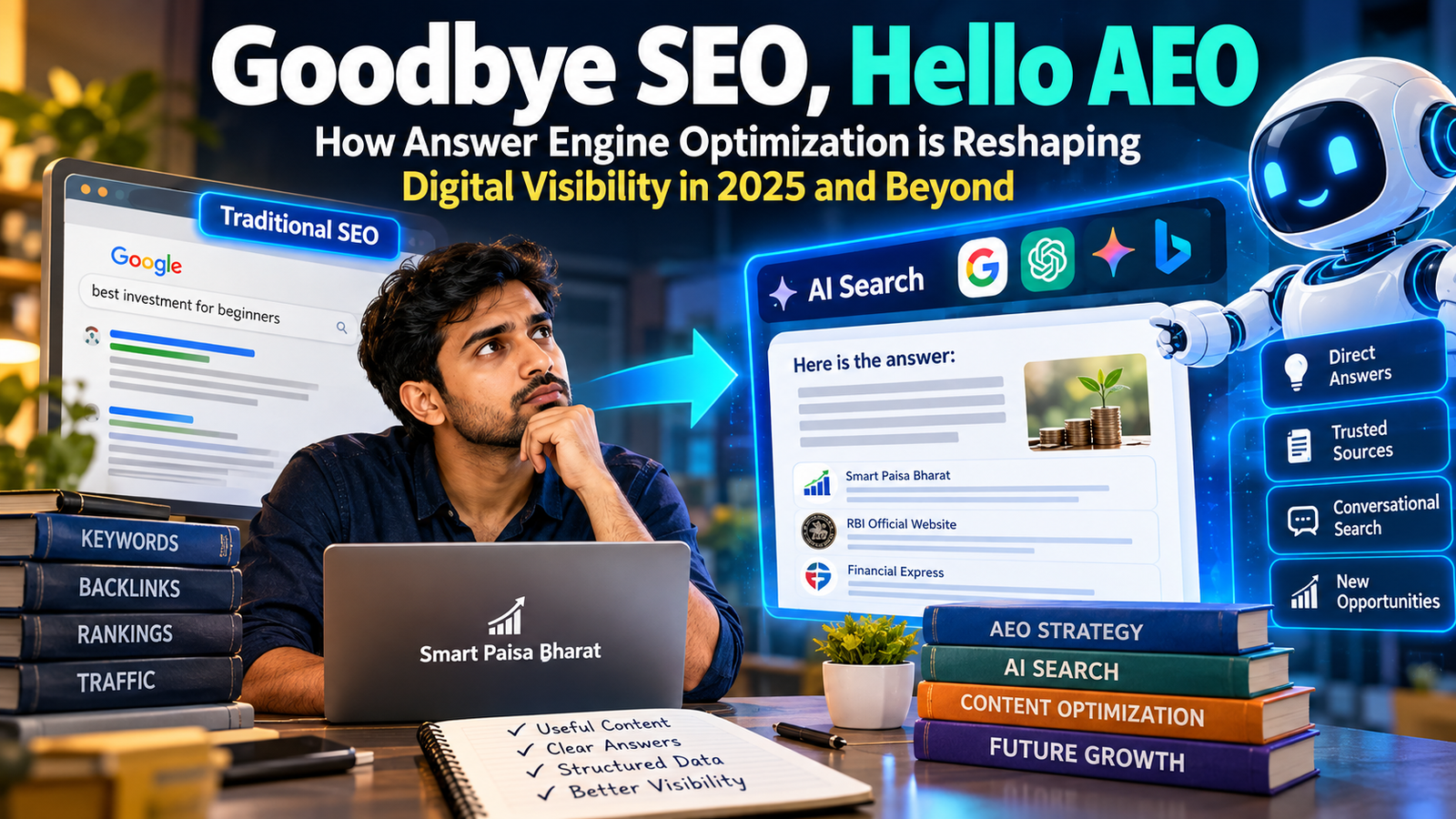
What Is AEO? Answer Engine Optimization & AI Search Guide
Think about the last time you searched for something online. You may have typed a few words into Google, opened several websites, compared the information and finally found your answer. Today, that experience is changing. People increasingly ask complete questions and receive AI-generated summaries, explanations and links to supporting sources.
For website owners, bloggers and businesses, this shift raises an important question: how can your content remain useful and discoverable when search engines and AI assistants can answer questions directly?
This is where Answer Engine Optimization, commonly known as AEO, enters the conversation.
AEO is a term used to describe efforts to make online content easier to discover, understand and use in systems that provide direct answers. It includes many familiar practices from search engine optimization, along with a stronger emphasis on answering specific questions clearly and providing information that deserves to be referenced.
But there is a lot of confusion around this topic. Some websites claim that traditional SEO is dead, that every article needs special AI markup, or that a few formatting tricks can guarantee a position in ChatGPT or Google’s AI answers.
The reality is more practical. Search technology is evolving, but helpful content, technical accessibility, reliable information and a good experience for readers remain essential.
In this Smart Paisa Bharat guide, we explain what AEO actually means, how it relates to SEO and generative AI search, and how bloggers and website owners can build a practical, sustainable strategy.
Answer Engine Optimization (AEO) is the practice of making website content clear, useful, accurate and accessible so that search engines and AI-powered answer systems can better understand it and potentially use it when responding to relevant questions. AEO includes clear answers, descriptive headings, trustworthy sources, useful examples and sound technical SEO. It does not guarantee that a website will appear in an AI-generated answer.
1. What Is Answer Engine Optimization (AEO)?
Answer Engine Optimization is a content and website optimization approach focused on making information easy to understand, retrieve and reference when someone asks a question through a search engine or AI-powered service.
Imagine a reader searching for: “How does a SIP work for a beginner in India?”
A useful article should not force that reader to scroll through a long introduction before explaining the basic concept. It should answer the question directly, explain how the process works, provide a realistic example, discuss important limitations and link to trustworthy information.
That is the central idea behind AEO: help people find a useful answer, and make the supporting information easy for search systems to interpret.
What is an answer engine?
An answer engine is a broad term for a system that responds to questions with direct information rather than simply presenting a list of links.
Depending on the product, an answer engine may use a search index, a language model, retrieved web pages, a knowledge base or a combination of these technologies.
Examples of experiences that can provide direct answers include Google’s AI Overviews, Google’s AI Mode and ChatGPT search.
These products are not identical. They can use different retrieval systems, models, ranking signals and methods for selecting links or sources.
Why has AEO become important?
People do not always search using short keywords anymore. A reader might ask a detailed question, explain a particular situation and then ask follow-up questions to understand the answer more deeply.
Google’s documentation describes how AI search experiences can use related searches to explore subtopics and find additional relevant pages. This means a user’s information need may extend beyond the exact wording of the original query.
For publishers, this makes comprehensive, clearly organised and genuinely helpful content particularly relevant.
Official reference: Google Search Central: Optimizing your website for generative AI features.
AEO is a useful industry term, not a separate Google ranking system with a publicly documented checklist or guaranteed result. The work commonly described as AEO overlaps heavily with established SEO, content quality and website accessibility.
2. How Does AI-Powered Search Work?
To understand AEO, it helps to understand the basic process behind modern search experiences.
Although every platform has its own technology, many AI search systems combine language models with information retrieved from external sources or an underlying search index.
Step 1: The user asks a question
A person might search for a simple definition, a detailed explanation or a comparison between several options.
For example, someone researching personal finance may ask, “What is the difference between an SIP and a fixed deposit, and what risks should a beginner understand?”
This is more complex than a search for a single keyword because it includes multiple related information needs.
Step 2: The system identifies relevant information
Depending on the platform and query, a search system may retrieve relevant web pages, search for related subtopics, consult available sources or use other information retrieval methods.
Google describes a process called query fan-out in which AI search experiences can issue multiple related searches to gather information across different aspects of a question.
This helps explain why a page may be relevant to a related subtopic even when its wording does not exactly match the user’s original question.
Step 3: The AI generates a response
A language model may use retrieved information and its other available context to generate a natural-language response.
Some experiences display supporting links or citations so readers can explore the original sources. The sources selected can vary by question, location, platform and other circumstances.
AI-generated answers can also contain mistakes, incomplete explanations or outdated information. A citation should therefore be checked against the source rather than treated as automatic proof that every sentence is correct.
Step 4: The user may visit a website
A reader may click a supporting link to verify a claim, explore a detailed example, compare products or learn about a subject that needs more explanation.
This is an important opportunity for publishers. A website should offer something valuable beyond a short definition, such as original analysis, detailed instructions, calculations, research, useful tools or practical experience.
Do not write only to produce a paragraph that an AI could repeat. Build a useful page that answers the main question and gives readers a good reason to explore the complete article.
3. AEO vs SEO vs GEO: What Is the Difference?
Three terms frequently appear in discussions about AI search: SEO, AEO and GEO. They are related, but they are not interchangeable in every context.
Search Engine Optimization (SEO)
SEO is the practice of improving a website’s accessibility, content, structure and relevance so search engines can discover, understand and potentially show its pages for relevant searches.
It includes technical SEO, content optimisation, internal linking, page experience, relevant external references and other established practices.
Answer Engine Optimization (AEO)
AEO focuses on making content useful and understandable in experiences that respond directly to questions. It commonly emphasises concise explanations, question-based headings, complete answers and clear supporting evidence.
Generative Engine Optimization (GEO)
GEO stands for Generative Engine Optimization. It is commonly used to describe efforts to improve the visibility or inclusion of content in responses generated by AI systems.
GEO can overlap with AEO, particularly when a publisher is trying to make information easier for generative systems to retrieve and reference.
| Area | Main focus | Example |
|---|---|---|
| SEO | Search discovery, relevance, indexing and organic visibility. | Making a personal finance article crawlable, useful and relevant to a search query. |
| AEO | Clear, direct and complete answers to specific questions. | Explaining what an SIP is in a concise section before providing a detailed example. |
| GEO | Content discoverability and potential inclusion in generative AI responses. | Publishing original research with clear methodology and reliable supporting references. |
For Google Search specifically, its official guidance explains that the established SEO best practices remain relevant to AI Overviews and AI Mode. Google also notes that AEO and GEO are terms used in the industry to describe work focused on AI search visibility.
In other words, publishers do not need to abandon SEO and build an entirely separate website optimisation system for AI.
Source: Google’s official generative AI search optimization guide.
4. What Does Google Actually Recommend for AI Search?
There is a difference between a practical content recommendation and an officially required ranking factor. Understanding that difference can help website owners avoid wasting time on techniques that promise more than they can deliver.
Google’s Search Central guidance provides several useful principles for websites that want to perform well in its AI search experiences.
Create unique and useful content
Google recommends creating original, satisfying content that helps people rather than simply repeating information already available across the internet.
For a finance blog, that could mean adding a transparent calculator example, explaining an Indian tax concept in plain language, documenting a real research process or showing readers how to verify a financial claim.
Make sure Google can access and index the page
A page must meet the applicable technical requirements and be eligible to appear in Google Search with a snippet to be considered for supporting links in AI Overviews or AI Mode.
Google does not guarantee that a page will be crawled, indexed or displayed simply because it meets those requirements.
Provide a good page experience
Readers should be able to find the main information without unnecessary distractions. Pages should load properly, work across devices and make the article’s content easy to distinguish from advertisements, navigation and other elements.
Use structured data accurately
When structured data is appropriate, it should accurately describe the visible content on the page and follow Google’s applicable guidelines.
Structured data can help search engines understand a page, but adding markup does not guarantee a rich result or an AI citation.
Use relevant images and videos
High-quality visual content can support an explanation and give readers additional ways to understand a topic.
For example, a financial calculator tutorial may benefit from a clearly labelled screenshot, while an article explaining compound interest may benefit from a simple chart.
Images should be relevant, accessible and accompanied by appropriate alternative text where needed.
Read Google’s official guidance: Top ways to succeed in Google’s AI experiences on Search.
There is no special AEO score, guaranteed AI citation technique or universal number of words required to appear in AI Overviews. Google’s official documentation says that existing SEO best practices remain the foundation.
5. How to Structure Content for Answer Engine Optimization
A well-structured article makes it easier for readers to navigate a topic and helps systems interpret the relationship between different sections.
The goal is not to make every paragraph follow a rigid formula. It is to present information in a logical order, with the most important answer easy to find.
5.1 Answer the main question early
Start with a short introduction that establishes the subject and explains why it matters. Follow it with a direct answer to the main question.
For example, an article targeting “What is AEO?” could begin with a definition of AEO in the first few paragraphs, then expand into examples, technical requirements and practical strategies.
Avoid forcing readers to pass through a long promotional introduction before they reach the answer.
5.2 Use descriptive headings
Headings should tell readers what the next section actually covers.
Compare these examples:
| Less helpful heading | More descriptive heading |
|---|---|
| The Big Change | How AI Search Changes the Way People Discover Websites |
| Important Tips | How to Make Your Articles Easier to Understand and Navigate |
| Future Results | How to Measure Organic Search and AI Search Visibility |
Use one main H1 for the article, H2 headings for major sections and H3 headings for relevant subsections. This is a useful content structure, not a requirement to repeat a keyword in every heading.
5.3 Use questions that reflect genuine reader needs
Question-based headings can be helpful when they match what readers actually want to know.
For a financial education article, useful questions might include:
- What is the difference between an SIP and a lump-sum investment?
- How is compound interest calculated?
- What charges should investors check before investing?
- What are the risks of a particular financial product?
Each question should receive a complete answer supported by suitable context. Do not add dozens of repetitive questions merely to increase keyword coverage.
5.4 Explain difficult concepts with practical examples
A definition is useful, but an example often makes the concept much easier to understand.
Suppose an article explains a monthly investment calculator. A practical explanation might show the assumed monthly contribution, investment period, illustrative return rate and resulting estimate.
It should also explain that investment returns are uncertain and that a calculator’s output is an estimate rather than a guaranteed result.
Examples like these add meaningful information that a reader can apply, rather than simply repeating a general definition.
5.5 Use tables when they genuinely improve understanding
Tables can help readers compare related information, such as the differences between two financial products, the features of different tools or the steps in a process.
Keep tables readable on mobile devices. Avoid using a table simply to repeat paragraphs that would be clearer as ordinary text.
5.6 Keep important information visible
The main content should be available as readable text on the page. Do not place essential information exclusively inside an image, an inaccessible interactive element or a file that readers must download.
If you use calculators, expandable sections or other interactive elements, provide enough explanatory text for readers to understand the topic and the tool’s limitations.
6. Original Content, Trust and Credibility: What Makes a Page Worth Citing?
One of the biggest mistakes in AI search optimisation is assuming that adding more words or more keywords automatically makes an article more useful.
A page can be long and still provide little value if it repeats the same basic information found on hundreds of other websites.
The stronger approach is to add information that helps readers understand something more clearly, make a more informed decision or complete a task.
Show your research and sources
When an article makes a factual claim, particularly in finance, law, health or technology, provide a reliable source where appropriate.
For example, an article discussing Google’s AI search guidance should link to Google Search Central rather than rely on an unsourced social media post.
A useful source list should identify the organisation or publication, link to the original document and make it clear which claims the source supports.
Separate facts from estimates and opinions
Readers should be able to distinguish established facts from projections, illustrative examples and the author’s interpretation.
Consider a financial article that discusses the future of artificial intelligence. It should not present a market forecast as an established outcome or imply that a popular technology guarantees investment returns.
The same principle applies to SEO. A third-party tool’s recommendation is not automatically an official Google ranking requirement.
Explain who created the article
A clear author or editorial identity helps readers understand where the information comes from.
For Smart Paisa Bharat, use an accurate author name or editorial team name, a genuine author profile and an appropriate editorial or correction policy.
Do not invent professional qualifications, medical expertise, financial certifications or personal experience to make an article appear more authoritative.
Update content when the facts change
Some information remains useful for years, while other information changes quickly.
A basic explanation of how a search engine indexes a page may remain relevant for a long time. A description of a current Google Search feature, an AI crawler policy or a regulatory requirement may need to be checked periodically.
Update an article when there is a meaningful factual change. Avoid changing publication dates or adding a new year to a title solely to make an unchanged article look fresh.
A useful article gives readers something they can verify, understand or apply. Original explanations, practical examples, transparent research and genuine experience can make a page more valuable than a generic summary of information already available elsewhere.
7. Technical SEO for AI Search Visibility
Even the most useful article cannot attract search traffic if search engines cannot access it, understand its content or include it in their search results.
This is why technical SEO remains an important part of an AEO strategy.
7.1 Make sure your pages can be crawled
Search engines use automated crawlers to discover and retrieve publicly accessible web pages.
For a website owner, the first step is to make sure important articles are not unintentionally blocked by robots.txt rules, security settings, hosting restrictions or other access controls.
For Google Search, Googlebot must be able to access the relevant content under the applicable technical requirements.
For publishers who want their content to be discoverable in ChatGPT search, OpenAI explains that OAI-SearchBot should not be blocked if the publisher wants its pages to be included in ChatGPT search summaries and snippets.
Official OpenAI resource: Publishers and Developers FAQ .
Allowing a crawler to access a page does not guarantee that the page will be selected, cited or displayed in a particular AI response.
7.2 Understand robots.txt and crawler access
The robots.txt file provides instructions to crawlers about which parts of a website they are requested to access or avoid.
If you manage your website through WordPress or a hosting control panel, review the relevant robots.txt settings before making changes.
Do not copy a robots.txt configuration from another website without understanding what each rule does.
A poorly configured rule can unintentionally restrict access to important content or resources.
Also remember that robots.txt is not a security mechanism and does not guarantee that a page will remain private.
7.3 Use Google Search Console
Google Search Console is a useful tool for monitoring how Google discovers and processes your website.
For an individual article, review the URL Inspection tool to understand whether Google has indexed the page and whether technical issues have been reported.
You can also use Search Console to review search queries, impressions, clicks, click-through rates and other available search performance information.
Google’s documentation also describes a Generative AI performance report for measuring visibility in supported generative AI experiences in Search Console. The availability and scope of reporting can change, so check the current Search Console interface and documentation.
Official resource: Google Search Central: AI search optimization and measurement .
7.4 Submit and maintain an XML sitemap
An XML sitemap helps search engines discover URLs that a website owner considers important.
For a WordPress website, an SEO plugin may generate a sitemap automatically. Make sure it contains the canonical URLs of your published content and does not unnecessarily include duplicate, redirected or non-indexable pages.
A sitemap is a discovery aid, not a guarantee of indexing or ranking.
7.5 Use canonical URLs and avoid unnecessary duplication
A website may unintentionally create multiple URLs for substantially the same content.
For example, a post may be accessible through different URL parameters or archive paths. Where appropriate, canonical tags can help indicate the preferred URL for a page.
If you update an old article, avoid creating multiple copies of the same post simply to target different variations of a keyword.
When a URL must change, use an appropriate permanent redirect and update relevant internal links and sitemap entries.
7.6 Improve mobile usability and page performance
Many readers access blogs through mobile devices. A page that is difficult to read, overloaded with pop-ups or slow to load can create a poor experience even when its content is useful.
For Smart Paisa Bharat, pay particular attention to:
- Readable font sizes and sufficient line spacing.
- Responsive images that do not extend beyond the screen.
- Tables that can be viewed comfortably on mobile.
- Reasonable image file sizes and efficient loading.
- Navigation and advertisements that do not obscure the main content.
- Clear links and buttons that are easy to use on a touchscreen.
AEO should improve the experience of reading the article, not add more technical clutter to the page.
8. Schema Markup, FAQs and Structured Data: What Do You Actually Need?
Structured data is a way of describing information on a web page in a format that search engines can process.
For example, Article structured data can identify information such as a headline, author, publication date and image.
However, there is an important distinction between helping search engines understand a page and guaranteeing that the page will receive a special display in search results.
Is special AEO schema required?
No special schema.org markup is required specifically for a website to appear in Google AI Overviews or AI Mode.
Google’s official guidance says that established SEO practices remain relevant and that publishers do not need to create additional AI-specific structured data to be eligible for these experiences.
Use structured data that accurately describes your actual content and follows the applicable search engine guidelines.
Official reference: Google Search Central: AI features and your website .
What about Article schema?
Article structured data may help search engines understand details about an article, such as its headline, author and dates.
If you use WordPress and AIOSEO, check whether the plugin is already generating appropriate Article schema for your posts.
Avoid adding a second, conflicting schema block without first checking what your theme and plugins output.
If your post uses an author profile, publication date and featured image, ensure the structured data reflects the actual visible information.
Does adding FAQ schema guarantee a rich result?
No. FAQ content can still be useful to readers, but adding FAQ structured data does not guarantee a special Google search result.
Google has limited FAQ rich results primarily to well-known, authoritative government and health websites. Ordinary finance and general-purpose blogs should not assume that FAQ markup will generate an FAQ rich result.
You can still include a clear FAQ section because it answers genuine questions and improves the completeness of the article.
Should you add an llms.txt file?
Some publishers discuss llms.txt as a way to provide information to AI systems. However, Google explicitly states that creating new AI-specific text files is not necessary to appear in its AI search features.
Do not spend time building additional files solely because a third-party SEO tool claims that they guarantee AI visibility.
Focus first on crawlability, useful content, clear website structure, accurate metadata and appropriate access controls.
9. How to Optimize for Google, ChatGPT and Other AI Search Platforms
Different AI-powered search experiences have different systems for discovering, retrieving and presenting information. A single tactic cannot guarantee visibility across all of them.
A sensible strategy is to maintain a technically sound website, publish useful information and understand the basic access and measurement options provided by each platform.
9.1 Google AI Overviews and AI Mode
Google’s AI search experiences are built on its broader search infrastructure and quality systems.
For a publisher, this means established SEO fundamentals remain important: make the page accessible, provide original and useful information, use internal links, maintain a good page experience and ensure that any structured data matches the visible content.
There is no guaranteed way to make Google select a particular paragraph or website for an AI-generated answer.
Google’s official guidance: Optimizing your website for generative AI features .
9.2 ChatGPT search
ChatGPT search can provide responses with links to relevant web sources. OpenAI provides publisher guidance explaining how websites can manage access for its search crawler.
If you want your public content to be discoverable in ChatGPT search summaries and snippets, review whether your website permits OAI-SearchBot to access the relevant pages.
OpenAI also explains that publishers can use appropriate controls if they do not want their pages indexed or included in certain search experiences. These controls should be understood before being implemented.
Allowing OAI-SearchBot does not guarantee that ChatGPT will cite your article or that every page will appear in search results.
Read: OpenAI Publishers and Developers FAQ .
9.3 Other AI-powered search tools
Other AI assistants and search products may use their own crawlers, search partners, retrieval systems or data sources.
Their access requirements, source selection and citation behaviour can differ.
Before changing website settings, consult the official documentation for the particular platform you want to support.
Avoid installing unknown plugins or granting broad website access based on unverified claims about AI ranking.
Build one useful, technically accessible website for your readers. Then verify platform-specific crawler requirements and monitor the available evidence. Do not assume that a technique which works on one AI platform will automatically work on every other platform.
10. A Practical AEO Strategy for Smart Paisa Bharat
For Smart Paisa Bharat, AEO should support the site’s existing purpose: helping readers understand personal finance, investing, technology and digital tools through useful and trustworthy information.
Rather than creating a separate article for every small keyword variation, build a collection of closely related, comprehensive resources that answer real questions.
Step 1: Organize your blog into clear topic categories
Your existing categories can help readers and search engines understand the main subjects covered by the website.
For example:
- Personal Finance: budgeting, saving, debt management and financial planning.
- Investing and Wealth: mutual funds, SIPs, asset allocation and investment education.
- AI and Digital Tools: AI applications, productivity tools, digital platforms and tutorials.
- Financial Markets: market concepts, financial instruments and risk education.
- Tax and Compliance: taxation concepts, official rules and compliance guidance.
Use categories consistently. Avoid assigning a post to many unrelated categories simply to increase its exposure.
Step 2: Build topic clusters around reader questions
A topic cluster is a group of related articles that collectively explain a subject.
For example, a personal finance cluster could include:
- What is a Systematic Investment Plan (SIP)?
- How does a SIP calculator work?
- What is the difference between SIP and lump-sum investing?
- How do mutual fund expenses affect returns?
- What risks should a beginner understand before investing?
Each article should have a distinct purpose and provide meaningful information of its own.
A central guide can link to the detailed articles, while related articles link back to the central guide where relevant.
Step 3: Improve the usefulness of your financial calculators
Your website’s financial calculators can provide practical value beyond a general explanatory article.
For example, a compound interest calculator should explain the principal amount, assumed rate, investment duration, compounding frequency and the meaning of the result.
A SIP calculator should make clear that its projected returns are estimates based on assumptions rather than guaranteed investment outcomes.
Include a short explanation of the formula, a realistic example and a suitable financial disclaimer.
This helps readers understand the tool rather than simply entering numbers and receiving an unexplained result.
Step 4: Add useful internal links
Internal links connect related pages on the same website.
If an article explains AI in personal finance, it could link to a relevant calculator or a detailed guide on investment risks.
Use descriptive anchor text that explains what the reader will find on the linked page.
Avoid inserting links to unrelated pages or repeating the same keyword-rich anchor text unnaturally.
Step 5: Add genuine editorial value
Before publishing a new article, ask what makes it useful beyond a generic summary.
You might add:
- A calculation that readers can reproduce.
- A comparison based on clearly defined criteria.
- A practical walkthrough of a tool or process.
- Links to original government, regulatory or institutional sources.
- A clear explanation of risks, exceptions and limitations.
- Original images, diagrams or screenshots that genuinely support the topic.
Do not invent personal experience, test results or expert credentials to make a page appear more authoritative.
Step 6: Maintain and improve existing articles
Review older posts to identify outdated statistics, broken links, duplicate content, inaccurate claims and sections that no longer answer the reader’s question.
When two articles cover essentially the same topic, consider whether they should be consolidated into one more useful resource, with appropriate redirects where needed.
For content that remains accurate and valuable, a focused update may be more useful than creating a completely new URL.
11. How to Measure AEO and AI Search Performance
AEO is not something that can be measured reliably through one score from an SEO plugin.
Tools can help identify technical issues and suggest improvements, but a plugin score is not an official Google ranking or AI citation score.
Measure your website using actual search performance, visitor behaviour and meaningful business outcomes.
Google Search Console
Search Console provides information about how your website performs in Google Search.
Useful metrics include:
- Impressions: How often your pages appear in search results.
- Clicks: How often people click through to your website from Google Search.
- Click-through rate: The relationship between clicks and impressions.
- Average position: An aggregated position metric for the selected reporting period and dimensions.
Review performance over a suitable period rather than drawing conclusions from a single day.
Where available, review any reporting that specifically identifies generative AI search performance.
Website analytics
Use an analytics tool to understand what visitors do after arriving at your website.
Depending on your goals, useful measurements may include engaged sessions, returning visitors, calculator usage, newsletter signups, completed actions and other meaningful conversions.
For Smart Paisa Bharat, a visitor who uses a financial calculator and reads the related educational guide may be more valuable than a visitor who immediately leaves after viewing a single page.
Interpret analytics carefully. Traffic patterns can change because of seasonality, algorithm updates, changes in demand, advertising, website modifications and many other factors.
Monitor AI search visibility carefully
AI-generated answers can vary across queries, locations, users and time. A single manual search is not enough to establish whether a website consistently appears in AI answers.
If you monitor selected queries, record the date, platform, question and observed source links. Treat the result as an observation rather than proof of a universal ranking position.
Be cautious of services that claim access to private Google ranking data or promise guaranteed citations in AI-generated answers.
There is no universal AEO score that guarantees search visibility. Track the performance of your website, evaluate the usefulness of your content and use official search reporting wherever available.
12. Common AEO Mistakes Website Owners Should Avoid
As interest in AI search grows, many websites are promoting techniques that sound simple but can lead to poor content or unnecessary technical work.
Mistake 1: Believing that traditional SEO is dead
Search engine optimization remains relevant to Google’s AI search experiences. Technical accessibility, useful content and established search practices still matter.
AEO should build on sound SEO rather than replace it.
Mistake 2: Publishing large numbers of repetitive AI articles
Creating many pages that repeat the same information with slightly different keywords does not automatically make a website more authoritative.
Google’s guidance warns against producing large quantities of content primarily to manipulate search rankings without adding value for readers.
AI tools can assist with research and drafting, but publishers remain responsible for accuracy, originality, usefulness and compliance with search policies.
Official reference: Google’s guidance on generative AI content .
Mistake 3: Adding keywords to every heading
Repeating the same keyword in every heading can make an article difficult to read.
Use natural language and descriptive headings that match the section’s actual purpose.
Mistake 4: Adding unnecessary schema markup
Adding multiple conflictin
13. Frequently Asked Questions About Answer Engine Optimization
What is Answer Engine Optimization (AEO) in simple words?
Answer Engine Optimization is the practice of making website content clear, useful, accurate and easy for search systems to understand when people ask questions. It includes direct answers, descriptive headings, original information, trustworthy references and sound technical SEO.
Is AEO replacing SEO?
No. AEO is an approach that overlaps with traditional SEO. Google confirms that its existing SEO best practices remain relevant for AI Overviews and AI Mode. Website owners should continue to focus on useful content, indexing, technical accessibility and a good user experience.
What is the difference between AEO and GEO?
AEO stands for Answer Engine Optimization and generally focuses on making content useful for systems that provide direct answers. GEO stands for Generative Engine Optimization and generally focuses on content visibility in AI-generated responses. Both terms overlap, and neither represents a guaranteed ranking system.
How can I optimize my website for Google AI Overviews?
Make sure your pages can be crawled and indexed, publish original and helpful content, use descriptive headings, provide accurate information, maintain internal links and offer a good page experience. Google does not provide a guaranteed method for appearing in AI Overviews.
How do I get my website to appear in ChatGPT search?
Make your public website accessible and review OpenAI’s publisher guidance. OpenAI recommends allowing OAI-SearchBot to access content that you want to be discoverable in ChatGPT search summaries and snippets. Access does not guarantee that your page will be selected or cited.
Does AEO require special schema markup?
No special schema.org markup is required specifically for Google AI Overviews or AI Mode. Appropriate structured data may help describe your page, but it should accurately match the visible content and follow applicable search guidelines.
Does FAQ schema improve AI search rankings?
FAQ content can improve the usefulness of an article by answering common questions. However, adding FAQ schema does not guarantee a rich result, higher rankings or an AI citation. Use FAQs because they help readers, not merely to obtain a particular search display.
Is llms.txt necessary for AEO?
Google states that publishers do not need to create additional AI-specific text files to appear in its AI search features. Website owners should prioritise crawlability, helpful content, technical SEO and accurate structured data rather than treating llms.txt as a guaranteed ranking technique.
Can AI-generated content rank on Google?
AI-assisted content can be useful when it is accurate, original, relevant and created to help readers. Google warns against producing large amounts of content primarily to manipulate rankings without adding value. Publishers remain responsible for the quality and accuracy of what they publish.
How long does AEO take to show results?
There is no fixed timeline for AEO results. Crawling, indexing, rankings and AI search visibility can vary depending on the website, content, competition, technical conditions and search system. No particular article structure or optimisation method guarantees a specific ranking or timeframe.
Conclusion: Build for People, Prepare for AI Search
Search is changing, and AI-powered tools are giving people new ways to discover and understand information. For bloggers, publishers and businesses, this creates opportunities as well as uncertainty.
But the underlying purpose of a good website has not changed: help people find information they can understand, trust and use.
Answer Engine Optimization provides a useful way to think about that responsibility. Answer the main question clearly. Explain complex ideas with practical examples. Support important claims with reliable sources. Make the website technically accessible. Keep content accurate and easy to navigate.
For Smart Paisa Bharat, the opportunity is to combine personal finance education, practical financial tools and original technology explanations in a way that genuinely helps readers.
Do not build a strategy around fear of becoming invisible or promises of guaranteed AI citations. Build a website that deserves to be discovered, referenced and revisited.
That is a more sustainable foundation for search visibility, reader trust and long-term growth.
Research Sources and Further Reading
This article draws on official search documentation and publisher guidance. The resources below explain the underlying policies and technical recommendations in greater detail.
-
Google Search Central — Optimizing your website for generative AI features
Read Google’s official AI search optimization guideExplains how established SEO practices relate to generative AI search, including content quality, technical structure, crawlability, measurement and common misconceptions about AEO and GEO.
-
Google Search Central — AI features and your website
Read the AI features documentationExplains eligibility requirements for AI Overviews and AI Mode, content accessibility, structured data and website controls.
-
Google Search Central — Succeeding in Google’s AI experiences on Search
Read the official Search Central articleDiscusses original content, page experience, technical access, structured data, relevant images and understanding the value of search visits.
-
Google Search Central — Guidance on generative AI content
Read Google’s AI content guidanceExplains the importance of accuracy, quality, relevance and avoiding scaled content that adds little value for readers.
-
OpenAI — Publishers and Developers FAQ
Read OpenAI’s publisher and crawler guidanceExplains how website owners can manage crawler access and support discovery and linking of their public content in ChatGPT search.
Platform documentation and search features can change. Check the official resources for the latest requirements before making significant technical changes to your website.
This article is intended for general educational and informational purposes. It does not guarantee search rankings, AI citations, website traffic, AdSense approval or business results.
Search engines and AI platforms use their own systems and policies, which can change over time. Recommendations in this article are based on publicly available guidance and established website practices, not access to private ranking algorithms.
Smart Paisa Bharat recommends checking official documentation, verifying important claims and evaluating third-party SEO advice carefully before making technical or commercial decisions.