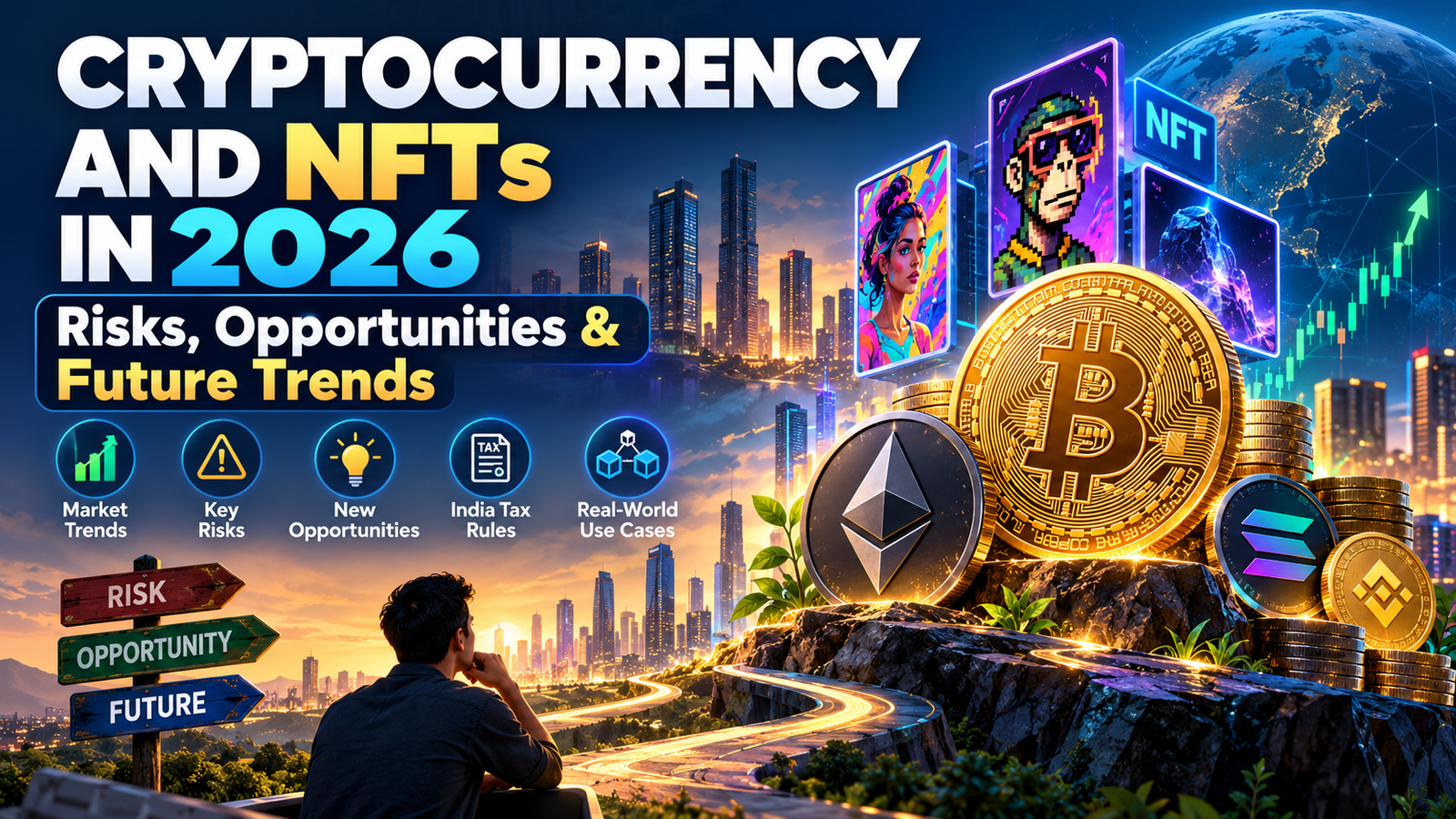
Cryptocurrency and NFTs in 2026: Risks, Benefits & Future Trends
Updated: September 2026 | By Smart Paisa Bharat Editorial Team
Digital assets have come a long way from being a niche experiment discussed by technology enthusiasts. Today, cryptocurrency, blockchain networks, tokenized assets, and digital collectibles are part of a much broader conversation about how money, ownership, and online businesses may evolve.
But there is a difference between understanding a technology and investing in it. A blockchain project can have an interesting purpose and still be a poor investment. A digital artwork can attract attention without having a reliable resale market. And a token that rises sharply in price can lose much of its value just as quickly.
That is why the cryptocurrency and NFT landscape in 2026 deserves a more thoughtful approach than simply following the latest coin, influencer, or market prediction.
In this guide, Smart Paisa Bharat explains how cryptocurrencies and NFTs work, where blockchain technology is finding practical applications, what investors should understand about digital ownership, and how Indian readers can approach this changing sector with better information and sensible risk management.
In this guide, you will learn:
- What cryptocurrency and NFTs actually are.
- Important blockchain developments and use cases to understand in 2026.
- How tokenization, stablecoins, and decentralized finance work.
- Why NFTs are evolving beyond digital artwork.
- The major financial, technical, and security risks.
- What Indian investors should know about crypto taxation and compliance.
1. What Is Cryptocurrency? A Simple Explanation
Cryptocurrency is a type of digital asset that uses cryptographic techniques and, in many cases, a distributed ledger to record and verify transactions. Instead of depending entirely on a single central database, blockchain networks allow multiple participants to maintain and validate transaction records according to the network’s rules.
Think of a blockchain as a shared digital record book. Transactions are grouped into blocks and linked together using cryptographic methods. Depending on the network, transactions may be validated by miners, validators, or other consensus mechanisms.
This structure can make records difficult to alter without detection. However, it does not mean that every cryptocurrency is secure, every transaction is reversible, or every project is legitimate.
How does a cryptocurrency transaction work?
- A user initiates a transaction. For example, someone sends a digital asset from one wallet address to another.
- The transaction is digitally signed. A private key authorizes the transaction without being publicly revealed.
- The network checks the transaction. Participating nodes verify it according to the blockchain’s rules.
- The transaction is recorded. Once accepted and sufficiently confirmed, the receiving wallet can recognize the transferred asset.
The important distinction is that a wallet generally does not store coins in the same way a physical wallet stores cash. It manages the keys or credentials used to access and authorize transactions associated with blockchain addresses.
Losing access to those keys can mean losing access to the assets. Sending funds to an incorrect address or interacting with a malicious smart contract can also result in irreversible losses.
2. Cryptocurrency Trends to Understand in 2026
The digital-asset industry is not a single market moving in one direction. It includes payment infrastructure, financial applications, blockchain development, digital ownership, and speculative trading.
The following areas are worth understanding because they illustrate different ways blockchain technology is being developed and used. Their long-term commercial success, adoption, and investment returns remain uncertain.
2.1 Bitcoin and the changing digital-asset market
Bitcoin was created as a peer-to-peer electronic payment system. Over time, it has also become widely discussed as a scarce digital asset and a possible alternative store of value.
Its protocol limits the total supply to 21 million bitcoin. That supply rule is an important part of its design, but scarcity alone does not guarantee a particular market price or protect holders from losses.
Bitcoin’s market value can be affected by liquidity, investor demand, interest rates, regulation, market sentiment, leverage, and broader economic conditions. Large price movements can occur in both directions.
For readers following Bitcoin in 2026, it is useful to separate three different questions:
- What is happening to the Bitcoin network and its technology?
- What are investors and financial institutions doing with the asset?
- What price risks could affect someone buying or selling it?
These questions are related, but they are not interchangeable. A technological improvement does not automatically lead to a higher price, and a rising price does not prove that a network has become more useful.
2.2 Ethereum and smart-contract applications
Ethereum is a blockchain platform designed to support programmable transactions and smart contracts. A smart contract is software deployed on a blockchain that executes according to predefined conditions.
These contracts can support decentralized exchanges, lending protocols, digital collectibles, tokenized assets, and other applications.
One reason Ethereum is frequently discussed in blockchain development is its ecosystem of developers, applications, and supporting infrastructure. Other networks also compete in this space, often emphasizing transaction costs, speed, scalability, or particular technical designs.
Users should remember that smart contracts are software. Bugs, flawed assumptions, compromised administrative keys, or vulnerabilities in connected applications can create substantial financial losses.
2.3 Stablecoins and digital payments
Stablecoins are digital tokens designed to maintain a relatively stable value, often by referencing a currency such as the US dollar. Depending on the design, a stablecoin may rely on reserves, collateral, algorithms, or a combination of mechanisms.
They are used in some digital-asset trading markets and blockchain-based payment applications. Their appeal is that they can allow value to move across compatible networks without the same day-to-day price movements associated with assets such as Bitcoin.
However, the word “stable” should not be interpreted as a guarantee. A stablecoin can lose its intended peg, experience liquidity problems, face redemption restrictions, or be affected by the quality and accessibility of its reserves.
Users should investigate who issues a stablecoin, what supports its value, whether redemption rights are clearly documented, and which legal protections apply in their jurisdiction.
2.4 Tokenization of real-world assets
Tokenization involves representing certain rights or interests in an asset through digital tokens. Depending on the legal and technical structure, the underlying asset could involve financial instruments, commodities, property-related interests, or other contractual rights.
Consider a simplified example: a company creates digital records representing fractional interests in an investment product. A blockchain may help record transfers and ownership information, while the legal documents determine what rights each holder actually receives.
This distinction matters. Owning a token that refers to a building does not automatically mean that the holder owns a legally enforceable share of the building. The rights depend on the issuer, applicable law, contractual arrangements, and the structure of the offering.
Tokenization is an area to watch for financial infrastructure and digital ownership, but it does not eliminate the need for reliable intermediaries, enforceable legal rights, accurate records, or investor protection.
2.5 Decentralized finance and on-chain financial services
Decentralized finance, commonly called DeFi, refers to financial applications that use blockchain-based smart contracts to provide services such as exchanging tokens, supplying liquidity, or borrowing and lending digital assets.
In some protocols, users interact directly with smart contracts instead of relying on a conventional financial institution to process every step. This can create new ways to access financial applications, subject to network availability and local laws.
DeFi also introduces risks that may be unfamiliar to traditional investors. These include smart-contract exploits, collateral liquidation, volatile borrowing costs, liquidity shortages, oracle failures, and governance disputes.
An advertised annual percentage yield is not the same as a guaranteed bank deposit interest rate. Rewards may change, token prices can fall, and the underlying protocol can fail.
2.6 Blockchain infrastructure and scaling solutions
As blockchain applications grow, developers continue to work on reducing transaction costs, improving throughput, and making networks easier to use.
Layer-2 networks and other scaling approaches aim to process transactions more efficiently while relying on a base blockchain for some combination of security, settlement, or data availability.
Different scaling systems use different technical designs. Users should understand where transactions are processed, how withdrawals work, what security assumptions apply, and whether assets depend on a bridge or third-party operator.
A lower transaction fee can be useful, but it is only one part of evaluating a blockchain network. Security, decentralization, reliability, user experience, and sustainable demand also matter.
3. What Are NFTs? Understanding Digital Ownership
A non-fungible token, or NFT, is a distinct digital token that can be associated with a particular item, record, or set of rights. Unlike interchangeable units of a cryptocurrency, each NFT has an individual identity within its system.
For example, one unit of a cryptocurrency may be interchangeable with another unit of the same type. An NFT, by contrast, may have a unique identifier that distinguishes it from other tokens in a collection.
NFTs became widely known through digital artwork, profile-picture collections, and collectibles. Their underlying technology can also be used for other types of digital records and ownership-related applications.
How does an NFT work?
- A creator or platform establishes a token using a blockchain-compatible smart contract.
- The token receives a unique identifier and may reference metadata or digital content.
- The blockchain records token ownership and subsequent transfers according to the contract’s rules.
- A marketplace or compatible application may display, sell, or otherwise interact with the token.
An important detail is that the image, video, music file, or other content associated with an NFT may be stored separately from the blockchain.
If that content is hosted by an external service, its continued availability can depend on the hosting provider, storage arrangement, or creator’s decisions. A token’s existence on a blockchain does not guarantee that every associated file will remain accessible forever.
Does buying an NFT mean owning the copyright?
Not automatically. Purchasing an NFT generally gives the buyer control of the token under the relevant blockchain and platform rules. Copyright, commercial usage rights, and other intellectual-property rights are separate legal matters.
A creator may grant certain rights through a license or contract, but those rights should not be assumed merely because a buyer owns the token.
Before purchasing an NFT, read the creator’s license, marketplace terms, and any documentation describing what the buyer can actually do with the associated content.
4. NFT Trends and Practical Use Cases in 2026
The NFT conversation has expanded beyond collectible artwork. The following applications demonstrate where unique blockchain-based records may be useful, although adoption and commercial viability differ across projects.
4.1 Digital collectibles and creative communities
Artists, musicians, game developers, and online communities can use NFTs to issue distinct digital collectibles or provide access to particular experiences.
A collectible might include artwork, behind-the-scenes content, membership access, or benefits defined by its creator.
The actual value depends on what buyers want, whether the creator continues to support the project, the quality of the community, and whether the promised benefits can be delivered.
4.2 Gaming and digital items
Blockchain-based gaming projects may represent selected in-game items as tokens that users can transfer between compatible wallets or marketplaces.
This is sometimes presented as a way to give players more control over digital items. In practice, ownership is still limited by game rules, intellectual-property rights, technical compatibility, and the willingness of developers to support those assets.
A token does not guarantee that an item will remain usable in a game if the developer closes the service or changes its rules.
4.3 Event tickets and membership credentials
NFT technology can be used to issue digital tickets, membership credentials, or records associated with events and communities.
A well-designed system may help organizers verify ticket records and track authorized transfers. It can also allow additional information or benefits to be associated with a ticket.
However, conventional ticketing systems can provide many of the same functions. Blockchain is useful only when its specific advantages justify the additional complexity, cost, and user requirements.
4.4 Digital identity and verifiable credentials
Blockchain-related systems are also being explored for credentials and identity-related applications. These may include certificates, professional achievements, memberships, or records that can be checked by another party.
Not every credential needs to be a publicly transferable NFT. Privacy, personal-data protection, revocation, and the ability to correct inaccurate records are important considerations in identity systems.
Sensitive personal information should not be placed on a public blockchain simply because the technology makes it possible.
4.5 NFTs and tokenized assets are not the same thing
A unique token may represent a digital collectible, a certificate, or a contractual right. A tokenized financial asset may instead be designed to represent an interest in a regulated instrument or other underlying asset.
The token format alone does not determine the legal status of the asset. The issuer, the rights attached to the token, the relevant jurisdiction, and the applicable rules must all be considered.
For anyone evaluating an NFT or tokenized product, the most important question is not simply whether it uses blockchain technology. It is what the buyer legally and practically receives.
Smart Paisa Bharat insight: Digital scarcity is not the same as economic value. A token can be unique, verifiable, and technically functional while having little demand, no dependable resale market, or no meaningful rights attached to it.
5. Cryptocurrency and NFT Risks Every Beginner Should Understand
The biggest mistake a beginner can make is assuming that a new technology automatically creates a safe investment. Cryptocurrency and NFTs involve several different types of risk, and understanding them is essential before committing money.
5.1 Extreme price volatility
Cryptocurrency prices can move sharply within hours or days. Smaller tokens and newly launched projects may experience particularly large price swings because of limited liquidity, concentrated ownership, speculation, or changes in market sentiment.
Imagine purchasing a token for ₹10,000. If its market price falls by 50%, the position is worth approximately ₹5,000 before fees and taxes. Recovering from that decline requires a 100% gain on the remaining value.
This simple example explains why protecting capital matters. A large percentage decline can be much harder to recover from than it initially appears.
5.2 Scams, fake projects, and misleading promises
Fraudulent schemes may use professional websites, fabricated testimonials, celebrity images, fake trading dashboards, or fabricated transaction records to appear legitimate.
Some projects advertise fixed daily returns, guaranteed profits, or referral-based rewards that are not supported by a sustainable business model.
No cryptocurrency, NFT, trading strategy, or blockchain protocol can honestly guarantee market profits simply because it uses advanced technology.
Warning signs include:
- Promises of guaranteed or unusually high returns with little or no risk.
- Pressure to deposit money immediately or recruit other participants.
- Unclear information about the company, founders, or legal entity.
- Withdrawal fees or additional deposits demanded before releasing supposed profits.
- Unverifiable claims of partnerships, audits, exchange listings, or regulatory approval.
A smart contract audit, even when genuine, does not prove that a project is financially sound, free of every vulnerability, or certain to succeed.
5.3 Wallet security and private-key theft
A cryptocurrency wallet may be software-based or a physical hardware device. Both require careful handling of access credentials.
Your seed phrase or recovery phrase can provide access to a wallet. Anyone who obtains it may be able to control the associated assets.
For safer wallet practices:
- Never share your recovery phrase, private keys, or wallet password.
- Use a secure, unique password and enable two-factor authentication on exchange accounts.
- Verify the complete destination address before confirming a transfer.
- Be cautious when connecting a wallet to unfamiliar websites or applications.
- Review token approvals and revoke unnecessary permissions using trusted tools.
- Consider a small test transaction before sending a significant amount to a new address.
Hardware wallets can reduce certain online exposure risks, but they do not protect users from every threat. A compromised recovery phrase, malicious transaction approval, or fraudulent recipient can still cause losses.
5.4 Exchange, custody, and withdrawal risks
Holding cryptocurrency through an exchange is different from controlling assets through a self-custody wallet.
With an exchange account, access may depend on the platform’s solvency, security, operational reliability, withdrawal policies, and compliance requirements.
With self-custody, the user takes responsibility for securing private keys and recovery information. That can reduce dependence on a custodian but also removes some opportunities for account recovery.
Before using a platform, investigate its legal entity, custody arrangements, withdrawal terms, security disclosures, and complaint procedures. An app being available for download does not establish that it is authorized or protected under Indian financial regulations.
5.5 Liquidity and NFT resale problems
A displayed NFT price is not proof that someone will buy the item at that price.
An NFT collection may show high asking prices but have very few completed sales. A buyer might struggle to find another purchaser, particularly during a market downturn.
Before buying a collectible, review actual completed sales, trading volume, marketplace fees, creator activity, and the number of independent buyers and sellers.
Do not treat a rare-item label or a high advertised floor price as a guarantee of resale value.
6. Cryptocurrency in India: Taxation and Compliance in 2026
Anyone buying, selling, transferring, or receiving cryptocurrency or NFTs in India should understand the applicable tax rules and reporting requirements. Tax treatment depends on the nature of the asset, the transaction, the taxpayer, and the law in force for the relevant tax year.
India’s Income-tax Act, 2025 took effect on 1 April 2026. The Income Tax Department has published guidance on virtual digital assets and the transition to the new framework.
Cryptocurrency and certain NFTs fall within the broad category of virtual digital assets (VDAs), subject to the statutory definitions and exclusions. The exact treatment of an individual transaction should be checked against the applicable provisions and current guidance.
6.1 Tax on income from transfers of digital assets
The Income Tax Department’s published VDA guidance describes a special 30% tax rate on income from transfers of virtual digital assets under the earlier Section 115BBH framework, together with applicable surcharge and cess.
Under that framework, the cost of acquisition is generally the permitted deduction, while other expenditure and the set-off or carry-forward of VDA transfer losses are restricted.
Since the Income-tax Act, 2025 applies from April 2026, taxpayers should verify the corresponding provisions, numbering, transition rules, and current tax-year requirements before filing a return. Do not assume that a section number from the earlier Act automatically applies to every transaction in the current tax year.
Official reference: Income Tax Department — Taxation of Virtual Digital Assets.
6.2 Understanding 1% TDS on VDA transfers
Section 194S of the earlier Income-tax Act provides for 1% tax deducted at source on consideration paid to a resident for the transfer of a virtual digital asset, subject to the applicable conditions and thresholds.
The Income Tax Department’s guidance describes thresholds of ₹50,000 in a financial year for specified persons and ₹10,000 for other payers under that framework.
TDS is not necessarily the final tax liability. It is a tax deduction mechanism, and the taxpayer may need to account for the transaction and any eligible TDS credit in the applicable return.
For transactions in the 2026–27 tax year, verify the corresponding provisions under the Income-tax Act, 2025 and current rules before relying on an older section number or threshold.
Official reference: Income Tax Department — TDS on transfer of VDAs.
6.3 Keep accurate transaction records
Maintaining records can make tax reporting and the verification of transactions considerably easier.
- Dates and times of purchases, sales, swaps, and transfers.
- Transaction values in Indian rupees and the exchange rates used.
- Exchange statements, wallet addresses, and transaction hashes.
- Fees, acquisition costs, and TDS details where applicable.
- Records of gifts, airdrops, NFT purchases, and other asset receipts.
Crypto-to-crypto swaps, transfers between personal wallets, gifts, staking rewards, and overseas exchange transactions can raise different tax and reporting questions. Their treatment should not be assumed to be identical.
For complex transactions, consult a qualified Indian chartered accountant familiar with digital assets and the current Income-tax Act.
Important: This section is general educational information, not personal tax or legal advice. Tax rates, section numbers, exemptions, thresholds, and filing procedures may change. Always verify the applicable law for the relevant tax year and your specific transaction.
7. A Practical Checklist Before Buying Any Cryptocurrency or NFT
Beginners do not need to understand every technical detail of a blockchain to ask sensible questions. The following checklist can help identify risks before money is committed.
Research the project
- What problem does the project claim to solve?
- Is there a working product, or only a marketing website and a token?
- Who operates the project, and can their identities and track records be verified?
- Is the token necessary for the product, and how is its supply distributed?
- Are the project’s claims supported by independent evidence?
Understand the financial exposure
- Could you afford to lose the entire amount invested?
- Are you borrowing money or using leverage to buy a volatile asset?
- Do you understand the fees, spreads, withdrawal conditions, and tax implications?
- Is there meaningful trading activity, or are displayed prices based on very few transactions?
- Are you making a decision based on research or fear of missing out?
For NFT buyers specifically
- What rights does the token actually provide?
- Who owns the copyright or intellectual property associated with the content?
- Where is the underlying artwork or file stored?
- Can the marketplace or creator change access or benefits?
- Is there independent evidence of demand beyond social-media promotion?
A project that cannot answer basic questions about ownership, fees, risks, and legal rights should be approached with considerable caution.
8. Frequently Asked Questions About Cryptocurrency and NFTs in 2026
What is cryptocurrency in simple words?
Cryptocurrency is a digital asset that uses cryptographic techniques and often a distributed ledger to record transactions. Some cryptocurrencies are designed for payments, while others support blockchain applications or serve different network functions.
Are cryptocurrency and NFTs the same thing?
No. Cryptocurrency units are generally designed to be interchangeable within the same asset, while NFTs have distinct token identities. NFTs can represent collectibles, digital records, or particular rights, depending on their terms and structure.
Are NFTs still relevant in 2026?
NFTs remain a technology used for digital collectibles, gaming items, membership credentials, and other applications. Their relevance depends on actual user demand and practical utility. The existence of an NFT does not guarantee financial value or a liquid resale market.
Can cryptocurrency provide guaranteed monthly income?
No cryptocurrency or blockchain investment can guarantee market-based profits or monthly income. Offers that promise fixed returns without clearly explaining the risks, legal structure, and source of revenue should be treated with caution.
Is cryptocurrency legal in India?
India’s treatment of crypto-assets involves taxation, compliance requirements, and an evolving regulatory framework. Taxation does not itself establish that every crypto-related activity is authorized, protected, or regulated in the same way as a conventional financial product. Readers should check current official rules and the status of the specific service or activity.
How are cryptocurrency profits taxed in India?
The Income Tax Department has published a special 30% tax framework for income from VDA transfers under the earlier Section 115BBH, with applicable surcharge and cess and restrictions on deductions and losses. Since the Income-tax Act, 2025 took effect on 1 April 2026, taxpayers should verify the corresponding provisions and current tax-year rules with the official Income Tax Department or a qualified tax professional.
Can NFTs be converted into cash?
An NFT may be sold through a compatible marketplace if a buyer is willing to purchase it. Sale proceeds depend on demand, marketplace availability, fees, and applicable rules. Some NFTs may have no willing buyers, and a sale at the advertised price is never guaranteed.
What is the safest way to store cryptocurrency?
There is no storage method that eliminates every risk. Users should compare reputable custodial services and self-custody wallets, protect recovery phrases, verify transactions, and understand how they can recover access if a device is lost. Security practices should match the user’s technical knowledge and risk exposure.
9. The Future of Cryptocurrency and NFTs: What Should Readers Watch?
The future of digital assets will not be determined by token prices alone. Practical adoption, reliable infrastructure, user protection, legal clarity, and the ability to solve real problems will all influence how blockchain applications develop.
Cryptocurrency may continue to be discussed in connection with digital payments, financial markets, and decentralized applications. NFTs may find uses in digital ownership, gaming, creator communities, and verifiable records. Tokenization could also influence how selected financial and contractual interests are represented and transferred.
Yet every one of these areas faces questions about scalability, security, consumer protection, privacy, governance, and commercial sustainability.
It is also possible for a technology to become more useful while some associated tokens lose value or disappear. Industry growth and investment performance are separate matters.
For everyday readers, a balanced approach means learning how the technology works, verifying claims independently, understanding local laws, and never risking essential savings on speculative assets.
Final Thoughts: Knowledge Before Investment
Cryptocurrency and NFTs represent a changing part of the digital economy. They offer new ways to transfer value, develop applications, and represent digital ownership, but they also introduce financial and technical risks that should not be ignored.
The most useful starting point for a beginner is not choosing a trending coin or searching for the next expensive NFT. It is understanding the underlying technology, the rights associated with an asset, the reliability of the platform, and the possibility of losing money.
At Smart Paisa Bharat, our goal is to make financial and technology-related topics easier to understand so readers can make informed decisions based on evidence rather than hype.
Keep learning, compare information from reliable sources, and remember that protecting your financial well-being matters more than chasing a market trend.
Official References and Further Reading
The following sources provide additional information on Indian tax rules and the wider digital-asset landscape:
- Income Tax Department — Income-tax Act, 2025 and Rules, 2026
- Income Tax Department — Taxation of Virtual Digital Assets
- Income Tax Department — TDS on transfer of VDAs
- OECD — Asia Capital Markets Report 2026: Developments in Crypto-Asset Markets
Editorial disclosure: This article is intended for educational and informational purposes only. It is not financial, investment, tax, or legal advice. Smart Paisa Bharat does not guarantee investment returns or recommend that readers buy or sell any particular cryptocurrency, NFT, or digital asset. Conduct independent research and consult qualified professionals where appropriate.
Content review: September 2026. Regulatory and tax rules may change; verify official sources before acting.