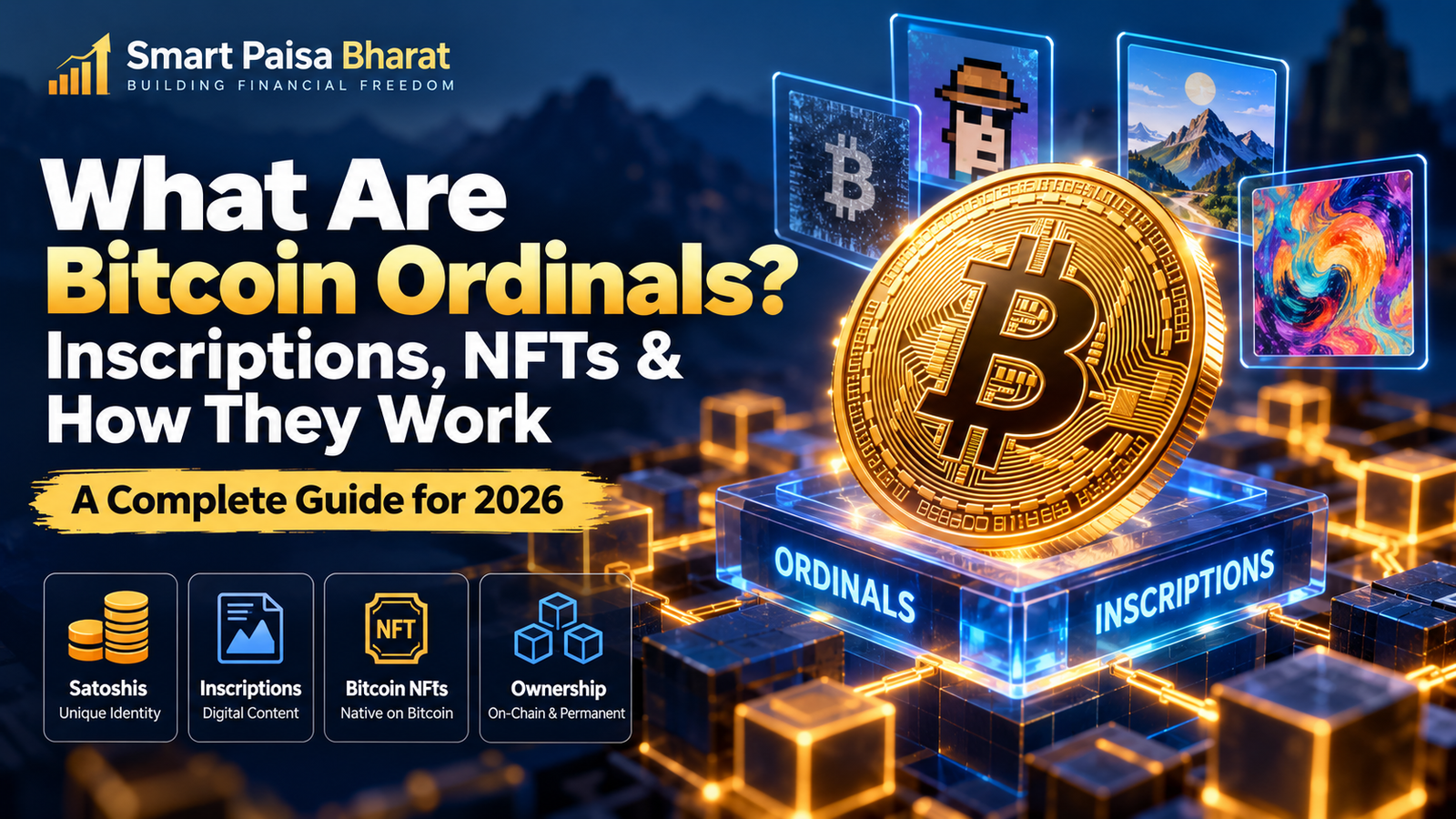
What Are Bitcoin Ordinals? Inscriptions, NFTs & How They Work
Updated: September 30, 2026
Bitcoin Ordinals Explained: How Bitcoin NFTs & Inscriptions Work in 2026
Bitcoin was originally designed as a peer-to-peer digital currency, but the network has become capable of much more than transferring BTC. Bitcoin Ordinals and inscriptions introduced a new way to attach digital content to individual satoshis, creating a native ecosystem for digital artifacts directly on Bitcoin.
In this guide, we explain what Bitcoin Ordinals are, how inscriptions work, why they are often compared with NFTs, what makes them different, and what investors, collectors and everyday Bitcoin users should understand in 2026.
What Are Bitcoin Ordinals?
Bitcoin Ordinals are a system for identifying and tracking individual satoshis, the smallest units of Bitcoin. One Bitcoin contains 100 million satoshis.
Ordinal theory gives individual satoshis a unique identity based on the order in which they are mined. This makes it possible to track a particular satoshi as it moves through Bitcoin transactions.
The important point is that an Ordinal itself is not simply an NFT. An Ordinal refers to the numbering and tracking system applied to satoshis. When digital information such as an image, text, audio file or code is attached to a satoshi, that data is called an inscription.
Ordinal = identity of a satoshi
Inscription = data attached to that satoshi
Digital artifact = the resulting Bitcoin-native digital item
What Is a Bitcoin Inscription?
A Bitcoin inscription is digital data recorded on the Bitcoin blockchain and associated with a particular satoshi through the Ordinals system.
Depending on the implementation and transaction limits, inscriptions can contain different forms of content, including text, images, HTML, SVG, audio, video and other digital data.
Unlike a traditional NFT that may depend on a smart contract and an external storage location, an Ordinal inscription can store its content directly in Bitcoin transaction data. This is one reason supporters describe inscriptions as Bitcoin-native digital artifacts.
The Ordinals documentation describes inscription content as being stored on-chain using Taproot script-path spends. This architecture is one of the technical foundations that made inscriptions possible without creating a separate blockchain or sidechain.
How Do Bitcoin Ordinals Work?
The process sounds complicated, but the basic concept can be explained in a few steps.
- Bitcoin is divided into satoshis. Each BTC contains 100 million satoshis.
- Ordinal theory assigns identities. Satoshis can be numbered according to their position in Bitcoin’s issuance history.
- Digital content is prepared. A user chooses content such as text, an image or another supported data format.
- The inscription transaction is created. The content is placed into the appropriate Bitcoin transaction structure.
- The transaction is broadcast. Bitcoin miners include the transaction in a block when it is accepted into the network.
- The inscription becomes part of Bitcoin’s blockchain history. The associated satoshi can then be tracked according to Ordinal theory.
The underlying Bitcoin network remains the same. Ordinals do not require users to create a separate blockchain for the inscription itself.
Why Are Bitcoin Ordinals Often Called Bitcoin NFTs?
The comparison with NFTs is understandable because both systems can represent unique digital items that people collect, transfer and trade.
However, the underlying technology is different.
| Feature | Bitcoin Ordinals | Typical Smart-Contract NFT |
|---|---|---|
| Underlying network | Bitcoin | Ethereum or another smart-contract blockchain |
| Core concept | Numbered satoshis and inscriptions | Tokens controlled by smart contracts |
| Digital content | Can be stored directly on Bitcoin | May be stored on-chain or referenced through external storage |
| Smart contract required? | No | Usually yes |
| Transaction fees | Bitcoin network fees | Fees of the relevant blockchain |
Therefore, calling an inscription a “Bitcoin NFT” can be useful for explaining the concept to newcomers, but technically it is better to use the terms Ordinal inscription or Bitcoin digital artifact.
What Makes Bitcoin Ordinals Different?
1. Bitcoin-native infrastructure
Ordinals operate within the Bitcoin ecosystem rather than requiring a separate NFT blockchain. This makes Bitcoin itself the foundation for the digital artifact.
2. On-chain data
One of the major attractions of inscriptions is that the content can be recorded directly in Bitcoin transaction data rather than simply pointing to a file hosted on a conventional website.
3. Scarcity can be connected to individual satoshis
Because Bitcoin has a finite supply of satoshis, collectors can assign additional significance to certain sats based on their historical characteristics, such as when they were mined or how they relate to important Bitcoin events.
4. Bitcoin becomes a programmable data layer
Ordinals demonstrated that Bitcoin can support forms of digital ownership, collectibles, applications and data that many users previously associated primarily with smart-contract platforms.
Bitcoin Ordinals in 2026: What Has Changed?
The Ordinals ecosystem in 2026 is very different from the speculative boom that attracted enormous attention in 2023.
Current inscription activity remains substantial, but market attention is more selective. Infrastructure, wallets, explorers and developer tools have continued to evolve while speculative activity has cooled from its earlier highs.
A live Ordinals explorer currently records more than 127 million inscriptions, demonstrating that inscriptions are no longer a small experiment on Bitcoin. However, the total count alone should not be interpreted as proof of economic value or future adoption.
A large inscription count does not mean that every inscription has collectible value. Many inscriptions are text-based or created for experimental, technical or token-related purposes.
This distinction is important for anyone researching Bitcoin Ordinals as an investment or collectible category.
Ordinals, Inscriptions, BRC-20 and Runes: What’s the Difference?
These terms are often mixed together online, but they describe different concepts.
- Ordinals: A system for identifying and tracking individual satoshis.
- Inscriptions: Data attached to individual satoshis using the Ordinals framework.
- BRC-20: A token experiment built using inscription-based data to represent fungible tokens on Bitcoin.
- Runes: A separate Bitcoin token protocol designed for fungible assets and associated with the broader ecosystem that developed around Bitcoin’s block space.
These technologies overlap historically, but they should not be treated as identical systems.
Why Do People Create Bitcoin Inscriptions?
There is no single reason. Different users approach inscriptions from very different perspectives.
Digital art and collectibles
Artists can use Bitcoin inscriptions to create digital works whose content is recorded directly on the Bitcoin blockchain.
Historical preservation
Some users see inscriptions as a way to preserve digital information as part of Bitcoin’s permanent public record.
Experiments and applications
Developers have experimented with HTML, generative content, token standards, games, metadata and other applications.
Collecting rare satoshis
Ordinal theory also creates a framework for identifying satoshis with particular historical or numerical characteristics. Some collectors treat these sats as digital curios.
Smart Paisa Bharat Insight
Bitcoin Ordinals are better understood as a new Bitcoin data and ownership experiment rather than simply another NFT trend. The technology has survived beyond its initial hype cycle, but individual inscriptions can still carry very different levels of utility, liquidity and risk.
⚠️ Risks You Should Understand Before Using Bitcoin Ordinals
Bitcoin Ordinals are an important technical development, but the existence of an inscription does not automatically mean that it has financial or collectible value. Anyone exploring Ordinals should understand the difference between the technology itself and the speculative market surrounding some digital artifacts.
1. Market and liquidity risk
Some Bitcoin inscriptions may trade actively while others may have little or no secondary-market demand. A historical sale price should not be treated as a guarantee of future value.
Digital-asset markets can change quickly, and prices may be affected by Bitcoin market conditions, collector interest, project activity, marketplace liquidity and broader crypto sentiment.
2. Not every inscription is rare
An inscription number by itself does not establish that an item is valuable. There are many different types of inscriptions, including text, images, applications and token-related data.
Collectors may consider factors such as provenance, creator, historical significance, rarity, content and demand. These factors are subjective and can change over time.
3. Bitcoin transaction fees
Inscriptions use Bitcoin block space. When demand for block space increases, Bitcoin transaction fees can also increase.
The cost of creating or transferring an inscription therefore depends on factors such as transaction size, fee rate and network conditions at the time of the transaction.
4. Wallet and UTXO management
Ordinals introduce an additional consideration for Bitcoin wallet management because individual satoshis can carry inscriptions.
A wallet that does not properly account for inscriptions may not provide the same level of control as an Ordinals-aware wallet. Users should understand how a wallet handles UTXOs and inscriptions before transferring funds.
The official ord documentation specifically warns that ordinary Bitcoin Core operations do not provide inscription-aware sat control and that careless wallet operations can result in inscriptions being lost.
5. Scams and fake collections
The popularity of Bitcoin NFTs and Ordinals has also created opportunities for impersonation, fake collections, phishing websites and fraudulent marketplaces.
Never assume that an inscription is authentic simply because its name, image or collection description appears on a third-party website. Verify transaction IDs, inscription IDs, provenance and marketplace information independently.
6. Regulatory and tax considerations
Digital-asset rules and taxation can vary by country and may change over time. Buying, selling, creating or transferring digital assets can have tax or reporting consequences depending on the user’s jurisdiction.
Readers should consult the applicable government guidance or a qualified professional for personal tax or legal questions.
💡 Technology Is Not the Same as Investment Value
Bitcoin Ordinals are a technical protocol concept. An inscription can be technically interesting without becoming a valuable collectible. Smart Paisa Bharat recommends separating technological research from investment assumptions and conducting independent due diligence before making any financial decision.
Are Bitcoin Ordinals Still Relevant in 2026?
Ordinals remain part of the Bitcoin ecosystem in 2026, although the conversation has evolved significantly from the initial wave of attention that followed the launch of inscriptions on Bitcoin mainnet in early 2023.
The underlying technology continues to support inscriptions and Bitcoin-native digital artifacts. Current Ordinals ecosystem data also continues to show substantial inscription activity on Bitcoin.
However, the number of inscriptions should not be interpreted as a measurement of economic value. An inscription count tells us how many inscriptions have been indexed, not how many are commercially successful, rare or valuable.
In other words, the 2026 discussion is less about whether inscriptions are technically possible and more about how developers, collectors and users will actually use the technology over the longer term.
Bitcoin Ordinals and the Block-Space Debate
One of the most important discussions created by Ordinals is not about artwork. It is about Bitcoin’s limited block space.
Bitcoin blocks have limited capacity. Transactions compete for inclusion according to network conditions and fee economics. When demand rises, users generally compete by offering higher transaction fees.
Supporters of inscriptions argue that users should be able to purchase available Bitcoin block space for valid transactions according to the network’s rules.
Critics have raised concerns that large inscription-related transactions can compete with conventional payment transactions for block space and may contribute to higher fees during periods of strong demand.
This disagreement is part of a broader debate about Bitcoin’s intended uses, fee markets and the economic value of block space.
Bitcoin Ordinals vs Traditional NFTs
Bitcoin Ordinals are often described as Bitcoin NFTs because both can be used for unique digital collectibles. Technically, however, their architecture is different.
| Feature | Bitcoin Ordinals | Typical NFT Model |
|---|---|---|
| Base network | Bitcoin | Ethereum or another smart-contract blockchain |
| Core concept | Numbering and tracking satoshis | Token managed by a smart contract |
| Digital content | Can be inscribed directly on Bitcoin | Depends on the individual NFT implementation |
| Separate token required? | No | Usually represented by a token contract |
| Transfer mechanism | Bitcoin transactions and UTXOs | Blockchain transactions interacting with the relevant contract |
The important distinction is that an Ordinal is not simply an ERC-721-style token on Bitcoin. Ordinal theory assigns identities to individual satoshis, while inscriptions associate digital content with those sats.
Ordinals, BRC-20 and Runes: What’s the Difference?
These terms frequently appear together in Bitcoin discussions, but they should not be treated as interchangeable.
| Technology | What it does | Main mechanism |
|---|---|---|
| Ordinals | Identifies and tracks individual satoshis | Ordinal numbering and transfer rules |
| Inscriptions | Associates digital content with satoshis | Bitcoin transaction data and Taproot |
| BRC-20 | Experimental fungible-token standard using inscriptions | JSON inscriptions and an off-chain indexing model |
| Runes | Fungible-token protocol on Bitcoin | Bitcoin UTXOs and Runestones using OP_RETURN |
Runes should particularly not be described as simply another name for Ordinals. The Runes protocol activated at Bitcoin block 840,000 and uses Bitcoin’s UTXO model and protocol messages known as Runestones.
Why Do Collectors Care About Bitcoin Digital Artifacts?
Collectors may be attracted to Bitcoin inscriptions for different reasons. Some appreciate the technology, while others are interested in digital art, provenance, historical Bitcoin events or particular satoshi characteristics.
Some collectors also focus on early inscriptions or sats associated with particular milestones in Bitcoin’s history.
But rarity alone does not create guaranteed market demand. A collectible ultimately depends on people being willing to recognize and value it.
Beginner Checklist: Before You Buy or Transfer an Ordinal
- Verify the exact inscription ID and transaction history.
- Check whether you are dealing with the original inscription or a copy.
- Understand the wallet’s support for inscriptions and UTXO control.
- Confirm the transaction fee before broadcasting a Bitcoin transaction.
- Research the creator, collection and provenance rather than relying only on social-media claims.
- Never share your seed phrase or private keys with a website or marketplace.
- Remember that digital-asset prices can fall sharply and liquidity can disappear.
- Consider applicable tax and regulatory requirements in your country.
Frequently Asked Questions About Bitcoin Ordinals
Are Bitcoin Ordinals the same as NFTs?
Not exactly. Ordinals provide a system for identifying and tracking individual satoshis. Inscriptions can attach digital content to those satoshis. Because these digital artifacts can be collected and traded, they are commonly compared with NFTs.
What is a Bitcoin inscription?
A Bitcoin inscription is digital content associated with a satoshi using the Ordinals framework. The content can include formats such as text, images, HTML, SVG, audio and other supported data.
Are inscriptions stored on Bitcoin?
The Ordinals documentation describes inscription content as being stored on-chain in Taproot script-path spend scripts. This is a key difference from systems where an NFT token only points to content stored somewhere else.
What is BRC-20?
BRC-20 is an experimental fungible-token standard that uses Ordinals inscriptions and structured data to define token operations. It is different from the Ordinals numbering system itself.
What are Bitcoin Runes?
Runes is a separate fungible-token protocol on Bitcoin. It uses Bitcoin’s UTXO model and Runestones rather than relying on the Ordinals inscription model.
Can an Ordinal lose its value?
Yes. An inscription’s market value is not guaranteed. Demand, liquidity, collector interest, project reputation and wider cryptocurrency market conditions can all change.
Can an inscription be lost?
An inscription can be mishandled if a user or wallet does not correctly manage the relevant satoshi and UTXO. This is why inscription-aware wallet management is important.
Final Takeaway: What Bitcoin Ordinals Mean in 2026
Bitcoin Ordinals have expanded the way developers and users think about Bitcoin. The protocol introduced a method for assigning identities to individual satoshis and enabled digital content to be associated with those sats through inscriptions.
The technology has applications ranging from digital art and collectibles to experiments involving data, applications and token protocols.
But the technology and the investment market should be viewed separately. An inscription can be permanent on Bitcoin without being valuable in the marketplace.
For beginners, the most useful approach is to understand the underlying Bitcoin mechanics first, verify information independently and treat claims about future prices or guaranteed returns with caution.
As the Bitcoin ecosystem continues to evolve, Ordinals remain an important example of how developers can build new applications around Bitcoin’s existing infrastructure without creating a separate blockchain.
Sources & Further Reading
For readers who want to verify the technical details, Smart Paisa Bharat recommends consulting primary documentation rather than relying only on social-media posts or promotional material.
- Ordinal Theory Handbook — Ordinals and Inscriptions
- Bitcoin Developer Documentation
- Current Bitcoin blockchain and Ordinals explorer data
- Applicable government and tax guidance for digital assets
Disclaimer — Smart Paisa Bharat
Smart Paisa Bharat publishes this article for general educational and informational purposes only. The information presented in this article is intended to explain Bitcoin Ordinals, inscriptions and related Bitcoin technologies and should not be considered financial, investment, trading, tax or legal advice.
Cryptocurrency, Bitcoin inscriptions, Ordinals and digital collectibles can involve significant risks, including price volatility, liquidity risk, technology risk, cybersecurity risk and the potential loss of funds. Past market activity does not guarantee future results.
Smart Paisa Bharat does not guarantee the value, future performance, profitability or appreciation of any Bitcoin Ordinal, inscription, NFT, token, collection or digital asset mentioned or discussed in this article.
Readers should conduct their own research, verify information using reliable primary sources and consider their personal financial circumstances before making any decision involving digital assets. Where appropriate, readers shou
Similar Posts
Apna Startup, Apna Swag: How to Launch a Zero-Budget Business in 2025″
🌟 Apna Startup, Apna Swag: Zero-Budget Business Launch Guide (Hinglish Style) Chalo shuru karte hain! Launching a startup without heavy investment is not a dream—it’s a proven formula. Inspired by brands like Apna (India’s fastest unicorn) and global bootstrapping success stories, this guide blends jugaad, tech hacks, and community power to help you start…
Cryptocurrency and NFTs in 2026: Risks, Benefits & Future Trends
Updated: September 2026 | By Smart Paisa Bharat Editorial Team Digital assets have come a long way from being a niche experiment discussed by technology enthusiasts. Today, cryptocurrency, blockchain networks, tokenized assets, and digital collectibles are part of a much broader conversation about how money, ownership, and online businesses may evolve. But there is a…
“Solar Goldmine: Build a Future-Proof Business with Low Investment in 2025”
🌞 Solar Business in India: A Future-Ready Opportunity for Aspiring Entrepreneurs Meta Description: Discover how to start a solar business in India, the minimum investment required, potential earnings, and why it’s one of the most promising long-term opportunities for individuals in 2025 and beyond. 📝 Table of Contents Introduction: The Bright Future of Solar Why…
7 Best Web3 Freelance Platforms in 2026 to Find Crypto Jobs
7 Best Web3 Freelance Platforms to Find Remote Crypto Jobs in 2026 Updated: September 2026 | By Smart Paisa Bharat Editorial Team Looking for Web3 freelance platforms in 2026? Freelancers can explore blockchain-focused marketplaces, crypto job boards, and professional talent networks to find opportunities in writing, software development, design, marketing, research, and community management. However,…
Facebook Viewpoints 2026: Surveys, Rewards, PayPal & Safety Guide
Facebook Viewpoints: Can You Still Earn Money From Surveys and Research Tasks? If you have searched online for simple ways to make extra money, you may have come across Facebook Viewpoints. The platform became known for offering rewards to people who participated in selected surveys and research activities. But there is an important difference between…
5 Realistic Ways to Use AI to Earn Money Online in 2026
MONEY & CAREER • AI • ONLINE WORK