BRICS 2026: New Global Economic Map Taking Shape in New Delhi
Why BRICS 2026 Matters Beyond the Summit
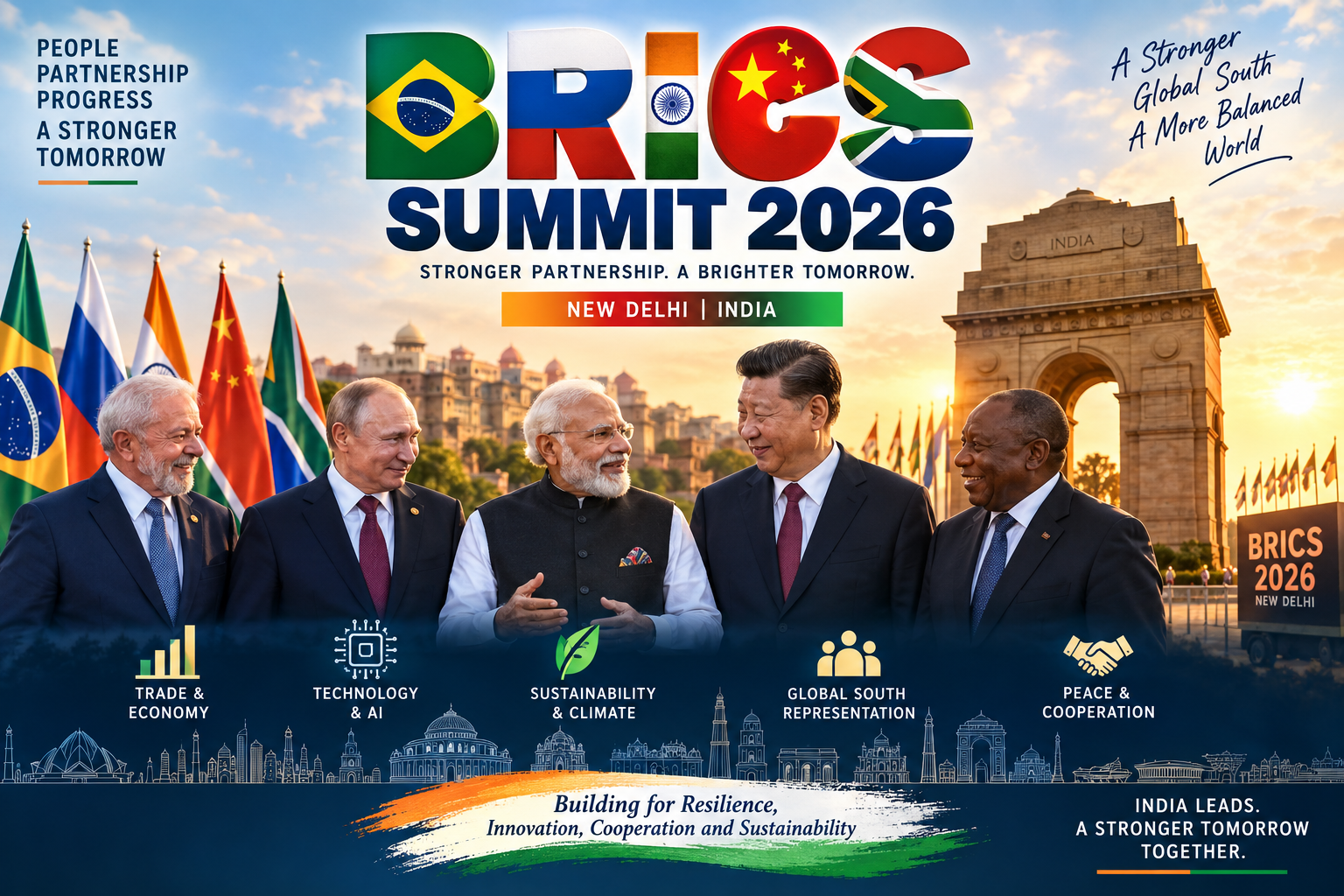
The BRICS Summit 2026 is over, but the bigger story has only just begun. India hosted the 18th BRICS Summit in New Delhi on September 12–13, bringing together leaders from the expanded BRICS grouping at a time when the global economy is going through a major reset.
Trade tensions are rising. Supply chains are being redesigned. Artificial intelligence is changing industries faster than many governments can regulate them. Countries are looking for new sources of energy, technology and investment, while emerging economies are demanding a louder voice in global decision-making.
Against this backdrop, New Delhi was not simply the venue for another diplomatic meeting. For India, the summit was an opportunity to put forward a broader vision of how emerging economies can work together without necessarily choosing one side of a divided world.
BRICS Summit 2026: The Big Picture
India held the BRICS chairship throughout 2026 under the theme “Building for Resilience, Innovation, Cooperation and Sustainability.”
The theme sounds diplomatic at first, but it actually captures many of the problems businesses and ordinary people are dealing with today.
Resilience is about surviving shocks. Innovation is about staying competitive. Cooperation is about finding common ground between countries that do not always agree. Sustainability is about making economic growth work over the long term.
The summit concluded with the adoption of the New Delhi Declaration, a 140-point document covering everything from global governance and trade to artificial intelligence, climate change, critical minerals, healthcare and space cooperation.
What Is BRICS and Why Has It Become So Important?
BRICS originally began as BRIC, bringing together Brazil, Russia, India and China. South Africa later joined, turning the group into BRICS.
The grouping has since expanded, bringing in countries including Egypt, Ethiopia, Indonesia, Iran, Saudi Arabia and the United Arab Emirates.
This expansion has changed the character of BRICS.
It is no longer simply a discussion among four or five emerging economies. It has become a much broader platform connecting major economies across Asia, Africa, the Middle East and Latin America.
That gives BRICS considerable economic and diplomatic weight, but it also creates a challenge: these countries do not always see the world in the same way.
And that is perhaps the most interesting thing about BRICS.
Its future depends on whether countries with very different interests can still find enough common ground to work together.
New Delhi Declaration 2026: The Most Important Outcome
The central outcome of the summit was the New Delhi Declaration.
Rather than focusing on just one headline issue, the declaration covers a wide range of economic, political, technological and development priorities.
The document reinforces BRICS principles including sovereign equality, mutual respect, inclusiveness, cooperation and consensus.
It also reflects the growing ambition of BRICS to become a practical platform for cooperation rather than simply a forum for political speeches.
That distinction will matter enormously in the years ahead.
1. India Pushes the Global South to the Front
One of India’s clearest messages during its BRICS presidency was that developing countries need a stronger voice in global institutions.
For years, emerging economies have argued that the international financial and political architecture does not fully reflect the economic weight or population of today’s world.
India therefore used its BRICS presidency to push discussions around reform of international institutions and greater representation for emerging and developing economies.
This is not simply a diplomatic talking point.
Decisions made by organisations such as the IMF, World Bank, WTO and United Nations can ultimately influence trade, investment, development finance and economic opportunities across developing countries.
For India, a stronger Global South voice is therefore closely connected with its own long-term economic interests.
2. India-China Relations Add Another Layer to the Summit
India-China relations were inevitably one of the most closely watched aspects of the summit.
The participation of Chinese President Xi Jinping and his engagement with Prime Minister Narendra Modi attracted considerable attention because the two countries have experienced serious strategic and border tensions in recent years.
Yet there is another side to the relationship.
India and China remain two of the world’s largest economies and important trading partners. Both are also members of BRICS.
That creates an unusual situation: two strategic competitors are simultaneously being asked to cooperate on issues affecting the wider developing world.
The New Delhi summit showed that those two realities can exist at the same time.
Competition does not necessarily mean that every channel of cooperation has to disappear.
3. Russia Remains Important for India’s Strategy
Russia’s continued role in BRICS is another important part of India’s balancing act.
India and Russia have maintained long-standing relationships across defence, energy and strategic sectors.
At the same time, India has deepened its economic and strategic engagement with the United States, Europe, Japan and other partners.
This is why describing India’s foreign policy simply as “East versus West” misses the bigger picture.
India is trying to maintain room to work with different countries according to its own interests.
That approach is commonly described as strategic autonomy.
4. BRICS Currency: What Is Fact and What Is Hype?
Few BRICS topics generate as many social-media headlines as the idea of a new BRICS currency.
But the reality is considerably more nuanced.
BRICS has not suddenly introduced a single currency that replaces the US dollar.
The more practical focus is on strengthening local-currency trade, improving cross-border payment arrangements and making transactions between member countries more efficient.
That distinction is important for investors.
A gradual move towards greater use of national currencies is very different from announcing an entirely new global reserve currency.
The realistic BRICS financial story is diversification—not an overnight “dollar replacement”.
The US dollar remains deeply embedded in international trade and global financial markets. But BRICS countries are increasingly interested in having more options.
5. Local-Currency Trade Could Matter More Than a BRICS Currency
For businesses, this may ultimately be one of the most practical BRICS developments.
If cross-border payment systems become easier to connect, companies could potentially benefit from lower conversion costs, faster settlements and fewer intermediaries.
This could be particularly relevant for:
- Exporters
- Importers
- MSMEs
- Fintech companies
- Banks
- International logistics businesses
For India, the objective is not necessarily to eliminate the dollar from international commerce. It is to create a financial system in which businesses have more efficient settlement choices.
6. Artificial Intelligence Moves to the Centre of BRICS
AI may become one of the biggest economic themes to emerge from BRICS cooperation.
The technology is already changing the way businesses operate, from banking and insurance to manufacturing, healthcare, agriculture and software development.
China has also promoted greater BRICS cooperation around open-source artificial intelligence.
For India, this is an area with enormous potential.
The country has a large technology workforce, a growing startup ecosystem and significant experience building digital infrastructure for a population of more than a billion people.
Future BRICS cooperation around AI could involve research, skills, computing infrastructure, responsible AI and technology access.
The countries that build strong AI ecosystems today could have a very different economic position ten years from now.
7. India’s Digital Public Infrastructure Gets a Bigger Stage
India’s Digital Public Infrastructure, or DPI, has become an increasingly important part of its international technology story.
Digital identity, payments and public-service platforms have demonstrated how technology can be deployed at enormous scale.
India’s BRICS engagement provides an opportunity to share some of these experiences with other emerging economies.
This could eventually create opportunities for Indian companies working in:
- Fintech
- Digital payments
- Cybersecurity
- Government technology
- Digital identity
- Financial inclusion
In other words, India’s future exports may not always be physical products. Increasingly, they could be digital systems and technology solutions.
8. Critical Minerals: The Next Global Competition
The transition towards electric vehicles, batteries, renewable energy and advanced electronics is creating another global competition: access to critical minerals.
Materials such as lithium, cobalt, nickel and rare-earth elements are increasingly important for modern industry.
That makes mineral supply chains a strategic issue, not merely a mining issue.
BRICS countries collectively possess significant natural resources, industrial capacity and consumer markets.
Greater cooperation in this area could help members build more resilient supply chains for future industries.
9. Supply Chains Are Changing Forever
Before the pandemic, businesses often focused heavily on finding the cheapest and fastest supply chain.
Recent years have changed that thinking.
Geopolitical tensions, shipping disruptions, tariffs and unexpected crises have shown companies that a cheap supply chain is not necessarily a safe supply chain.
The new question is increasingly:
“Can we keep producing and delivering even when the world becomes unstable?”
BRICS cooperation on resilient global value chains could therefore have practical implications for Indian manufacturing, logistics and exporters.
10. MSMEs Could Become One of the Biggest Beneficiaries
Large corporations already have international networks. Smaller businesses often struggle to cross that first border.
That is why MSME cooperation is potentially one of the most useful parts of the BRICS economic agenda.
Better access to international markets, finance, technology and supply chains could give smaller Indian companies opportunities to expand abroad.
Imagine an Indian manufacturer selling directly into another emerging market without having to build an expensive international network from scratch.
That is where BRICS can move from diplomatic language to something entrepreneurs can actually feel in their businesses.
11. Startups and Young Entrepreneurs
BRICS is also becoming increasingly relevant to the startup world.
Cooperation between incubators, investors, universities and innovation networks could make it easier for startups to discover international customers and partners.
India’s large startup ecosystem gives the country a strong starting point.
Over time, the real opportunity could be a much wider emerging-market innovation network connecting entrepreneurs across continents.
12. Agriculture and Food Security
Food security is becoming a strategic economic issue as climate change, extreme weather and geopolitical disruptions affect agricultural production.
BRICS cooperation is increasingly looking towards climate-resilient agriculture and technology.
AI, satellite imagery, sensors and data analytics can help farmers monitor crops, predict weather-related risks and use water and other resources more efficiently.
For India, agricultural technology could become an important bridge between traditional farming and the digital economy.
13. Healthcare and Traditional Medicine
BRICS cooperation is no longer restricted to trade and geopolitics.
Healthcare has become another important area of collaboration, including preventive health, medical research, traditional medicine and health-system resilience.
For India, this also creates an opportunity to expand international cooperation around Ayurveda and other traditional systems while placing greater emphasis on research, evidence and responsible healthcare practices.
14. Space Cooperation Is Moving Forward
Space may sound far removed from everyday economics, but satellite technology already affects agriculture, telecommunications, weather forecasting, disaster management and national security.
BRICS members have discussed expanding cooperation around remote-sensing satellites and other space-related areas.
Future cooperation could include satellite data, scientific research, space debris and other emerging areas of space technology.
For India, with its growing space capabilities, this represents another opportunity to build international technology partnerships.
15. Climate Finance and Green Growth
Emerging economies face a difficult equation.
They need rapid economic development while also dealing with rising climate risks.
That is why climate finance, renewable energy, clean technology and sustainable infrastructure remain important BRICS priorities.
The challenge is turning climate commitments into affordable financing that reaches actual projects rather than remaining only in international declarations.
16. Terrorism Remains a Major Indian Priority
India also used the BRICS platform to reinforce its position on terrorism.
The New Delhi Declaration condemned the Pahalgam terrorist attack and reaffirmed the importance of stronger international cooperation against terrorism.
For New Delhi, this issue is not simply about foreign policy. It is directly connected with national security and regional stability.
India has continued to argue that the international community should adopt a consistent approach towards terrorism rather than applying different standards depending on political circumstances.
17. Middle East Tensions Put BRICS Unity to the Test
The summit also took place against the backdrop of continuing instability in the Middle East.
BRICS includes countries with very different relationships and interests in the region, making consensus difficult.
The declaration nevertheless emphasised restraint, dialogue and diplomatic approaches to resolving escalating tensions.
This illustrates both the potential and the limitations of BRICS.
The grouping can bring countries with very different positions to the same table—but reaching detailed agreement on complex geopolitical conflicts remains difficult.
18. Palestine and the Gaza Crisis
The situation in Gaza and the broader Palestinian issue also remained part of the international discussions surrounding the summit.
BRICS members have increasingly called attention to humanitarian concerns and the role of multilateral diplomacy in addressing major international conflicts.
For India, the challenge is once again one of balance: maintaining relationships across different geopolitical camps while continuing to support dialogue and international law.
19. Can BRICS Really Challenge the G7?
This question produces plenty of headlines, but the answer is not straightforward.
BRICS has enormous population and economic weight. However, it is not a mirror image of the G7.
Its members have very different political systems, economic structures and foreign-policy objectives.
India and China, for example, have their own strategic competition. Russia has a very different relationship with Western countries than India does.
So BRICS does not need to become another G7 to matter.
Its influence may instead come from its ability to coordinate emerging economies around specific economic and development issues.
20. BRICS’ Biggest Strength Is Also Its Biggest Challenge
The diversity of BRICS is both its advantage and its weakness.
Members can disagree on geopolitics while still cooperating on trade, technology, agriculture, finance and climate.
But maintaining that cooperation will become harder as the group expands.
The real test is whether BRICS can continue finding practical areas of common interest despite political differences.
China Takes the BRICS Chair in 2027
India’s year at the helm has now ended.
The BRICS chairship moves to China in 2027, with the next summit scheduled to be hosted by China.
This transition will be closely watched because China is one of the most influential members of the grouping and has its own vision for deeper economic and technological cooperation.
The next phase could put even greater emphasis on areas such as AI, trade, technology, investment and economic connectivity.
What Does BRICS 2026 Mean for Indian Investors?
It would be a mistake to assume that every BRICS announcement will immediately move the Indian stock market.
Diplomatic agreements often take years to translate into measurable corporate earnings.
However, several long-term themes deserve attention.
| Theme | Potential Indian Impact |
|---|---|
| Fintech | Potential growth in cross-border payment infrastructure |
| Manufacturing | Opportunity from supply-chain diversification |
| AI & Technology | Growing demand for AI services, software and infrastructure |
| Critical Minerals | Strategic importance for batteries, electronics and EVs |
| Energy | Continued importance of oil, gas and renewable energy |
| Theme | Potential Indian Impact |
|---|---|
| Fintech | Potential growth in cross-border payment infrastructure |
| Manufacturing | Opportunity from supply-chain diversification |
| AI & Technology | Growing demand for AI services, software and infrastructure |
| Critical Minerals | Strategic importance for batteries, electronics and EVs |
| Energy | Continued importance of oil, gas and renewable energy |
| Pharmaceuticals | Potential expansion across emerging-market economies |
| Logistics | Potential benefits from higher international trade |
| MSMEs | Potential access to new markets and trade networks |
Important: These are broad economic themes, not recommendations to buy or sell any particular stock.
BRICS Currency: The Bottom Line
After all the headlines and social-media speculation, the conclusion is fairly simple.
- No common BRICS currency has suddenly replaced the US dollar.
- Local-currency settlement is receiving greater attention.
- Cross-border payment cooperation remains an important objective.
- The dollar remains a dominant part of global finance.
- BRICS is working towards greater financial diversification.
The most realistic future is therefore not a sudden financial revolution. It is a gradual evolution towards a more diversified international payment and settlement system.
Smart Paisa Bharat View: BRICS Is Bigger Than a Currency Story
There is a temptation to reduce BRICS to a simple headline: “BRICS versus the dollar.”
That misses the bigger opportunity.
The real BRICS story is about how emerging economies are trying to build more options in a rapidly changing global economy.
For India, that means opening doors for trade, technology, manufacturing, digital infrastructure, energy, startups and international partnerships.
India is also trying to maintain relationships with countries that do not always agree with each other.
That balancing act will not always be easy. But it gives New Delhi something valuable: the ability to participate in several parts of the global economy at the same time.
BRICS 2026 was therefore not about replacing one global power with another.
It was about India’s attempt to help shape a world where economic power is spread across more countries and where emerging economies have a greater say.
The summit in New Delhi may be finished.
India’s BRICS chairship may be finished.
But the bigger experiment has only entered its next chapter.
India hosted BRICS in 2026. China takes the chair in 2027. What happens next could determine how influential BRICS becomes during the next decade.
BRICS Summit 2026: Quick Facts
| Summit | 18th BRICS Summit |
|---|---|
| Host Country | India |
| Location | New Delhi |
| Dates | 12–13 September 2026 |
| Venue | Bharat Mandapam |
| 2026 Chair | India |
| 2026 Theme | Building for Resilience, Innovation, Cooperation and Sustainability |
| Major Outcome | New Delhi Declaration |
| Declaration | 140 points |
| Major Themes | Trade, finance, AI, technology, climate, energy and Global South |
| 2027 Chair | China |
BRICS Summit 2026 FAQs
When was the BRICS Summit 2026 held?
The 18th BRICS Summit was held in New Delhi on September 12–13, 2026.
What was the main outcome of BRICS 2026?
The summit adopted the 140-point New Delhi Declaration covering political, economic, financial, technological and development issues.
Did BRICS launch a new currency in 2026?
No. The major financial discussion focused on local-currency settlement and stronger cross-border payment cooperation rather than the immediate launch of a single BRICS currency.
What was the theme of India’s BRICS presidency?
India’s theme was “Building for Resilience, Innovation, Cooperation and Sustainability.”
Which country will chair BRICS in 2027?
China will take over the BRICS chairship in 2027 and host the next summit.
Why is BRICS important for India?
BRICS gives India a platform to strengthen emerging-market trade and cooperation while promoting priorities such as Global South representation, technology, digital infrastructure, energy security and financial diversification.
Sources & Further Reading
This article is independently written. Official documents and reputable reporting were used to verify key factual developments.
- Government of India / Prime Minister’s Office – New Delhi Declaration
- Press Information Bureau – BRICS 2026 developments
- Reuters – BRICS summit and international developments
- Associated Press – BRICS and global economic developments
Similar Posts
Top 5 Economies in 2025: GDP Rankings, Global Shifts & Future Outlook
🌐 The World’s Top 5 Economies in 2025: Global Heavyweights, Surging Challengers & What It Means for You When nations shift economic gears, it affects your salary hikes, investment returns, and even grocery costs. In 2025, global economic rankings are undergoing a tectonic transformation, and understanding the new hierarchy of economic muscle is essential…