UPI Charges From October 15, 2026: 0.4% MDR, ₹2,000 Rule & Who Actually Pays?
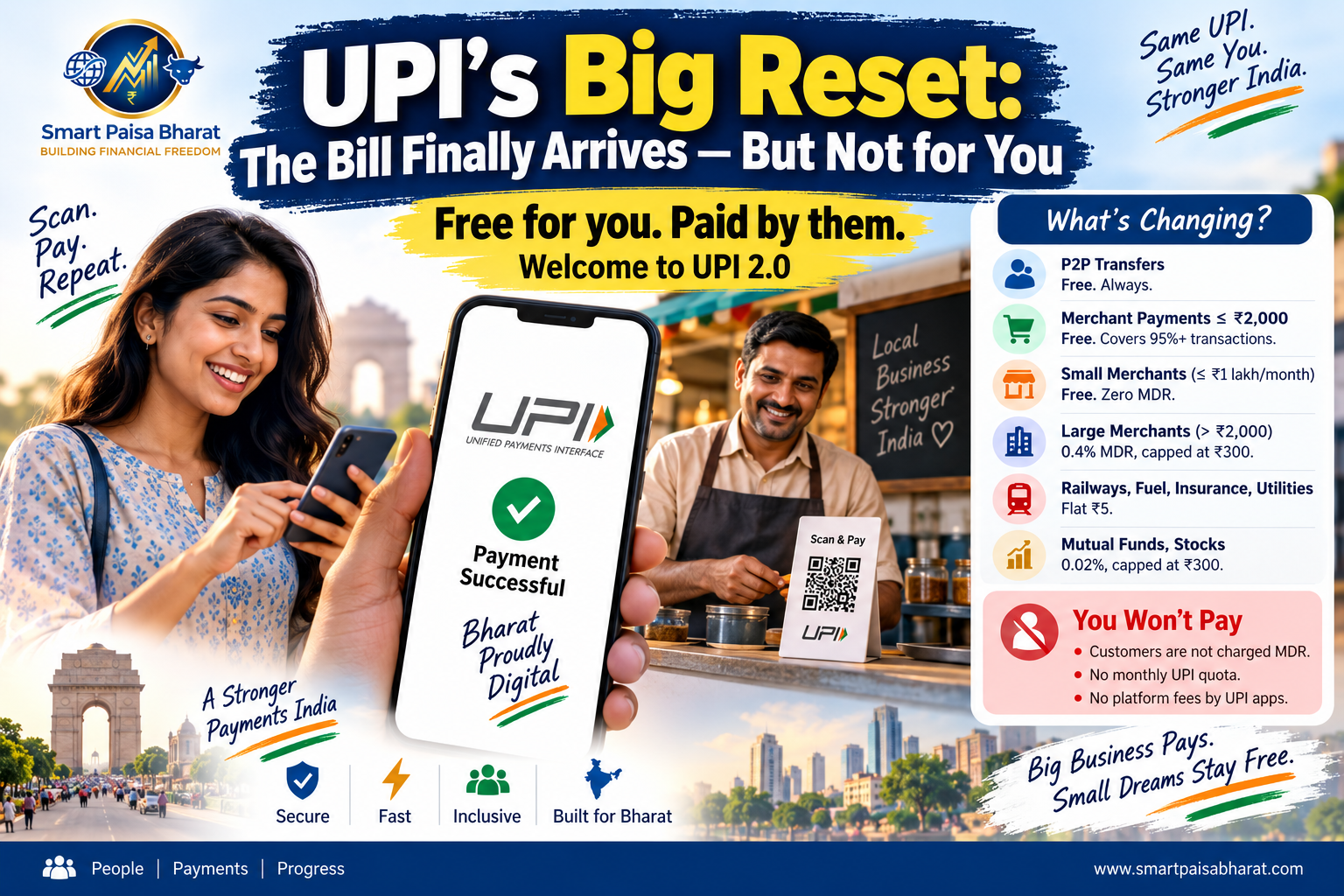
🚀 UPI’s Big Reset: The Bill Finally Arrives — But Not for You
“Free for you. Paid within the merchant ecosystem.”
NPCI’s revised UPI Merchant Discount Rate (MDR) framework will take effect from October 15, 2026. A standard MDR of 0.4% applies to specified Person-to-Merchant (P2M) transactions above ₹2,000, with a maximum MDR of ₹300 for transactions of ₹75,000 and above. Person-to-Person (P2P) UPI transactions remain free.
October 15, 2026 is set to become an important date in India’s digital payments story.
But if you’re a regular UPI user, there is no reason to assume that your everyday UPI payments are suddenly becoming expensive.
The major change is happening on the merchant side. Under the revised framework, specified higher-value Person-to-Merchant (P2M) transactions will attract Merchant Discount Rate (MDR), while Person-to-Person (P2P) payments and a large majority of everyday merchant transactions remain protected.
In simple words:
UPI’s merchant economics are changing. Your everyday UPI experience largely isn’t.
⚡ UPI 2026: The 60-Second Version
- 👤 P2P UPI transfers: Remain completely free, irrespective of the amount transferred.
- 🛒 Merchant payments up to ₹2,000: Remain free of MDR.
- 🏪 Eligible small merchants: Small merchants under the zero-MDR P2PM framework remain protected.
- 💳 Eligible P2M payments above ₹2,000: Standard MDR of 0.4%.
- 🔒 ₹300 cap: Standard MDR is capped at ₹300 for transactions of ₹75,000 and above.
- 🚆 Specified essential sectors: ₹5 flat MDR on eligible transactions above ₹2,000.
- 📈 Specified capital-market transactions: 0.02% MDR, capped at ₹300.
- 💰 Customers: MDR is a merchant-side payment ecosystem charge. Customers are not supposed to be charged MDR.
- 📊 Government estimate: Approximately 96% of P2M transactions will remain unaffected.
⚠️ One Important Clarification
You may see social-media posts describing this as “UPI 2.0”. In this article, that phrase is only an editorial description of UPI’s next phase. The official framework is the revised UPI Merchant Discount Rate (MDR) framework.
💡 Is UPI Really Becoming Paid?
The short answer is: not in the way many headlines suggest.
If you send ₹5,000 to a friend, ₹20,000 to a family member or make another Person-to-Person UPI transfer, the revised merchant MDR framework does not turn that transfer into a consumer-paid UPI fee.
The new MDR structure primarily concerns specified Person-to-Merchant (P2M) transactions, particularly those above ₹2,000.
So the more accurate way to describe the change is:
Selected merchant payments are entering a new pricing framework — not every UPI payment is becoming chargeable.
🧾 What Is MDR?
MDR stands for Merchant Discount Rate.
In simple language, MDR is a payment-processing charge within the merchant payment ecosystem.
It is important not to confuse MDR with:
- GST
- Income Tax
- A government transaction tax
- A universal UPI fee charged to consumers
The government has specifically clarified that MDR is not a tax and is not a charge collected by the Government or NPCI. It is distributed among participants in the payment ecosystem.
🎯 Why ₹2,000 Is the Most Important Number
If you want to understand the new UPI MDR framework quickly, remember one number:
Eligible Person-to-Merchant payments up to ₹2,000 remain zero-MDR.
For specified eligible P2M transactions above ₹2,000, the standard MDR is 0.4%.
But there are important exceptions, including small merchants covered by the zero-MDR framework and certain sectors with separate MDR treatment.
🧮 UPI MDR Examples: How Much Is 0.4%?
The following table illustrates the standard calculation for eligible standard P2M transactions. Sector-specific and zero-MDR categories may have different treatment.
| Transaction | Standard Rate | Illustrative MDR |
|---|---|---|
| ₹1,000 | Protected | ₹0 |
| ₹2,000 | Protected | ₹0 |
| ₹3,000 | 0.4% | ₹12 |
| ₹5,000 | 0.4% | ₹20 |
| ₹10,000 | 0.4% | ₹40 |
| ₹50,000 | 0.4% | ₹200 |
| ₹75,000 | 0.4% | ₹300 |
| ₹1,00,000 | 0.4% | ₹300 cap |
🔒 Why Does the ₹300 Cap Matter?
The standard MDR rate is 0.4%, but the framework also sets a ₹300 maximum cap per transaction.
The cap becomes relevant at ₹75,000 because:
For example, a ₹1 lakh eligible standard P2M transaction would mathematically produce ₹400 at 0.4%, but the applicable MDR is capped at ₹300.
🏪 What About Small Merchants?
This is one of the most important protections in the new framework.
Small merchants receiving up to ₹1 lakh per month through UPI QR under the specified P2PM category continue to receive zero-MDR treatment on their transactions.
This is particularly relevant for India’s:
Neighbourhood businesses remain protected under the applicable zero-MDR framework.
Eligible small vendors remain covered by zero-MDR provisions.
Smaller businesses can continue accepting eligible UPI payments without the standard MDR burden.
🚆 The ₹5 Rule: Special Treatment for Selected Sectors
Not every eligible transaction above ₹2,000 follows the standard 0.4% formula.
Certain essential and thin-margin sectors have a separate ₹5 flat MDR for eligible transactions above ₹2,000.
- 🚆 Railways
- 📱 Telecommunications
- 🛡️ Insurance
- ⛽ Fuel
- 🌾 Agricultural inputs
If an eligible railway transaction is ₹10,000, the applicable sector-specific MDR is ₹5 rather than the standard 0.4% calculation. The customer is not supposed to bear that MDR.
📈 What About Mutual Funds and Stock Market Payments?
Capital-market related payments receive separate treatment under the framework.
Specified payments involving mutual funds, securities, stockbrokers and dealers attract an MDR of 0.02%, subject to a maximum cap of ₹300 per transaction.
| Payment | 0.02% Calculation |
|---|---|
| ₹10,000 | ₹2 |
| ₹1,00,000 | ₹20 |
| ₹10,00,000 | ₹200 |
| ₹15,00,000+ | ₹300 maximum |
👤 What Happens When You Send Money to a Friend?
This is probably the biggest point of confusion surrounding the new UPI framework.
If you send ₹5,000 to a friend, ₹20,000 to a family member or transfer another amount through a normal Person-to-Person UPI transaction, the new MDR framework does not make that transaction chargeable.
The government has also clarified that individuals will continue to have unlimited free UPI usage, with no monthly quota or tiered cap created by this MDR framework.
🛍️ Will Customers Have to Pay the MDR?
No. MDR is not designed as a customer-paid UPI fee.
The Finance Ministry has clarified that customers will not be required to pay MDR when making UPI payments.
Banks have been advised to ensure that merchants do not pass MDR charges on to customers, while UPI application providers are prohibited from imposing platform fees or hidden charges related to UPI usage.
Suppose your restaurant bill is ₹3,500. You authorize a UPI payment of ₹3,500. The applicable MDR is a merchant-side payment ecosystem charge; it is not an additional ₹14 that should automatically be added to your UPI payment.
Consumers should nevertheless distinguish MDR from any separate, legitimately disclosed commercial fee relating to a product or service. Such charges are a different issue from the UPI MDR itself.
📊 The 96% Figure Explained
One of the most important numbers in the new framework is 96%.
According to the Ministry of Finance, MDR is expected to apply to only around 4% of merchant transactions.
That means approximately 96% of P2M transactions are expected to remain unaffected because they are either below the ₹2,000 threshold or covered by the zero-MDR framework for small merchants.
Note: The 96% figure is a government estimate based on the transaction data and categories used for the framework. Actual transaction patterns may change over time.
🧠 Why Is UPI’s Business Model Changing?
UPI has grown from a digital-payment experiment into one of the world’s largest real-time payment ecosystems.
But scale also creates costs.
Behind every simple QR payment are systems for:
- 🔐 Cybersecurity
- 🛡️ Fraud prevention
- 🏦 Bank connectivity
- ⚙️ Payment infrastructure
- 📱 Application support
- 🏪 Merchant onboarding
- 🌐 System reliability
- 🚀 Continuous technology upgrades
The government has described the revised framework as part of an effort to support the long-term sustainability, resilience and continued expansion of the UPI ecosystem.
Can a massive real-time payment network remain affordable for everyday users while creating a sustainable economic model for the infrastructure behind it?
The revised MDR framework is one policy response to that question.
🏦 Is MDR a Government Tax?
No.
MDR is not GST, income tax or a government transaction tax.
It is a payment ecosystem charge associated with eligible merchant transactions. The revenue is distributed among participants in the payment ecosystem, including banks, payment service providers and UPI application providers.
Merchant-side payment ecosystem charge.
Tax applicable to eligible goods and services.
Tax on taxable income under applicable law.
⚠️ What Could Change for Businesses?
While customers are protected from MDR, eligible merchants will need to account for the new payment economics.
Businesses may respond differently depending on:
- Transaction size
- Profit margins
- Monthly UPI volume
- Customer payment preferences
- Competition
- Other payment options available
Some businesses may absorb the cost as an operating expense. Others may review their payment strategy or compare different payment methods.
It would be premature to say that all merchants will increase prices. Actual business responses will depend on individual circumstances and market conditions.
💳 UPI vs Cards: Why the Comparison Matters
The introduction of UPI MDR will naturally lead to comparisons with card-payment economics.
Traditional card payment arrangements can involve merchant discount rates that vary according to the card network, card type, merchant category and applicable rules.
The standard UPI MDR of 0.4% for eligible transactions therefore should not automatically be treated as equivalent to the cost structure of every card payment.
The actual economics depend on the complete payment arrangement, including merchant costs, settlement, rewards, customer behaviour and applicable fees.
🗓️ October 15, 2026: What Actually Changes?
Think of October 15 as a merchant-payment pricing framework change, not as a day when UPI suddenly becomes a paid service for everyone.
- ✔️ P2P UPI transfers remain free.
- ✔️ Eligible merchant payments up to ₹2,000 remain free of MDR.
- ✔️ Eligible small merchants remain under zero-MDR provisions.
- ✔️ Specified P2M transactions above ₹2,000 attract MDR.
- ✔️ Standard MDR is 0.4%.
- ✔️ Standard MDR is capped at ₹300 per transaction.
📱 What Should Normal UPI Users Do?
For most people, the answer is simple: continue using UPI normally.
- ✔️ Send money to friends and family.
- ✔️ Make eligible low-value merchant payments.
- ✔️ Scan QR codes as usual.
- ✔️ Use your preferred UPI application.
- ✔️ Don’t assume that a ₹2,000+ payment means you personally have to add an MDR amount.
The key change is primarily on the merchant-side economics, not the basic consumer UPI experience.
🔮 What Should We Watch After October 15?
1️⃣ Merchant Behaviour
Will large merchants absorb the MDR or change their payment strategy?
2️⃣ Consumer Experience
Will customers continue to experience a simple and frictionless UPI checkout?
3️⃣ Payment Mix
Will higher-value transactions move between UPI, cards, bank transfers and other payment methods?
4️⃣ Small-Merchant Adoption
Will zero-MDR protection encourage more small businesses to continue accepting digital payments?
5️⃣ UPI Economics
Can UPI create a sustainable economic model while maintaining the affordability that made it popular?
🚨 Don’t Fall for “UPI Is No Longer Free”
The statement “UPI is no longer free” is too broad.
A more accurate description is:
Selected higher-value merchant UPI transactions are entering an MDR framework, while most everyday UPI transactions remain unaffected.
🧩 The Bottom Line
So, will you pay more for your everyday UPI?
Under the new framework, customers are not supposed to pay MDR.
The major change is on the merchant side and applies to specified higher-value commercial transactions.
- ₹0 MDR for protected low-value merchant payments
- 0.4% standard MDR for eligible P2M transactions above ₹2,000
- ₹300 maximum standard MDR per transaction
- ₹5 flat MDR for specified essential sectors
- 0.02% MDR for specified capital-market transactions
- ₹0 MDR for P2P UPI transfers
The government estimates that approximately 96% of P2M transactions will remain unaffected.
🚀 Final Thought: UPI Is Entering Its Next Phase
UPI’s biggest achievement has been making digital payments feel almost invisible.
Scan a QR code. Enter your PIN. Payment complete.
But behind those few seconds is a massive technology and banking infrastructure that requires continuous investment in security, reliability, fraud prevention and innovation.
The revised MDR framework represents an attempt to create a more sustainable economic model while protecting everyday users and smaller merchants.
Whether the framework produces the intended results will become clearer through actual transaction data, merchant behaviour and payment trends after implementation.
The QR Code Isn’t Getting Expensive.
The economics behind the QR code are changing.
“Free for you. Paid within the merchant ecosystem.”
❓ Frequently Asked Questions About UPI Charges 2026
Will UPI become chargeable for normal users from October 15, 2026?
No blanket consumer UPI fee is being introduced. P2P transactions remain free and eligible low-value merchant payments remain protected under the new framework.
What is the new UPI MDR rate?
The standard MDR for specified eligible P2M transactions above ₹2,000 is 0.4%, subject to a ₹300 maximum cap per transaction.
Is UPI MDR a tax?
No. MDR is a payment ecosystem charge associated with eligible merchant transactions. It is not a government transaction tax.
What happens to UPI payments below ₹2,000?
Eligible Person-to-Merchant payments up to ₹2,000 remain free of MDR.
Will small shops have to pay MDR?
Eligible small merchants receiving up to ₹1 lakh per month through UPI QR under the specified P2PM category continue to receive zero-MDR treatment.
What is the ₹300 UPI MDR cap?
For eligible standard P2M transactions, MDR is capped at ₹300 per transaction. The cap becomes relevant from ₹75,000, because 0.4% of ₹75,000 equals ₹300.
Are P2P UPI transfers affected?
No. Person-to-Person UPI transactions remain completely free, irrespective of the amount transferred.
Will customers have to pay the 0.4% MDR?
No. MDR is a merchant-side payment ecosystem charge. The government has advised banks to ensure merchants do not pass MDR on to customers.
What is the UPI MDR for specified stock-market transactions?
Specified payments involving mutual funds, securities, stockbrokers and dealers attract an MDR of 0.02%, capped at ₹300 per transaction.
Which sectors have the ₹5 flat MDR?
Specified essential and thin-margin sectors including railways, telecommunications, insurance, fuel and agricultural inputs have a ₹5 flat MDR for eligible transactions above ₹2,000.
Does the new MDR framework create a monthly UPI limit for users?
No. The framework does not create a monthly quota, volume restriction or tiered cap on free UPI usage for individuals. Separate daily transaction limits set by banks or NPCI are security and risk-management measures, not MDR charges.
📌 UPI MDR 2026: Quick Recap
| Effective date | October 15, 2026 |
| Standard MDR | 0.4% on specified eligible P2M transactions above ₹2,000 |
| MDR cap | ₹300 per transaction |
| Cap threshold | ₹75,000 and above |
| P2P UPI | Free |
| Merchant payments up to ₹2,000 | Zero MDR |
| Specified essential sectors | ₹5 flat MDR above ₹2,000 |
| Specified capital-market payments | 0.02%, capped at ₹300 |
📌 Smart Paisa Bharat — Disclaimer
This article is provided for general informational and educational purposes only. UPI, MDR rates, exemptions, merchant classifications and implementation requirements may change through official notifications, NPCI directions or regulatory updates.
Readers should verify the latest applicable rules from official sources before making financial or business decisions. Smart Paisa Bharat does not provide investment, tax or financial advice.
📚 Sources & Further Reading
- Ministry of Finance / Press Information Bureau — UPI MDR framework and consumer clarification, September 15, 2026.
- National Payments Corporation of India (NPCI) — Revised UPI MDR framework and FAQs, September 15, 2026.
- Indian Express — Reporting on UPI MDR, ₹2,000 threshold and ₹300 cap.
- Moneycontrol — Analysis of UPI MDR framework and payment economics.
- Reuters / Indian business reporting — Coverage of the revised UPI merchant-payment framework.