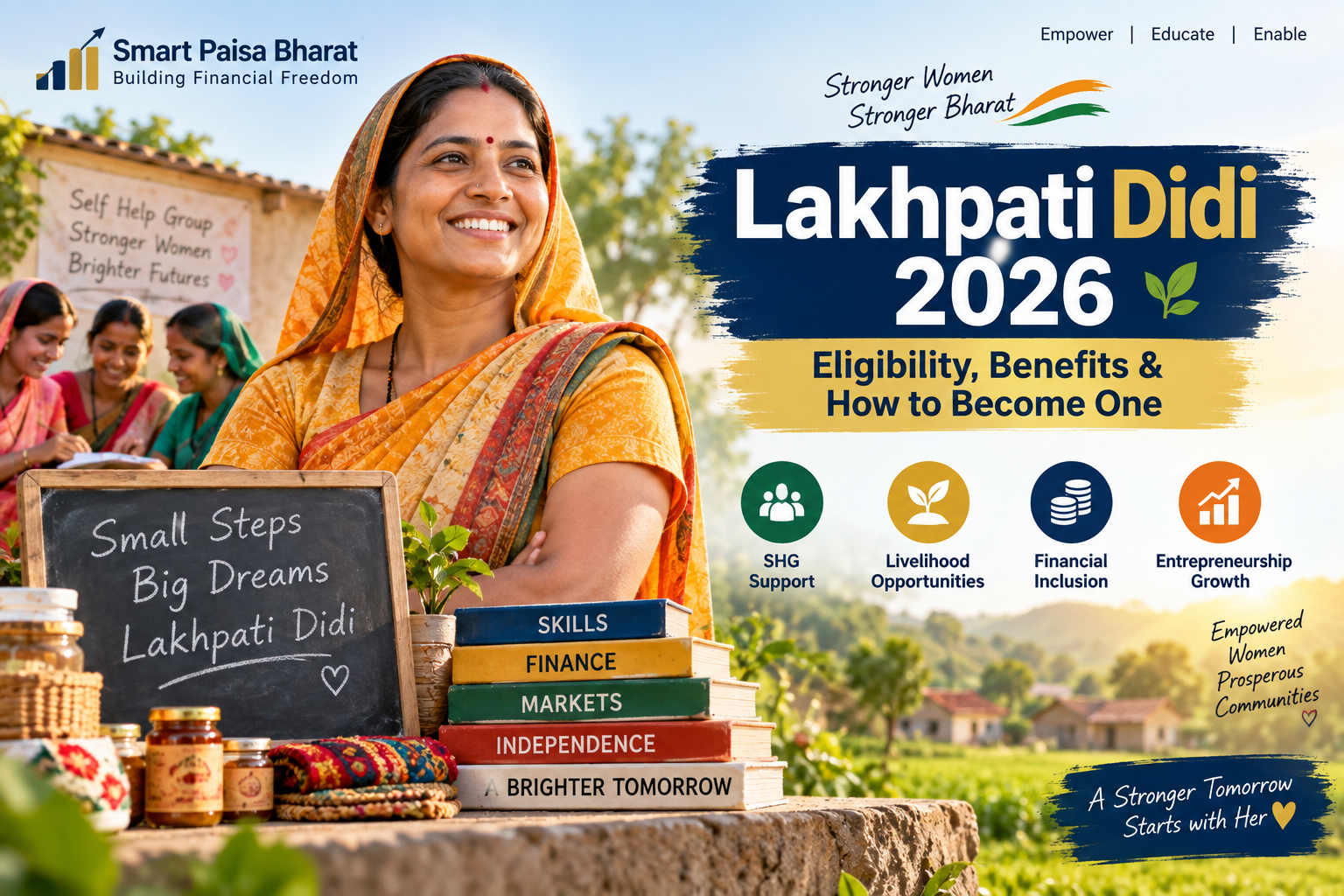
Lakhpati Didi 2026: How Rural Women Can Build Sustainable Income
Lakhpati Didi 2026: Eligibility, Benefits, SHG Support & How It Works
For many women in rural India, earning a regular income is not simply about having a job. It can mean having the confidence to start a small business, contribute more to the household, manage money independently and create better opportunities for the family.
This is where the Lakhpati Didi initiative has received growing attention.
The initiative focuses on helping women associated with Self-Help Groups (SHGs) build sustainable livelihoods and reach an annual household income of at least ₹1 lakh. It is implemented through the wider Deendayal Antyodaya Yojana–National Rural Livelihoods Mission (DAY-NRLM). 2
The story has also moved beyond the original three-crore target. The government reported that the three-crore target was achieved by December 2025 and has now been working toward a six-crore Lakhpati Didi target. 3
Last updated: September 2026
What Is Lakhpati Didi?
Lakhpati Didi is not simply a scheme where every woman receives ₹1 lakh directly from the government.
Instead, it is an initiative connected with the SHG ecosystem under DAY-NRLM that aims to help eligible rural women build sustainable sources of income.
According to the official Lakhpati Didi portal, a Lakhpati Didi is an SHG member whose annual household income is ₹1 lakh or more, with the income sustained over at least four agricultural seasons and/or business cycles. The benchmark also uses an average monthly income of more than ₹10,000. 4
The ₹1 lakh figure should not be understood as a one-time cash payment. The initiative is about creating sustainable household income through livelihood activities, entrepreneurship, skills, finance, market connections and other forms of support.
Why Has Lakhpati Didi Become Important in 2026?
The initiative has moved into a new phase.
The government said in June 2026 that the original target of creating three crore Lakhpati Didis had been achieved by December 2025. The next focus is on expanding the initiative toward six crore Lakhpati Didis. 5
That shift also means that the conversation is becoming broader than simply helping women increase income.
The current focus includes entrepreneurship, better access to finance, skills, markets, technology, value chains and stronger support for women-led enterprises.
In September 2026, the Ministry of Rural Development also discussed stronger SHG-bank linkages, individual enterprise financing and improved access to credit as part of the wider financial-inclusion effort. 6
Who Can Become a Lakhpati Didi?
The initiative is primarily connected with women who are members of Self-Help Groups under the rural livelihoods ecosystem.
However, becoming a Lakhpati Didi is not simply a matter of filling out a form and receiving ₹1 lakh.
The central idea is to help an eligible SHG member build a sustainable livelihood that can take the household income above the required benchmark.
The official implementation framework includes identifying potential Lakhpati Didis, providing training and capacity building, developing livelihood plans and connecting women with relevant government programmes, markets and other stakeholders. 7
What Does ₹1 Lakh Annual Income Actually Mean?
This is one of the most misunderstood parts of the initiative.
Suppose a household earns income through a combination of farming, livestock, a small shop, food processing, tailoring or another livelihood activity.
The objective is not necessarily for one woman to receive ₹1 lakh as a grant.
Instead, the household should build income that meets the programme’s sustainability criteria.
If a rural household develops two or three complementary livelihood activities and the combined household income becomes sustainable enough to meet the Lakhpati Didi benchmark, the woman can potentially be recognised within the initiative’s framework.
The actual income calculation and verification should follow the applicable official programme process rather than an informal calculation made from social-media claims.
What Support Can SHG Women Receive?
The support is not limited to one type of financial assistance.
DAY-NRLM and related programmes use a combination of livelihood support, capacity building, financial inclusion, enterprise development and market linkages.
Some important areas include:
- Skill and capacity development
- Livelihood planning
- Access to SHG-based financial support
- Enterprise development
- Training and handholding
- Market connections
- Product and service development
- Technology and business support
- Financial literacy
- Linkages with relevant government programmes
The official Lakhpati Didi framework specifically describes training, livelihood models, household livelihood planning, product and service clusters, value-chain interventions and stakeholder linkages as part of the approach. 8
Can Lakhpati Didi Help Women Start a Business?
Yes, entrepreneurship is an important part of the broader approach.
One example is the Start-up Village Entrepreneurship Programme (SVEP), a sub-scheme under DAY-NRLM that supports SHGs and their family members in setting up small enterprises in the non-farm sector.
Government information says SVEP can include training, handholding, enterprise support, access to a Community Enterprise Fund and business mentorship. 9
This can be particularly relevant for women who want to move from a small livelihood activity toward a more organised enterprise.
What Types of Work Can Help Increase Income?
There is no single business model that works for every village or every household.
The right livelihood depends on local demand, skills, available resources, market access and the ability to operate the activity sustainably.
Possible areas can include:
- Agriculture and allied activities
- Dairy and livestock
- Food processing
- Tailoring and garment-related work
- Handicrafts and traditional products
- Small retail businesses
- Local service businesses
- Nursery and horticulture activities
- Non-farm enterprises
- Other locally viable women-led businesses
The important word is viable. Starting a business simply because someone says it is profitable does not guarantee income.
How Does the Lakhpati Didi Process Work?
The journey can vary depending on the woman, SHG, livelihood and local implementation structure. However, the official framework describes several important stages.
- Identification: Potential SHG members are identified.
- Training: Women can receive capacity building and exposure to suitable livelihood models.
- Livelihood planning: A plan can be prepared around the household’s existing and potential income sources.
- Enterprise and value-chain support: Product or service opportunities and market linkages can be developed.
- Financial linkage: Eligible SHGs and members can be connected with appropriate financial resources.
- Handholding: Community Resource Persons and other support structures can help with implementation.
- Income tracking: Livelihood and income information can be periodically recorded under the programme framework.
These steps are designed to make the income improvement sustainable rather than treating ₹1 lakh as a one-time milestone. 10
How Does SHG Finance Fit Into the Picture?
Self-Help Groups are central to the DAY-NRLM model.
Government information says SHGs can receive financial support through instruments such as Revolving Fund (RF) and Community Investment Fund (CIF). These mechanisms can help SHGs create a financial base from which members can access funds for appropriate purposes. 11
There is also a strong emphasis on SHG-bank linkage and access to formal credit.
Financial assistance is not the same as free money. Loan-related products can involve repayment obligations, eligibility requirements, documentation and other conditions. Always understand the terms before borrowing.
New Focus: Better Markets for Women-Led Businesses
Increasing production is only one side of the business equation.
A woman may make excellent food products, handicrafts or agricultural goods, but without customers and reliable market access, increasing production may not increase income.
This is why market access has become an increasingly important part of the Lakhpati Didi strategy.
In June 2026, the Ministry of Rural Development discussed measures including enterprise promotion, marketing, capacity building, ONDC partnerships and financial inclusion. The government also discussed plans involving SHE-MARTs and district fulfilment centres as part of the wider effort to strengthen market access for women-led enterprises. 12
What Are SHE-MARTs?
SHE-MARTs are part of the newer market-access discussion around the SHG ecosystem.
Government information describes them as planned dedicated retail spaces for women under the SHG ecosystem, intended to help women-led groups sell products more directly to consumers and reduce dependence on intermediaries. 13
For women entrepreneurs, this reflects an important shift: earning more is not only about producing something. It is also about finding customers, improving product quality, managing costs and building a repeat market.
Is Lakhpati Didi a ₹1 Lakh Free Money Scheme?
No.
This is perhaps the most important point to remember.
The name can easily create the impression that eligible women simply receive ₹1 lakh in cash.
That is not what the initiative’s official definition says.
The ₹1 lakh figure refers to the sustainable annual household income benchmark used for identifying a Lakhpati Didi. 14
Support can involve skills, livelihood planning, financial inclusion, enterprise development and market linkages rather than a universal ₹1 lakh cash transfer.
Lakhpati Didi vs a Direct Cash Scheme
| Point | Lakhpati Didi Initiative | Direct Cash Scheme |
|---|---|---|
| Main idea | Build sustainable household income | Provide a specified financial transfer |
| ₹1 lakh meaning | Annual income benchmark | Would depend on the specific scheme |
| Business support | Important part of the livelihood approach | Depends on the particular programme |
| SHG connection | Central to the initiative | Depends on the scheme |
| Market access | Increasingly important | Depends on the scheme |
What Is the 2026 Target?
The Lakhpati Didi initiative has entered a larger expansion phase.
After the government reported achieving the original three-crore target by December 2025, the stated ambition moved toward six crore Lakhpati Didis. 15
The official Lakhpati Didi portal is also showing workshops and programmes in 2026 focused on farm and non-farm livelihoods, rural enterprise clusters, entrepreneurship and the roadmap toward six crore Lakhpati Didis. 16
This makes the topic particularly relevant for readers interested in rural entrepreneurship, women’s financial inclusion and government livelihood programmes.
How Can a Woman Find Out More?
If you or someone in your family is interested in the initiative, the first practical step is to understand the local SHG and DAY-NRLM structure.
Instead of paying an agent for a supposed “Lakhpati Didi registration,” ask about the official Self-Help Group and rural livelihood support channels available in your area.
The official Lakhpati Didi website provides information about the initiative, eligibility concept, implementation approach and updates.
A social-media post saying “Pay ₹500 and get ₹1 lakh under Lakhpati Didi” should be treated with extreme caution. Verify any application, payment or document requirement through an official government channel before sharing personal information or money.
Frequently Asked Questions
Lakhpati Didi is an initiative connected with DAY-NRLM that aims to help SHG women build sustainable household incomes of at least ₹1 lakh annually.
The initiative is an outcome of the Deendayal Antyodaya Yojana–National Rural Livelihoods Mission (DAY-NRLM), rather than simply a universal ₹1 lakh cash scheme. 17
No. The ₹1 lakh figure refers to the sustainable annual household income benchmark used by the initiative. 18
The initiative focuses on women who are members of Self-Help Groups within the rural livelihoods framework. The programme works to identify potential members and support them in developing sustainable livelihood activities.
The official definition uses annual household income of ₹1 lakh or more, with sustainability measured over at least four agricultural seasons and/or business cycles and an average monthly income above ₹10,000. 19
The government has stated an ambition to move from the original three-crore target toward six crore Lakhpati Didis. 20
Yes. Entrepreneurship, training, livelihood planning, finance and market linkages are important parts of the wider DAY-NRLM and Lakhpati Didi approach. 21
Use the official Lakhpati Didi portal and Ministry of Rural Development or PIB sources for current programme information instead of relying on social-media claims.
Final Thoughts
The most interesting part of the Lakhpati Didi initiative is not simply the number ₹1 lakh.
The bigger idea is helping women move from small or irregular livelihood activities toward income that is more sustainable, organised and connected to real markets.
That can involve farming, livestock, food processing, services, retail, handicrafts, small enterprises or other activities that make sense for a particular community.
The 2026 direction also shows a stronger focus on entrepreneurship, finance and market access as the programme moves toward the six-crore target.
For readers, the key takeaway is simple: Lakhpati Didi is about building sustainable income, not receiving a guaranteed ₹1 lakh payment.
Lakhpati Didi 2026: Quick Facts
- Target group: Women associated with Self-Help Groups
- Income benchmark: ₹1 lakh or more annual household income
- Sustainability: At least four agricultural seasons and/or business cycles
- Average monthly benchmark: More than ₹10,000
- Framework: DAY-NRLM
- Original target: 3 crore Lakhpati Didis
- Reported milestone: 3 crore target achieved by December 2025
- Current stated target: 6 crore Lakhpati Didis
- Focus areas: Livelihoods, entrepreneurship, finance, skills and markets
- Important: ₹1
Similar Posts
“Digital Rupee Explained: How India’s e₹ is Transforming Money, Banking, and the Future of Payments”
💰 India’s Digital Rupee: The Bold Leap Towards a New Monetary Era India is no stranger to transformation—but the latest disruptor isn’t a startup or a new tax law. It’s a revolution minted by the Reserve Bank of India: the Digital Rupee (e₹). As cash usage fades and digital convenience takes over, India is…
5 Realistic Ways to Use AI to Earn Money Online in 2026
MONEY & CAREER • AI • ONLINE WORK
“Solar Goldmine: Build a Future-Proof Business with Low Investment in 2025”
🌞 Solar Business in India: A Future-Ready Opportunity for Aspiring Entrepreneurs Meta Description: Discover how to start a solar business in India, the minimum investment required, potential earnings, and why it’s one of the most promising long-term opportunities for individuals in 2025 and beyond. 📝 Table of Contents Introduction: The Bright Future of Solar Why…
“How to Earn Money as an AI Operator in 2025: The Ultimate Guide to Renting Your AI Skills”
Monetize Your AI Expertise: The Ultimate Playbook for Becoming an AI Operator in 2025 Introduction: Welcome to the AI Utility Economy We’re entering an era where AI isn’t just a tool—it’s an on-demand service economy. Forget about the $250K hardware investments or wrangling PhD-level data science teams. The new frontier is AI Expertise on Tap,…
“VFX Career in 2025: Skills, Salary, Courses & Scope in India”
🎯 VFX Career Guide 2025: From Beginner to ₹1 Crore Studio Owner 🎨 1. What is VFX? | वीएफएक्स क्या है? VFX (Visual Effects) involves digitally creating or manipulating imagery that cannot be captured in live action. It blends CGI (Computer-Generated Imagery), compositing, motion capture, simulations (fire/water), and matte painting to create impossible worlds—like superheroes…
Amazon Affiliate Program से Zero Investment में Online Paise Kaise Kamaye? | पूरी हिंदी गाइड 2025″
शून्य निवेश, अधिक कमाई! अपने मोबाइल से शुरू करें Amazon Associate बिजनेस – पूरी गाइड (गाँव या शहर, हर कोई कर सकता है) आज का ज़माना डिजिटल सोने की खान है! क्या आप जानते हैं कि बिना एक रुपया लगाए, बिना कोई स्टॉक रखे, और घर बैठे आप एक सफल ऑनलाइन बिजनेस शुरू कर सकते…