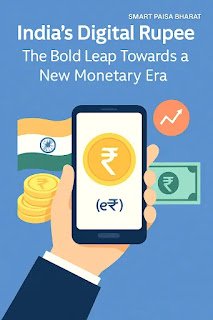
“Digital Rupee Explained: How India’s e₹ is Transforming Money, Banking, and the Future of Payments”

💰 India’s Digital Rupee: The Bold Leap Towards a New Monetary Era
India is no stranger to transformation—but the latest disruptor isn’t a startup or a new tax law. It’s a revolution minted by the Reserve Bank of India: the Digital Rupee (e₹).
As cash usage fades and digital convenience takes over, India is testing a bold hypothesis—can sovereign digital currency redefine how a nation of 1.4 billion transacts, saves, and trusts its money? Let’s explore the answer.
🧠 The Digital Rupee Decoded: More Than Just “Digital Cash”
The e₹, or Central Bank Digital Currency (CBDC), is India’s official digital legal tender—a virtual version of your ₹10, ₹100, or ₹500 note, directly issued by the RBI.
This isn’t crypto hype. It’s a stable, government-guaranteed medium of exchange with features that place it between physical currency and digital payments.
✅ Key Takeaways:
- Issued by RBI → Not mined, not volatile.
- Stable value → 1 e₹ = ₹1 always.
- No interest → Like coins or cash, it holds value, not grows it.
🔍 How Does e₹ Compare?
| Feature | UPI (Digital Rail) | Crypto (Digital Asset) | Digital Rupee (e₹) |
|---|---|---|---|
| Ownership | Bank-managed | Decentralized | RBI-backed |
| Trust Source | Banks & Apps | Code/Community | Indian Government |
| Price Volatility | None | Extreme | None |
| Offline Capability | No | No | Yes (being rolled out) |
🛤️ India’s e₹ Journey: From Experimental to Transformational
📆 Key Milestones
- Nov 2022: Launch of e₹-Wholesale (e₹-W) for financial institutions.
- Dec 2022: e₹-Retail (e₹-R) pilot begins for consumer use in 5 cities.
- 2024-25: User base expands to 5M+, more than 16 banks onboarded, and welfare schemes start using e₹ for direct benefit transfers.
📈 Growth Pulse
| CBDC Segment | FY 2022–23 | FY 2023–24 | Growth Trend |
|---|---|---|---|
| e₹ Retail | ₹57 million | ₹2.34 billion | Explosive user adoption 🚀 |
| e₹ Wholesale | ₹109 million | ₹0.8 million | Slump due to legacy systems |
Retail adoption is skyrocketing, while wholesale remains niche due to mature alternatives.
🌟 Why India is Betting Big on the Digital Rupee
1. Slash Spending on Physical Cash
Printing and managing currency cost India ₹4,984 crore in 2021–22. The e₹ wipes out:
- Printing presses
- Currency vans
- Note replacements
📉 Up to 80% savings in national currency logistics.
2. Bring the Unbanked Into the Fold
With nearly half the country still outside full financial inclusion, e₹ can offer:
- No-account-needed digital payments
- Offline functionality for remote villages
- Integration with basic feature phones
3. Eliminate the Shadow Economy
Each e₹ transaction leaves a digital footprint, helping reduce:
- Black money circulation
- Fake currency infiltration
- Under-the-table dealings
4. Turbocharge Global Transfers
Traditional cross-border transfers are slow and expensive. With e₹:
- Transfers are instant
- Fees are minimal
- Settlements with countries like UAE & Hong Kong already tested
🌍 $22M+ settled in cross-border pilots in 6 weeks.
5. Programmable Currency for Smart Governance
e₹ is not just digital—it’s programmable. That means:
- Subsidies can be restricted to specific use cases
- Farm loans can be pre-coded for seeds, not smartphones
- Government funds go where they’re meant to go
This could be the biggest game-changer in public finance.
🧱 The Big Barriers: Not Just Tech—But Trust
❗ Privacy Trade-offs
The RBI promises privacy for small-value e₹ use. But the digital trail remains—raising concerns about surveillance.
⚠️ Cyber Attacks Are Real
As with any digital system, e₹ must fend off:
- Data breaches
- Wallet hacks
- Infrastructure tampering
Robust encryption is in place, but the system’s only as strong as its weakest link.
😕 UPI’s Popularity
UPI is already a habit for millions—fast, free, and widely accepted. So why bother switching?
Because:
- UPI needs internet and bank support
- e₹ works offline
- e₹ reduces dependence on banking intermediaries
Still, breaking UPI’s dominance will take time.
🏦 Will Banks Feel the Burn?
If users shift from bank deposits to e₹ wallets:
- Lending capacity may shrink
- Liquidity may tighten
- Banking profits may take a hit
The RBI plans a gradual rollout to manage these risks.
🌐 Infrastructure Gaps Persist
Digital Rupee adoption in villages demands:
- NFC or Bluetooth for offline payments
- Rural device access
- Literacy around wallets and PINs
RBI is running limited trials, but mass rollout needs serious support.
🌎 India in the Global CBDC Game
| Country | Status | Innovation Edge |
|---|---|---|
| India | Active pilot | Offline use + programmability |
| China | Advanced testing | e-CNY used in retail, Olympics |
| Bahamas | Live | First nation to fully launch CBDC |
| Nigeria | Live | Struggles with trust, low use |
🪙 India is positioned uniquely—with the scale, tech infrastructure, and global partnerships to lead the next wave of digital currency innovation.
📍 What’s Ahead: From Pilot to Daily Reality
🔄 Interoperability:
- Linking e₹ with UPI, RuPay, Visa, and wallets.
📡 Offline Payment Rollout:
- Nationwide NFC and QR-based transactions via mobile.
📊 Real-Time Economic Tuning:
- Using e₹ data for smarter inflation control, rate setting, and policy direction.
🎯 The endgame? A frictionless, trusted, sovereign digital economy.
🧠 Final Word: The Future Isn’t Cashless—It’s Choice-Based
The e₹ isn’t about deleting cash. It’s about giving India a stronger, smarter alternative—with efficiency, transparency, and inclusion at its core.
💡 Lasting Thought:
“CBDC success won’t be measured in download numbers—but in how seamlessly it fits into India’s everyday life.”
❓ FAQs — Your Top Digital Rupee Questions Answered
🔹 Is the Digital Rupee the same as UPI?
No. UPI is a payment platform that moves money from your bank. e₹ is money itself, issued and held digitally.
🔹 Can I use e₹ without a bank account?
Yes! The Digital Rupee is being designed to work independently of banks, especially for those in unbanked regions.
🔹 Will e₹ transactions be anonymous?
Low-value transactions will have cash-like privacy, but large ones will be trackable for legal and regulatory reasons.
🔹 Is it safe from hacking?
RBI has implemented advanced security protocols, but as with any tech, user education and system updates are key.
🔹 Where can I get the Digital Rupee?
Participating banks are offering e₹ wallets via mobile apps. More banks and cities are being added in phases.
⚠️ Smart Paisa Bharat Disclaimer – Read Before You Dive In!
This content is a knowledge-first financial explainer, crafted to simplify complex ideas around India’s Digital Rupee (CBDC). While we break down economic trends, digital currency tools, and tech-driven payment insights, please note:
- 📌 We don’t offer financial prescriptions, crypto recommendations, or investment shortcuts.
- 📌 Our views are independent and for awareness purposes only—not endorsed by RBI or any bank.
- 📌 Policy shifts and digital frameworks evolve rapidly—always verify with official channels before acting on this information.
- 📌 Smart Paisa Bharat is a platform for financial literacy, not liability—you hold the power and responsibility for your money choices.
Stay smart. Stay secure. Stay informed.