India’s 3-Hour Deepfake Rule 2026: AI Content Rules Explained
Artificial intelligence can now create convincing images, voices and videos in minutes. That technology has opened new possibilities for creativity and communication, but it has also made deceptive digital content much easier to produce and distribute.
In response to these challenges, India strengthened its digital intermediary rules in 2026 with new provisions dealing with synthetically generated information (SGI), including certain deepfakes and AI-generated content.
Quick takeaway: The often-mentioned “3-hour deepfake rule” does not mean that every AI-generated image or video must automatically be deleted within three hours. The three-hour removal timeline applies to unlawful information after the applicable court order or reasoned government/agency intimation described in the rules.
What Changed in India’s AI Content Rules in 2026?
On 10 February 2026, India amended the Information Technology (Intermediary Guidelines and Digital Media Ethics Code) Rules, 2021 to strengthen safeguards relating to synthetically generated information.
The changes recognise that modern AI systems can generate or alter realistic digital material at a scale that was difficult to achieve with traditional editing tools.
The updated framework therefore places additional responsibilities on intermediaries and platforms that enable users to create, upload, publish, share or distribute synthetic information.
What Does “Synthetically Generated Information” Mean?
The term is broader than the commonly used word deepfake.
In simple terms, synthetic information can involve digital material that has been created, generated, modified or altered using computer resources.
Examples can include:
- AI-generated videos
- AI-generated images
- Artificially generated or cloned voices
- Digitally manipulated photographs
- Altered audio recordings
- AI-generated representations of people or events
However, an important distinction remains: AI-generated content is not automatically illegal. The legal consequences depend on the nature of the material and whether it falls within prohibited or unlawful categories.
What Is India’s 3-Hour Deepfake Rule?
This is the part of the new framework that has received significant public attention.
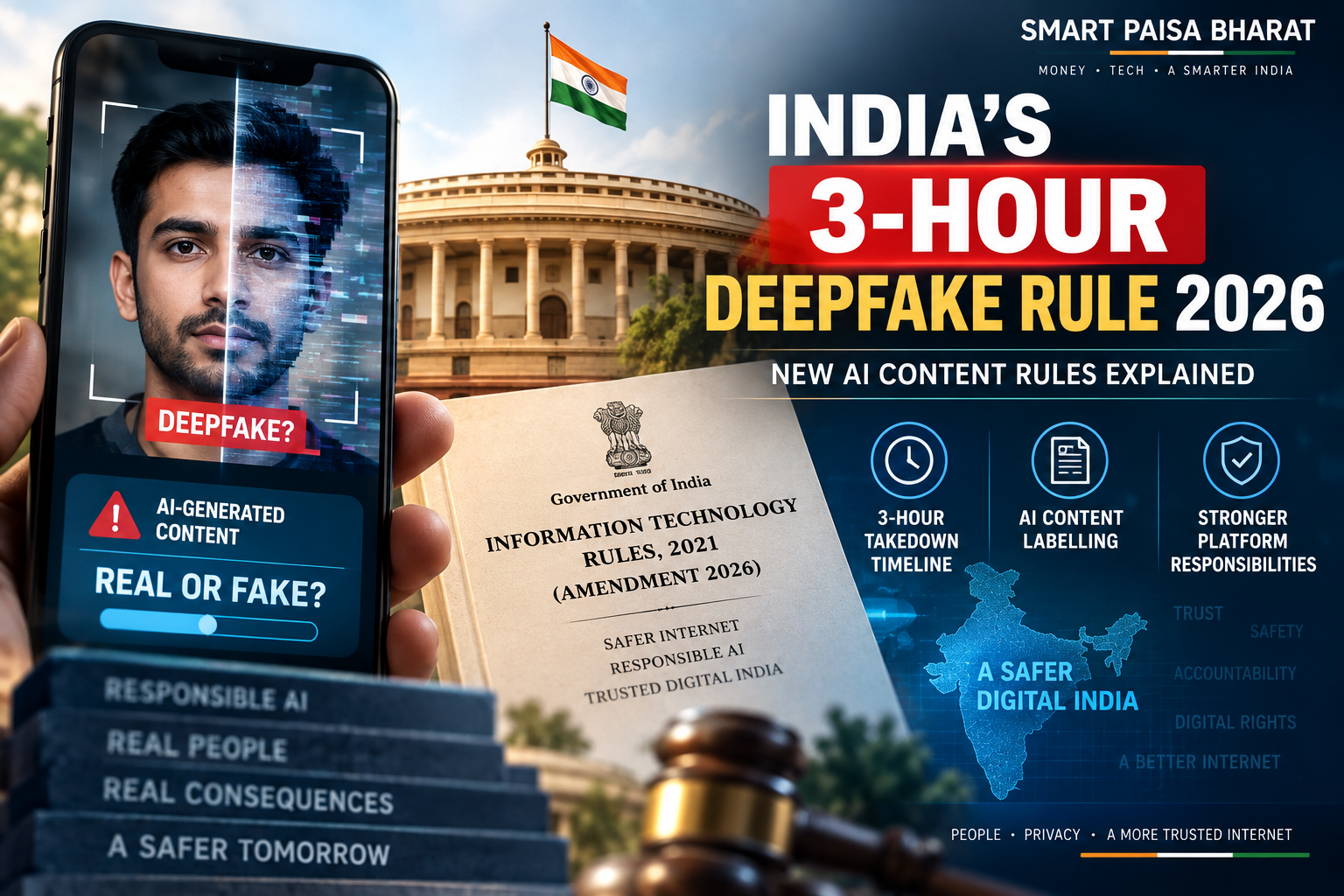
Under the amended framework, intermediaries and social-media platforms are required to remove or disable access to unlawful information within three hours after receiving a valid order from a competent court or a reasoned intimation from the appropriate government or its authorised agency.
This represents a significant reduction from the earlier timeline applicable to the relevant removal process.
Important clarification
The three-hour timeline should not be interpreted as a universal rule that every AI-generated video, image or voice must disappear within three hours. The legal trigger and the nature of the unlawful information matter.
Why Are Deepfakes a Serious Digital-Safety Issue?
A convincing manipulated video can make a person appear to say something they never said or make an event appear to have happened when it did not.
The problem becomes more difficult when such material is shared rapidly across several platforms before viewers have time to verify its authenticity.
Deepfake technology can also be misused for impersonation, fraud, harassment, privacy violations and other unlawful activities.
At the same time, synthetic media has legitimate uses in education, entertainment, accessibility, advertising, research and creative production. The important issue is therefore not simply whether AI was used, but how the resulting content is created, presented and used.
What Types of AI Content Can Fall Under the Rules?
The amended framework addresses several categories of unlawful synthetic information.
Depending on the circumstances, this can include synthetic material that:
- Contains child sexual exploitation or abuse material.
- Contains non-consensual intimate imagery.
- Is obscene, pornographic or sexually explicit where prohibited by law.
- Invades another person’s privacy.
- Creates or alters false documents or electronic records.
- Falsely portrays a natural person or real-world event in a deceptive manner.
- Violates another applicable law.
The exact legal position depends on the content, circumstances and applicable legislation. Readers should not treat every AI-generated image or video as falling into the same legal category.
AI Labels and Content Transparency
One of the notable elements of the updated framework is greater emphasis on transparency around synthetic content.
Covered synthetic information that is not prohibited is subject to prominent disclosure requirements so users can identify that it has been created, generated, modified or altered using computer resources.
The rules also provide for permanent metadata or other appropriate technical provenance mechanisms, where technically feasible, to help identify the computer resource used to create or modify the content.
The goal is straightforward: make it easier for people to distinguish synthetic material from ordinary recordings and reduce the possibility of deceptive presentation.
What Do the New Rules Mean for Social Media Platforms?
Online intermediaries now face stronger due-diligence responsibilities when their services enable users to create or distribute synthetic information.
The amended rules require reasonable and appropriate technical measures to prevent unlawful synthetic information from being created or disseminated through covered services.
Platforms also have responsibilities relating to labelling, metadata, user awareness, complaints and timely action.
In practice, this means content moderation increasingly has to combine technology, human review and legal procedures rather than relying on a simple automated “delete” decision.
What Does This Mean for Everyday Internet Users?
For ordinary users, the most useful lesson is simple: do not assume that realistic-looking content is automatically genuine.
AI systems can reproduce faces, voices, backgrounds and visual styles with increasing realism.
Before sharing a suspicious video, check these six things:
- Who published the original content?
- Is the source credible and identifiable?
- Can the event be confirmed through independent sources?
- Does the audio, lip movement or visual detail appear unusual?
- Is there an AI-generated or synthetic-content disclosure?
- Could the material have been edited or taken out of context?
A short verification step can prevent misleading content from spreading much further.
Are All AI-Generated Images and Videos Illegal?
No.
AI can be used to create fictional artwork, educational illustrations, entertainment, product concepts, animations and many other forms of legitimate content.
The amended framework distinguishes between permissible synthetic information and synthetic information that violates applicable law.
For creators, the safest approach is transparency. Avoid presenting fictional or manipulated material as an authentic recording of a real person or event when that presentation could deceive people or violate someone’s rights.
Deepfakes, Privacy and Personal Reputation
A manipulated image or video involving a real person can cause harm even if it remains online for a relatively short time.
The risks can include impersonation, harassment, reputational damage, privacy violations and financial fraud.
The challenge becomes greater when synthetic media is copied and reposted across different services.
This is one reason why faster response mechanisms and clearer identification of synthetic content are becoming increasingly important.
What Should Businesses Know About AI-Generated Content?
Businesses are increasingly using AI for marketing, advertising, training videos, product demonstrations, social-media campaigns and customer communications.
A simple internal review process can reduce unnecessary legal and reputational risks.
- Keep records of important AI-generated marketing material.
- Disclose synthetic content where appropriate.
- Be careful when using a real person’s likeness, voice or identity.
- Do not create deceptive testimonials or fabricated evidence.
- Review high-risk AI content before publishing.
- Maintain a process for handling complaints and removal requests.
Why AI Transparency Matters More in 2026
The bigger story is not simply the three-hour timeline.
AI has moved from an experimental technology into everyday communication. Millions of people can now create convincing digital material using tools that were once available only to professional production teams.
That makes transparency increasingly important.
People need ways to understand whether they are watching an authentic recording, a modified piece of media or content created entirely with AI.
The 2026 amendments are part of India’s broader effort to address these risks through platform responsibilities, content identification and faster action against unlawful material.
India Deepfake Rules 2026: Key Takeaways
- India strengthened the IT Rules in February 2026 to address harms associated with synthetically generated information.
- The three-hour timeline applies to specified unlawful information following the applicable court or government/agency direction.
- AI-generated content is not automatically illegal. Its legality depends on the content and applicable law.
- Covered synthetic content can require prominent labelling and technical provenance mechanisms where feasible.
- Platforms have stronger technical and due-diligence responsibilities regarding unlawful synthetic information.
- Users should verify suspicious AI-generated content before forwarding or publishing it.
Final Takeaway
Artificial intelligence is making digital creation faster and more accessible. The same technology, however, can make false information look remarkably real.
India’s 2026 changes show that the conversation around AI is moving beyond innovation alone. Transparency, accountability and responsible digital publishing are becoming equally important.
For internet users, the most practical habit is verification. For creators, it is transparency. For businesses, it is responsible use. And for platforms, it is the ability to respond to unlawful content through the applicable legal process.
AI technology will continue to evolve. Digital responsibility will need to evolve with it.
Official Sources
For readers who want to review the underlying government information, the following official sources provide additional details:
- Press Information Bureau — 2026 IT Rules amendments and synthetic information
- Ministry of Electronics & Information Technology — 2026 IT Rules amendment document
- MeitY — IT Rules and related amendments
Disclaimer: This article is provided for general educational and informational purposes only. It is not legal advice. Regulations, government directions and platform policies can change. Readers should consult the relevant official notification or a qualified legal professional for advice about a specific situation.