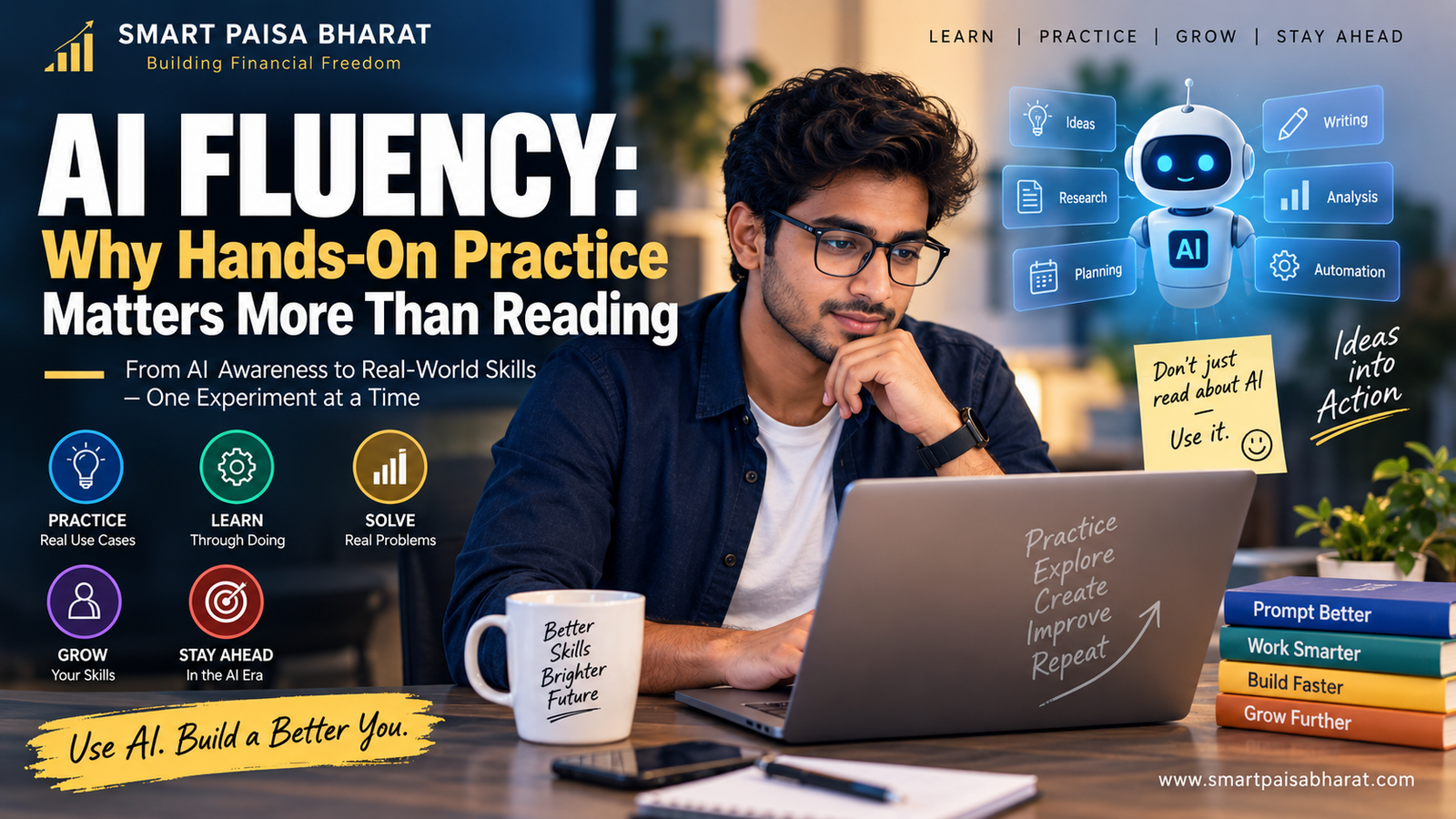
“AI Fluency Unlocked: Why Real Skills Come From Doing, Not Just Reading”
AI is no longer something people simply read about. It is becoming part of how we write, research, analyze information, create content, solve problems and get everyday work done. But knowing that AI exists is very different from knowing how to use it well.
That difference is where AI fluency comes in.
You do not need to become a machine-learning engineer or understand every technical detail behind an AI model. What matters is learning how to communicate with AI, test its answers, recognize its limitations and turn the technology into something genuinely useful.
The fastest way to build that ability is not endless reading. It is practice.
Quick Jump
- What Is AI Fluency?
- Why Reading Alone Is Not Enough
- Why Hands-On Practice Works
- The Core Skills of AI Fluency
- Learn Better Prompting Through Practice
- Why AI Answers Should Be Checked
- A Simple AI Fluency Roadmap
- The 7-Day AI Practice Challenge
- Common Mistakes Beginners Make
- Why AI Fluency Will Remain Valuable
- Frequently Asked Questions
What Is AI Fluency?
AI fluency is the practical ability to work effectively with artificial intelligence.
Think about learning a new language. Reading vocabulary lists can help, but real fluency develops when you start using those words in conversations. AI works in a similar way.
You become more comfortable with AI when you actually use it to solve problems.
For example, instead of simply watching a video about AI prompting, you could ask an AI assistant to:
- turn rough notes into a structured article outline,
- explain a complicated concept in simple language,
- compare two approaches to a problem,
- generate ideas for a project,
- review a piece of writing,
- create a study plan, or
- help organize a large amount of information.
Every interaction teaches you something about what AI does well, where it struggles and how your instructions affect the result.
That experience gradually becomes AI fluency.
Why Reading About AI Alone Is Not Enough
There is nothing wrong with learning the theory behind artificial intelligence. Understanding basic concepts can give you useful context.
The problem begins when learning stops at information consumption.
You can read dozens of articles about prompting and still struggle when you have to write your first useful prompt. You can watch tutorials about AI tools and still not know which tool makes sense for a particular task.
That happens because knowledge and ability are not exactly the same thing.
Reading tells you what is possible. Practice teaches you how to make it work.
Real learning often starts with small experiments. Try something. Look at the result. Notice what went wrong. Change your instructions. Try again.
That cycle is much closer to how practical AI skills develop.
Why Hands-On Practice Works
Hands-on learning creates feedback.
When you interact with an AI tool, you immediately see the consequences of your instructions. If the answer is too generic, you learn that the request needs more context. If the output contains an error, you learn to verify important information.
Over time, several useful habits develop naturally.
1. You Learn to Give Better Instructions
Vague questions often produce vague answers.
Compare:
Basic: “Write about investing.”
More useful: “Explain the basic principles of long-term investing to a beginner in simple language. Use practical examples and clearly separate general education from financial advice.”
The second instruction provides direction, audience and boundaries.
2. You Learn to Provide Context
AI does not automatically know the exact goal behind every request.
If you provide relevant context, the output can become considerably more useful. Tell the tool who the audience is, what you are trying to achieve, what format you need and what limitations should be respected.
3. You Learn Through Mistakes
An imperfect AI response is not necessarily a wasted interaction.
It can become a learning opportunity.
Ask yourself:
- What did I actually ask for?
- What information was missing?
- Which part of the response was useful?
- Which part needs correction?
- How could I phrase the request differently?
This simple review process can improve your AI skills surprisingly quickly.
The Core Skills Behind AI Fluency
AI fluency is broader than knowing how to write prompts. It includes several connected abilities.
Understanding the Task
Before opening an AI tool, identify the actual problem.
Do you need ideas, research support, editing, summarization, analysis, organization or automation?
A clear task usually leads to a clearer interaction.
Writing Useful Prompts
A useful prompt can include:
- Goal: What should the AI help you accomplish?
- Context: What background information matters?
- Audience: Who is the result for?
- Format: Should the answer be a table, list, article, email or checklist?
- Constraints: What should the AI avoid or prioritize?
You do not have to use all of these every time. The point is to give the AI enough information to understand the job.
Evaluating the Output
This is one of the most important AI skills.
A confident-sounding response is not automatically a correct response. AI systems can misunderstand questions, produce outdated information or generate unsupported claims.
For important subjects, verify facts using reliable sources before relying on the information.
Editing Instead of Accepting Everything
AI can produce a first draft quickly. That does not mean the first draft should always be the final version.
Good AI users edit, question, restructure and personalize the output.
The goal is not to remove human judgment. The goal is to use AI to make human judgment more effective.
Learn Better Prompting Through Practice
Prompting becomes easier when you stop treating it like a secret formula.
Start with a normal sentence describing what you want.
For example:
First attempt:
“Give me ideas for improving my website.”
Improved version:
“Act as a website content strategist. Review these goals: increase organic traffic, make the homepage easier to understand and encourage visitors to explore useful tools. Give me 10 practical improvements, explain why each matters and organize them by priority.”
The second prompt does not require complicated terminology. It simply gives the AI a clearer assignment.
That is an important lesson: better prompting is often better communication.
Why AI Answers Should Be Checked
AI fluency also means knowing when not to trust an answer immediately.
For everyday brainstorming, an imperfect answer may simply mean you need another attempt. But topics involving money, law, medicine, security, current events or other high-impact decisions require additional care.
Check important claims against trustworthy and current sources.
When using AI for research, ask it to distinguish between:
- known facts,
- assumptions,
- interpretations, and
- information that needs verification.
This habit makes AI much more useful because you are not treating the system as an unquestionable authority.
A Simple AI Fluency Roadmap
You don’t need to master everything at once. Build your skills in stages.
Stage 1: Explore
Choose one AI assistant and experiment with simple tasks. Ask questions, rewrite text, brainstorm ideas and summarize information you already understand.
Stage 2: Improve
Take the prompts that produced useful results and make them more specific. Add context, audience and desired format.
Stage 3: Verify
Start checking important claims. Compare AI-generated information with reliable sources and learn to recognize uncertainty.
Stage 4: Apply
Use AI on real projects instead of random experiments. Apply it to writing, research, learning, business planning, coding, organization or another area that matters to you.
Stage 5: Build Your Own Workflow
Eventually, you will discover which AI tools and techniques fit your work. Create repeatable workflows rather than starting from zero every time.
The 7-Day AI Fluency Practice Challenge
If you want to improve quickly, try this simple seven-day exercise.
| Day | Practice |
|---|---|
| Day 1 | Ask AI to explain a topic you already understand. Compare its explanation with your own knowledge. |
| Day 2 | Take a vague prompt and rewrite it with a clear goal and audience. |
| Day 3 | Use AI to organize messy notes into a useful structure. |
| Day 4 | Ask AI for several solutions to one problem and compare the trade-offs. |
| Day 5 | Give AI an existing piece of writing and ask for constructive editing suggestions. |
| Day 6 | Verify several factual claims from an AI response using reliable sources. |
| Day 7 | Create one repeatable AI workflow that you can use in your real work. |
Seven days will not make anyone an AI expert. But it can change the way you approach AI: from passive consumption to active experimentation.
Common AI Learning Mistakes to Avoid
Trying Every New Tool
The AI ecosystem changes quickly. New tools appear constantly, but collecting tools is not the same as developing skills.
Choose a small number of useful tools and learn how to use them properly.
Copying Prompts Without Understanding Them
Prompt libraries can provide inspiration, but blindly copying prompts limits learning.
Understand why a prompt works and adapt it to your situation.
Accepting the First Answer
Your first AI response is often a starting point, not the finished product.
Ask follow-up questions, request alternatives and correct inaccurate assumptions.
Ignoring Privacy
Think carefully before putting sensitive personal, financial, business or confidential information into an AI service.
Good AI fluency includes understanding the privacy and security implications of the tools you use.
Using AI Without Human Review
AI can accelerate many tasks, but responsibility for important decisions should not automatically be handed over to a chatbot.
Use AI as an assistant, not as a replacement for judgment.
Why AI Fluency Will Remain Valuable
Specific AI tools will change. Interfaces will change. Models will improve. Some applications will disappear while new ones emerge.
But the underlying skill of working effectively with intelligent software can remain useful across those changes.
People who understand how to define a problem, communicate clearly with AI, evaluate results and improve workflows can adapt as the technology evolves.
That is why AI fluency is more useful than memorizing the features of one particular tool.
Tools change. Learning how to work with tools is the transferable skill.
The Human Skill AI Cannot Replace: Judgment
It is tempting to think AI fluency means getting machines to do as much work as possible.
There is another side to it.
The more AI can generate, the more valuable human judgment becomes.
Someone still needs to decide whether an idea makes sense, whether a source is trustworthy, whether a piece of writing sounds authentic and whether a recommendation fits the real situation.
That human layer is what turns AI-generated output into meaningful work.
The Bottom Line
You don’t become AI fluent by reading about AI forever. You become fluent by using it, questioning it, correcting it and learning from every interaction. Start with one real problem, experiment with the technology and gradually build your own workflow.
Frequently Asked Questions About AI Fluency
What does AI fluency mean?
AI fluency means being able to use artificial intelligence effectively and responsibly. It includes communicating clearly with AI, evaluating its responses, checking important information and applying AI to real-world tasks.
Do I need coding skills to become AI fluent?
No. Coding can be valuable for certain AI-related careers, but practical AI fluency can be developed without programming. Writing, research, productivity and creative workflows are all useful starting points.
How can a beginner learn AI skills?
Start with everyday tasks. Use an AI assistant to brainstorm, summarize, organize information or improve a draft. Then review the results and experiment with better instructions.
Is prompt engineering the same as AI fluency?
No. Prompting is one part of AI fluency. True fluency also includes understanding limitations, evaluating outputs, verifying information, protecting sensitive data and choosing appropriate use cases.
Can AI always provide accurate information?
No. AI systems can produce incorrect or outdated information. Important claims should be checked against reliable and current sources, particularly when the information could affect financial, legal, medical or other significant decisions.
How long does it take to become comfortable with AI?
There is no fixed timeline. Regular practice with meaningful tasks can build confidence much faster than passive consumption. Even short daily experiments can help you develop better habits.
What is the best way to practice AI?
Use AI on problems that are actually relevant to you. Real tasks create better feedback than simply collecting tutorials or prompts.
Final Thoughts
AI is moving from an interesting technology to an everyday working tool. The people who benefit from it most will not necessarily be those who have read the most about artificial intelligence.
They will be the people who have learned how to experiment, communicate, verify and adapt.
So don’t wait until you understand everything about AI.
Pick one task today.
Give AI a clear assignment. Study the result. Improve your instructions. Check the important facts. Then try again.
That is how AI fluency grows — one practical experiment at a time.
Disclaimer: This article is for general educational and informational purposes. AI tools can make mistakes, and their features and capabilities can change over time. Always review important AI-generated information and use appropriate professional or authoritative sources when making significant decisions.