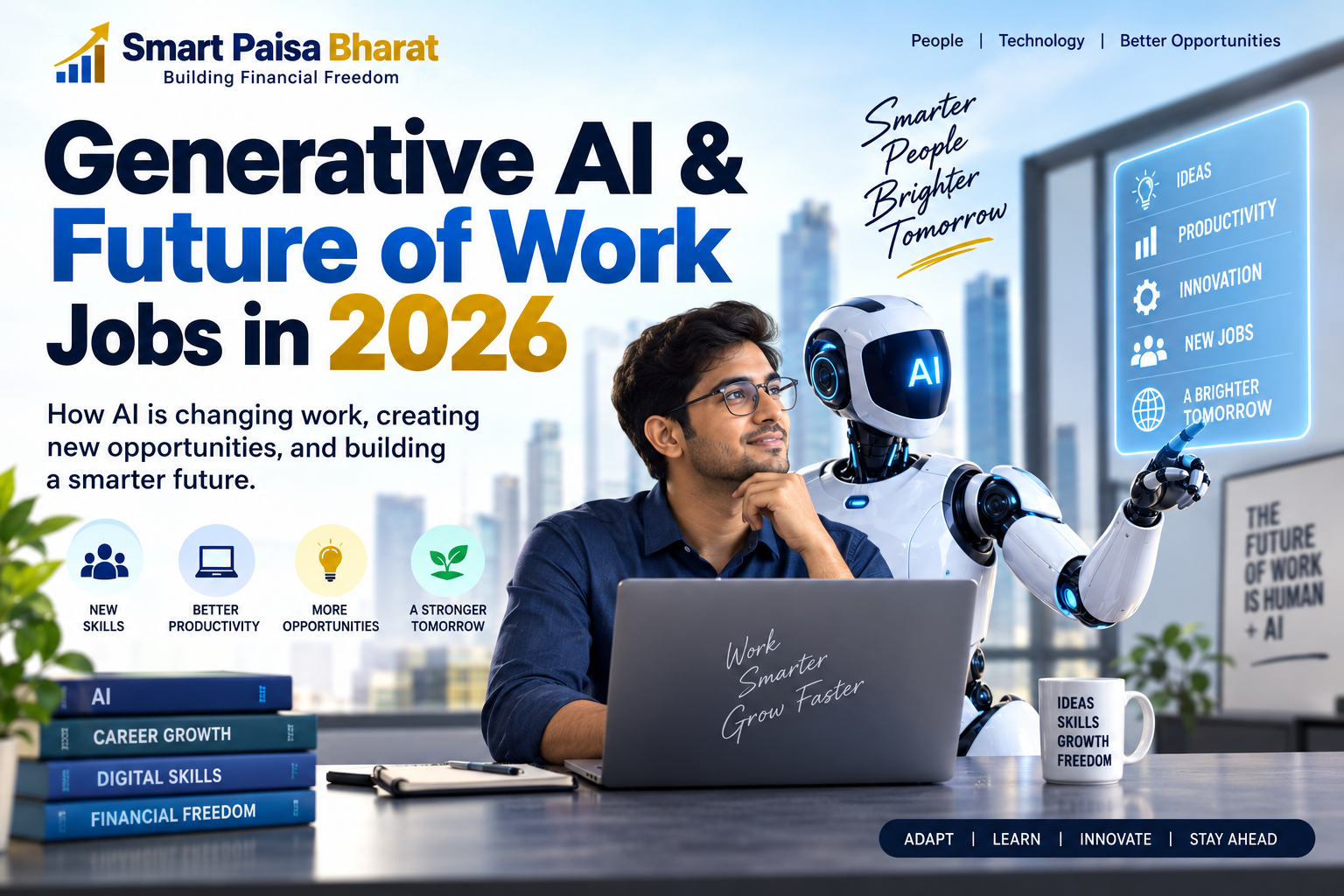
Generative AI & Future of Work: Jobs in 2026
How Generative AI Is Changing Work and Skills in 2026
The workplace is changing faster than many businesses expected. Artificial intelligence is no longer limited to research labs or technology companies. Generative AI is now becoming part of everyday work, helping teams create content, analyze information, communicate with customers, write software, and complete routine tasks more efficiently.
But the real opportunity is not simply about replacing human effort with machines. The bigger shift is about combining human judgment with intelligent technology to create faster, more flexible, and more productive ways of working.
For businesses, professionals, and entrepreneurs, understanding this transition can be more valuable than chasing every new AI tool that appears in the market.
What Is Generative AI?
Generative AI refers to artificial intelligence systems that can create new content from instructions or prompts. Depending on the system, that content can include written text, images, software code, summaries, ideas, presentations, and other forms of digital work.
Unlike traditional automation, which generally follows predefined rules, generative AI can respond to natural-language instructions and produce different outputs based on the context provided.
For example, a marketing team could use AI to develop an initial campaign concept, while a financial analyst could use it to organize a large amount of information into a more understandable summary.
The important point is that AI-generated output still requires appropriate human review, especially when decisions involve money, customers, legal matters, security, or sensitive information.
Why Generative AI Is Changing the Workplace
One of the most significant changes brought by generative AI is the reduction of time spent on repetitive knowledge-work tasks.
Employees may spend hours drafting emails, preparing reports, researching topics, summarizing meetings, organizing documents, or creating first drafts. AI can often assist with these early stages, allowing people to spend more time reviewing information, solving problems, and making decisions.
This creates a different model of productivity: instead of asking whether AI can do an entire job, businesses can ask which parts of a job can be improved with AI while keeping meaningful human oversight.
Where Businesses Can Use Generative AI
1. Marketing and Content Creation
Marketing teams can use generative AI to brainstorm campaign ideas, develop content outlines, summarize customer feedback, create variations of advertisements, and support social media planning.
However, successful marketing still depends on understanding the audience. AI can generate possibilities, but human teams need to decide whether the message is accurate, relevant, original, and aligned with the brand.
2. Customer Service
AI assistants can help customer-service teams handle frequently asked questions, summarize conversations, organize support requests, and prepare suggested responses.
This can reduce repetitive workload and help employees focus on complex cases that require empathy, negotiation, or detailed investigation.
3. Software Development
Developers are increasingly using AI tools to explain code, generate initial code drafts, identify potential errors, write documentation, and assist with testing.
AI does not remove the need for skilled developers. Instead, it can change how developers spend their time. Reviewing architecture, security, performance, and business requirements remains an important human responsibility.
4. Research and Data Analysis
Generative AI can help professionals organize large amounts of information, summarize documents, identify themes, and turn complex material into easier-to-understand explanations.
For research-heavy businesses, this can make the early stages of information gathering considerably more efficient.
5. Human Resources
HR teams can use AI to draft job descriptions, organize employee feedback, prepare training materials, and support internal communication.
Because employment decisions can have significant consequences, businesses should use appropriate safeguards and human review when AI is involved in recruitment, evaluation, or employee-related decisions.
AI Is Changing Jobs, Not Simply Removing Them
One of the biggest misunderstandings about artificial intelligence is that every AI improvement automatically means fewer jobs.
The actual effect can be more complicated. Some tasks may become automated, while new responsibilities and skills emerge around managing, checking, improving, and implementing AI systems.
A professional who learns how to work effectively with AI may be able to complete certain tasks faster than someone who relies entirely on manual processes.
This means the future of work is likely to place greater importance on skills such as:
- Critical thinking
- Problem solving
- Communication
- Creativity
- Data interpretation
- AI literacy
- Domain expertise
- Decision-making
- Adaptability
The Human Advantage Still Matters
Generative AI can process information quickly, but productivity is not only about speed.
People bring context, experience, judgment, emotional intelligence, accountability, and an understanding of real-world consequences.
For example, an AI system may produce a convincing business recommendation, but a manager still needs to ask whether the underlying assumptions are correct and whether the recommendation makes sense for the company’s customers and goals.
This is why the strongest approach is often not human versus AI, but human plus AI.
The Risks Businesses Should Not Ignore
Adopting AI without a clear strategy can create new problems alongside potential productivity gains.
Accuracy and Hallucinations
AI systems can sometimes produce information that sounds convincing but is incorrect. Important facts should therefore be verified before they are used in business decisions or published publicly.
Privacy and Confidential Information
Businesses should understand how AI tools handle information before entering customer data, financial records, confidential documents, or other sensitive material into an external system.
Cybersecurity
AI can improve productivity, but it can also introduce new security considerations. Organizations need appropriate access controls, employee awareness, and security policies when adopting AI-powered tools.
Overdependence on Automation
When employees rely too heavily on automated systems, important skills can gradually weaken. Businesses should therefore treat AI as an assistant rather than an unquestioned authority.
How Small Businesses Can Start Using AI
Businesses do not need to transform their entire operation overnight.
A practical starting point is to identify repetitive tasks that consume significant employee time.
For example:
- Drafting routine emails
- Creating first drafts of documents
- Summarizing meetings
- Organizing research
- Preparing content ideas
- Generating internal documentation
- Analyzing customer feedback
- Creating basic reports
After identifying a suitable task, businesses can test an AI workflow on a small scale, measure the results, and establish human-review procedures before expanding its use.
A Smarter AI Adoption Strategy
Successful AI adoption is not about using the maximum number of tools. It is about finding the right tools for the right problems.
A simple framework can help:
- Identify the problem: Find a process that is repetitive, slow, or difficult to manage.
- Test the technology: Use an appropriate AI solution on a limited scale.
- Measure the outcome: Compare time, quality, cost, and employee experience.
- Add human oversight: Define where people must review or approve AI-generated work.
- Improve the workflow: Adjust prompts, processes, training, and controls based on real-world results.
The Future of Work Will Require Continuous Learning
AI technology is developing quickly, which means today’s useful workflow may look different a year from now.
Professionals who continue learning will have more opportunities to adapt as technology changes. Businesses will also need to invest in employee training rather than treating AI adoption as a simple software purchase.
The most valuable skill may not be knowing how to use one particular AI application. It may be knowing how to evaluate technology, ask better questions, verify results, and apply AI responsibly to real problems.
Generative AI and the Next Productivity Era
Generative AI is becoming an important part of the modern digital workplace. Its influence can already be seen across marketing, software development, customer service, research, administration, and many other knowledge-based activities.
But technology alone does not create better businesses.
The organizations that benefit from AI will need a combination of capable people, thoughtful processes, reliable information, responsible technology use, and clear accountability.
The future of work is therefore unlikely to be defined simply by humans or machines working independently. Instead, it will increasingly involve people using intelligent systems to extend what they can accomplish.
Final Thoughts
Generative AI is changing the way modern work gets done, but its greatest value comes from purposeful implementation rather than simply following the latest technology trend.
For employees, this is an opportunity to develop new skills and improve productivity. For businesses, it is an opportunity to rethink inefficient processes and create better workflows.
The goal should not be to automate everything.
The goal should be to use technology where it genuinely helps people work smarter, make better decisions, and create greater value.
Smart Paisa Bharat focuses on practical insights into AI, digital tools, money, business, and the changing economy. Follow the blog for more easy-to-understand technology and financial insights.