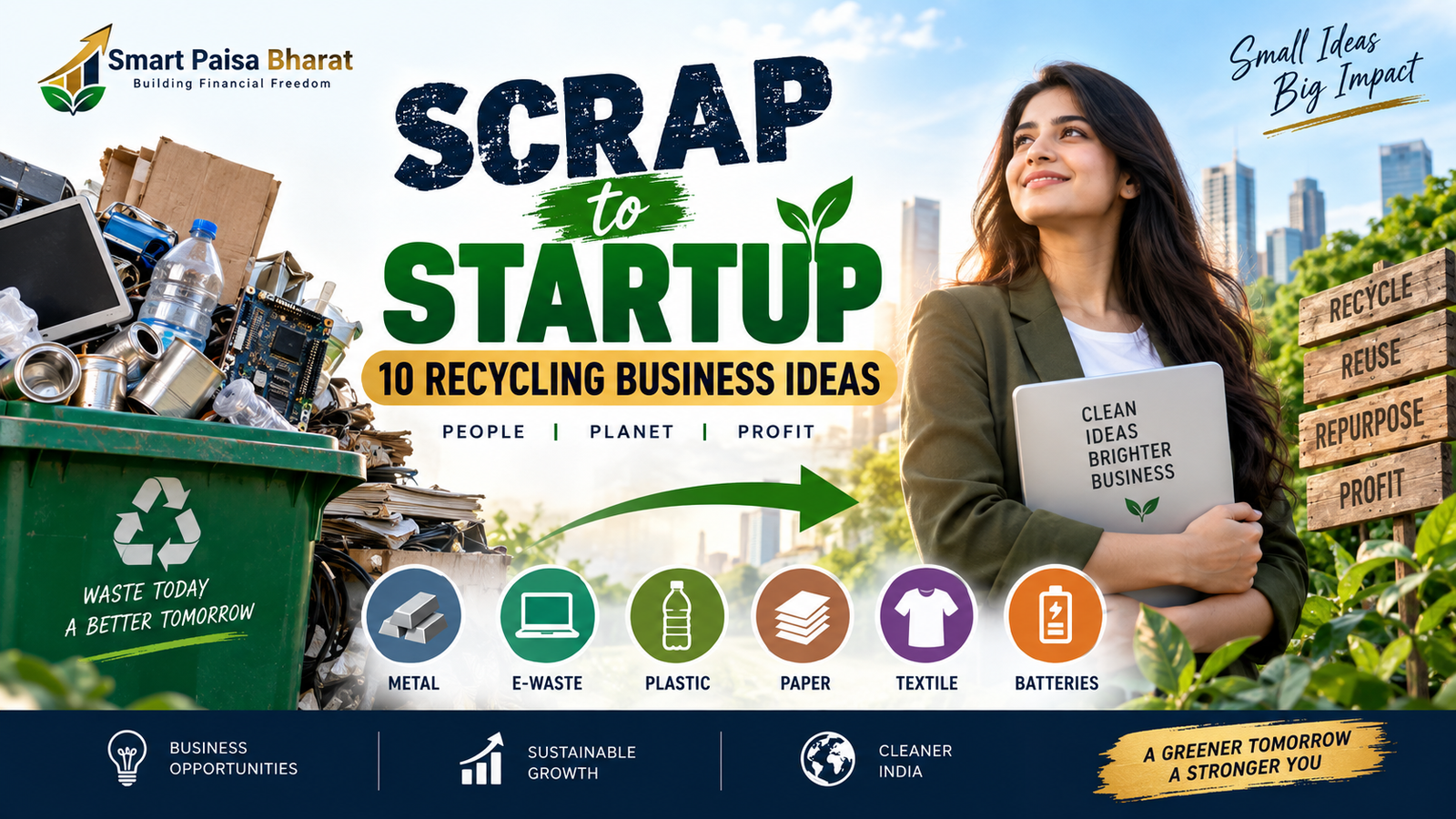
Scrap to Startup: 10 Recycling Business Ideas
Why Recycling Is Becoming a Smart Business Opportunity
What if the material sitting in a discarded box, old computer, broken appliance or unused warehouse could become the starting point of a business?
That is the basic idea behind the modern recycling economy. Every city produces waste, but waste does not always mean something has no value. A large part of it can be collected, separated, reused, refurbished or processed into another useful material.
For entrepreneurs, this creates an interesting business opportunity. You do not necessarily need to build a large recycling factory on day one. A small operation can begin with collection and sorting, then gradually move towards processing or specialised recycling as the business develops.
The most important change is the shift from an informal scrap business towards a more organised waste-to-value model. Customers want convenience, businesses want responsible disposal, manufacturers need compliant recycling channels, and recyclers need a reliable supply of material.
The Growing Opportunity in the Recycling Economy
The recycling industry sits at the intersection of three everyday realities: rising consumption, limited resources and increasing awareness about responsible waste management.
People replace phones, laptops, appliances, vehicles, packaging and clothing much faster than they did in the past. At the same time, businesses are becoming more conscious of how their discarded materials are handled.
This creates several possible business models. Some entrepreneurs earn by collecting material. Others make money through sorting and aggregation. More specialised businesses earn through refurbishment, material recovery or supplying processed material to manufacturers.
10 Recycling Business Ideas Worth Exploring
1. Scrap Metal Collection and Trading
Metal scrap remains one of the most familiar areas of recycling. Old machinery, construction off-cuts, vehicle components, electrical equipment and industrial leftovers can contain materials that have resale value.
A small entrepreneur can begin by building relationships with workshops, contractors, factories, repair centres and local businesses. The collected material can then be sorted into categories before being sold to authorised buyers or processing facilities.
The business becomes more efficient when the operator understands material grades, weighs everything accurately and maintains transparent records.
Good starting point: Collection, sorting and aggregation.
Key challenge: Price fluctuations and working-capital requirements.
2. E-Waste Collection and Recycling
Old computers, printers, smartphones, cables, routers, monitors and other electronic equipment are creating a growing stream of discarded material.
This sector is particularly interesting because electronic products contain reusable components and recoverable materials. However, e-waste should not be treated like ordinary household scrap.
India’s E-Waste (Management) Rules, 2022 provide the regulatory framework for e-waste management, including responsibilities for producers and the use of registered recyclers in the formal recycling system.
A new entrepreneur can therefore consider models such as collection services, corporate e-waste pickup, refurbishment partnerships or aggregation for authorised recyclers.
Good starting point: Collection and responsible channelisation.
Key challenge: Compliance, data security and responsible handling.
3. Used Electronics Refurbishment
Not every discarded electronic product belongs in a recycling facility. Some devices can be repaired, cleaned, tested and sold again.
A refurbishment business can focus on laptops, desktop computers, smartphones, networking equipment or other devices where replacement parts and technical skills are available.
The business model can be simple: acquire used equipment, diagnose it, repair or replace components, test it properly and sell it with transparent information about its condition.
This model can potentially create more value from a device than immediately selling it as scrap.
Good starting point: Technical repair and quality testing.
Key challenge: Warranty claims and inconsistent quality of used equipment.
4. Waste Paper Collection and Recycling
Offices, schools, printing businesses, warehouses and retail stores generate large quantities of paper waste.
A paper collection business can build regular pickup routes and supply sorted material to recycling mills or paper processors.
The opportunity becomes more attractive when the business moves beyond random collection and develops scheduled pickups for commercial customers.
Good starting point: Office and commercial collection contracts.
Key challenge: Storage space, transportation and paper-price fluctuations.
5. Plastic Waste Collection and Sorting
Plastic recycling is a broad field because different plastics require different handling and processing methods.
A small business does not necessarily need to manufacture recycled plastic immediately. It can begin by collecting, identifying, sorting and supplying suitable material to established processors.
The long-term opportunity lies in creating a dependable supply chain where material is consistently collected and properly separated.
Good starting point: Collection and segregation.
Key challenge: Contamination and differences between plastic categories.
6. Used Battery Collection and Recycling Support
The growth of electronics, electric mobility and energy-storage products is bringing greater attention to used batteries.
Battery waste requires specialised handling because damaged or incorrectly handled batteries can create serious safety and environmental risks.
For smaller entrepreneurs, the safer business model may be collection and channelisation through appropriate authorised partners rather than attempting chemical processing independently.
Entrepreneurs entering this field should understand the applicable battery-waste regulations, storage requirements and safety procedures before accepting material.
Good starting point: Collection partnerships and compliant aggregation.
Key challenge: Safety, transportation and regulatory compliance.
7. Textile Waste Collection and Upcycling
Old clothes and textile manufacturing waste do not always have to become low-value waste.
Entrepreneurs can build businesses around textile collection, sorting, reuse, resale and upcycling. Fabric scraps can potentially become bags, cleaning products, accessories, home items or other value-added products depending on quality and demand.
This model can work particularly well when the entrepreneur combines recycling with design and branding rather than selling everything as raw waste.
Good starting point: Collection, sorting and upcycled products.
Key challenge: Consistent material quality and product-market fit.
8. Used Tyre Collection and Recycling
Old tyres occupy considerable space and require specialised recycling or recovery channels.
An entrepreneur can explore collection and aggregation, partnerships with authorised processors, or specialised products made from recovered rubber where regulations and processing capabilities permit.
The important point is to avoid treating tyre waste as ordinary garbage. Proper storage, fire prevention and responsible downstream processing are essential.
Good starting point: Collection and aggregation.
Key challenge: Storage, transportation and downstream compliance.
9. Construction and Demolition Waste Recovery
Construction sites can generate concrete, metal, wood, bricks, packaging and other recoverable materials.
A business can focus on collection, sorting and recovery rather than simply transporting mixed waste to disposal sites.
The strongest opportunity may come from building relationships with contractors and developers who need regular waste-management support.
Good starting point: Commercial collection and material recovery.
Key challenge: Heavy transportation costs and site logistics.
10. Vehicle Scrapping and Parts Recovery
End-of-life vehicles contain metals, components and other materials that can enter organised recovery channels.
However, vehicle scrapping is a regulated activity and is not simply an extension of a traditional scrap shop.
Entrepreneurs can explore partnerships with authorised vehicle scrapping facilities, component recovery businesses and logistics providers rather than attempting unauthorised dismantling.
Good starting point: Logistics, collection partnerships or authorised facility models.
Key challenge: Capital requirements, documentation and regulatory compliance.
Which Recycling Model Can You Start With?
There is no single recycling business that fits every entrepreneur. Your choice should depend on available capital, technical knowledge, local supply, storage space and access to buyers.
| Business Model | Typical Starting Approach | Skills Needed | Main Consideration |
|---|---|---|---|
| Scrap Metal | Collection and trading | Sorting and market knowledge | Material prices |
| E-Waste | Collection and aggregation | Compliance and electronics knowledge | Authorised downstream partners |
| Refurbishment | Repair and resale | Technical skills | Quality control |
| Paper | Commercial collection | Sorting and logistics | Volume and transport |
| Plastic | Collection and segregation | Material identification | Contamination |
| Textile | Collection and upcycling | Design and sorting | Customer demand |
| Tyres | Collection and aggregation | Logistics and safety | Storage and compliance |
How to Start a Recycling Business Step by Step
Step 1: Choose One Waste Stream
Do not try to collect everything from day one. Choose one material and learn its entire value chain.
For example, if you choose e-waste, understand where it comes from, how it should be stored, who can legally handle it and which authorised recyclers or refurbishers can accept it.
Step 2: Study Your Local Supply
Before spending heavily on machinery, find out how much material is actually available in your area.
Talk to repair shops, offices, factories, schools, retailers, construction contractors, warehouses and other potential suppliers.
Step 3: Find Buyers Before Scaling
One common mistake is collecting material without knowing where it will ultimately be sold.
Identify potential buyers, recyclers, processors or manufacturers first. Understand their minimum volume requirements, quality specifications, payment terms and documentation requirements.
Step 4: Understand the Regulations
Waste businesses can involve environmental, municipal, transport, labour, fire-safety and other requirements depending on the material and the activity.
This is particularly important for e-waste, batteries, hazardous materials and vehicle scrapping.
Before starting operations, check the latest requirements with the relevant central, state and local authorities and obtain the registrations or permissions applicable to your business model.
Step 5: Start With Collection and Sorting
For many first-time entrepreneurs, collection and sorting can be a more practical starting point than immediately purchasing expensive processing equipment.
Once volumes become predictable, the business can consider additional services such as dismantling, refurbishment, baling, shredding or other permitted processing activities.
Step 6: Build a Reliable Record-Keeping System
Keep clear records of incoming material, weights, purchase prices, transportation costs, processing costs, sales and payments.
Good records are particularly valuable when the business grows and multiple suppliers and buyers become involved.
How Recycling Businesses Actually Make Money
The simple version of the recycling business is buying waste at one price and selling recovered material at another. In practice, successful businesses often create value at several stages.
- Collection fees or service charges
- Sorting and aggregation
- Resale of recovered materials
- Refurbishment and resale
- Processing and value addition
- Commercial waste-management contracts
- Specialised recycling services where legally permitted
The important number is not the selling price alone. Entrepreneurs need to calculate the complete cost of acquiring and moving the material.
Net operating margin = Sales value − purchase cost − collection − transport − labour − processing − rent − compliance − other operating expenses.
What Can Make a Recycling Business Successful?
The biggest advantage in recycling is often not machinery. It is consistency.
- A dependable source of recyclable material
- Reliable buyers
- Accurate weighing and sorting
- Efficient transportation
- Good inventory control
- Transparent transactions
- Proper documentation
- Strong safety practices
- Knowledge of material prices
An entrepreneur who can consistently collect clean, correctly sorted material may have a stronger business foundation than someone who simply owns expensive equipment without reliable supply.
Common Mistakes New Recycling Entrepreneurs Should Avoid
- Buying machinery too early: First prove that enough material is available.
- Ignoring transportation costs: Low-value waste can become unprofitable when collection routes are inefficient.
- Mixing different materials: Poor segregation can reduce the value of recyclable material.
- Depending on one buyer: Maintain alternative channels where possible.
- Ignoring regulations: Certain waste streams require specialised compliance.
- Underestimating working capital: Suppliers may need quick payment while buyers may pay later.
- Focusing only on volume: Quality, sorting and documentation can be equally important.
- Unsafe handling: Batteries, electronics and other specialised waste can present real safety risks.
Can a Small Entrepreneur Start a Recycling Business?
Yes, but the entry point matters.
A small entrepreneur does not necessarily need to compete with large recycling plants. A practical approach can be to specialise in collection, aggregation, refurbishment, sorting or a particular customer segment.
For example, instead of trying to handle every type of waste in a city, a new entrepreneur could build a scheduled pickup service for offices and small businesses, then supply collected material to established downstream partners.
The business can expand as the entrepreneur understands the material, customers and economics.
Recycling and the Circular Economy
The bigger opportunity behind recycling is the circular economy.
A traditional model follows a simple path: make, use and discard. A circular model tries to keep materials and products useful for longer through repair, reuse, refurbishment, remanufacturing and recycling.
That creates opportunities for entrepreneurs at different stages of the chain.
- Collection businesses bring waste into the system.
- Sorting businesses improve material quality.
- Repair businesses extend product life.
- Refurbishers create resale opportunities.
- Recyclers recover materials.
- Manufacturers can use recovered materials in new products.
Future Opportunities in Recycling
The recycling industry is likely to become more specialised rather than simply becoming larger.
Areas such as electronics, batteries, critical minerals, vehicle scrapping, textile recovery and industrial waste management are attracting increasing attention.
For entrepreneurs, that means the opportunity may not be in collecting the largest possible amount of waste. It may be in solving a specific problem better than existing operators.
Examples include scheduled corporate pickup, secure electronics disposal, specialised sorting, refurbishment, reverse logistics, material traceability and supplying consistent recycled inputs to manufacturers.
Frequently Asked Questions
1. Is recycling a good business for beginners?
It can be, particularly when the entrepreneur starts with a clearly defined material and understands the local supply and buyer network. Starting small can reduce the risk of committing too much capital before the business model is proven.
2. Which recycling business requires less technical knowledge?
Collection, aggregation and basic sorting are generally less technically demanding than specialised processing. However, even collection businesses need proper handling, transportation and regulatory knowledge for certain materials.
3. Is e-waste recycling profitable?
E-waste can contain valuable recoverable materials, but profitability depends on sourcing costs, material quality, processing arrangements, logistics and compliance. It should not be treated as ordinary scrap.
4. Can I start recycling without a factory?
Yes. Collection, aggregation, sorting, refurbishment and logistics can provide possible entry points. The exact permissions and partnerships required depend on the material and activity.
5. How much money is required to start?
There is no single startup figure. A collection-based operation can have a very different cost from a processing plant. Before investing, calculate equipment, rent, transport, labour, working capital, registrations and safety requirements.
6. Is scrap trading the same as recycling?
Not exactly. Scrap trading generally involves buying and selling discarded materials, while recycling involves processing waste into recovered materials or products. Some businesses operate across both parts of the value chain.
Final Thoughts
From Waste Collection to a Real Business
Recycling is often described as an environmental activity, but it is also a supply-chain business.
The entrepreneur has to solve practical problems: Where will the material come from? How will it be collected? How will it be sorted? Who will buy it? What does transportation cost? What rules apply? And how can the operation become more efficient over time?
Those questions are more important than simply choosing the recycling idea with the biggest headline number.
If you are starting from scratch, begin with one material, one customer group and one clear business model. Build reliable supply, understand your numbers and expand only after the first stage works.
The future of recycling is not simply about collecting more waste. It is about turning discarded materials into useful resources through better systems, smarter businesses and responsible practices.
Published by Smart Paisa Bharat — Building Financial Freedom.