How China Is Building Its AI Ecosystem for the Future
Artificial intelligence is no longer just a technology story. It is becoming part of how countries think about productivity, infrastructure, manufacturing, software and long-term economic growth.
China’s AI strategy is particularly interesting because the country is approaching artificial intelligence as a broad technology ecosystem rather than focusing only on individual chatbot products. Government policy, technology companies, semiconductor development, cloud infrastructure, industrial applications and AI research are all becoming part of the same larger picture.
That does not mean every Chinese AI project will succeed, nor does it mean China has solved every technological challenge. The more useful question is different: How is China building the foundations needed to make AI a larger part of its economy?
The answer involves several connected areas — AI models, computing power, chips, software, industrial adoption, talent and regulation.
Key Takeaway: China’s AI Strategy Goes Beyond Chatbots
China’s approach to artificial intelligence increasingly focuses on putting AI into real-world industries rather than treating it only as a consumer chatbot technology.
AI is being explored across software, manufacturing, communications, consumer services, research, transportation and other parts of the economy.
This broader approach matters because the long-term value of AI may come not only from the largest language models, but from how effectively those models and related systems are integrated into everyday economic activity.
What Is China’s AI Strategy?
In simple terms, China’s AI strategy can be understood as an effort to develop AI capabilities while also building the infrastructure and industrial ecosystem needed to deploy them at scale.
That includes research into advanced models, AI agents, computing infrastructure, semiconductor technology, data, software and practical applications.
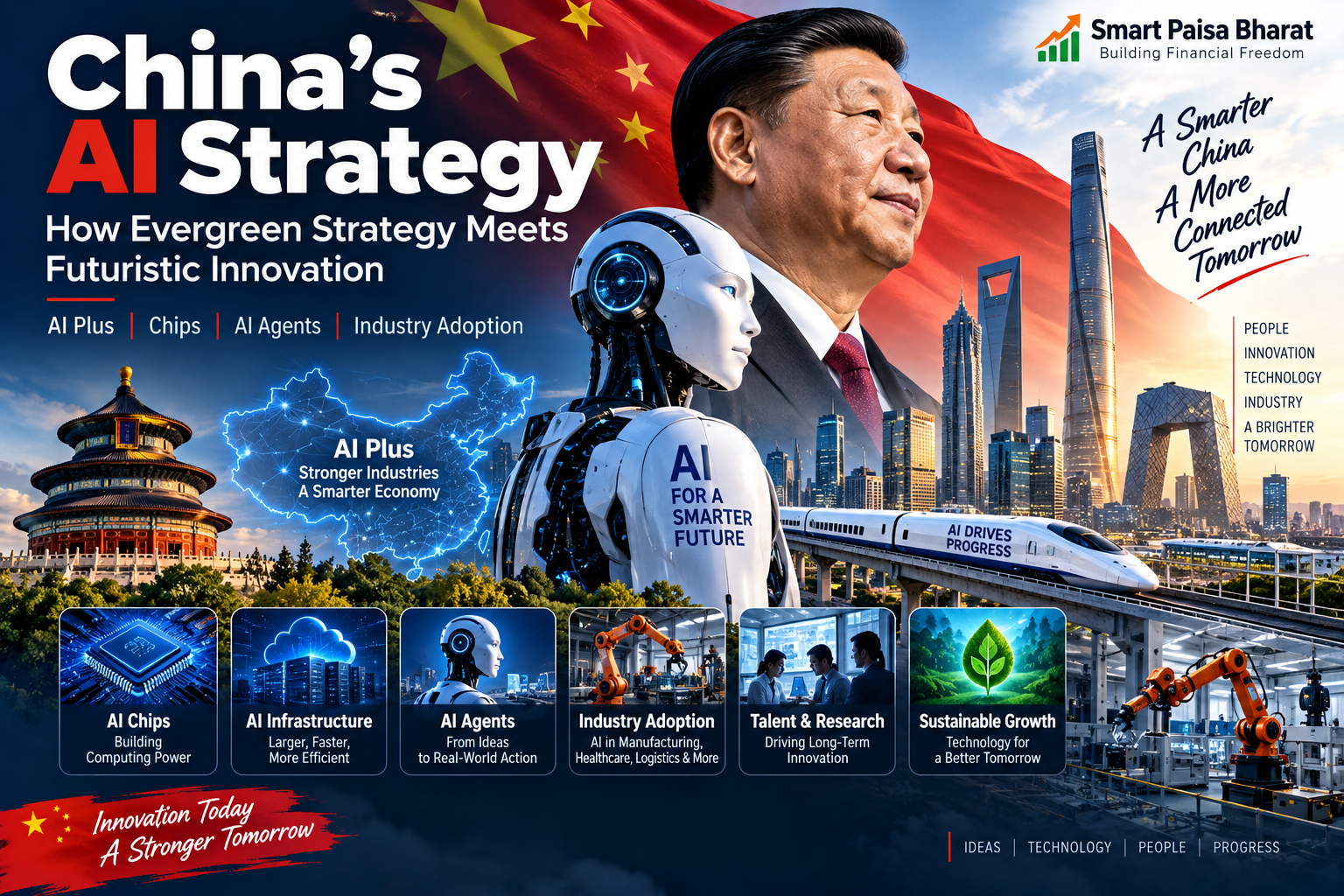
The country’s current policy direction also places significant attention on what is often described as “AI Plus” — the idea of combining artificial intelligence with existing industries and services.
This is an important distinction. Instead of asking only which company has the most impressive AI model, the broader question is how deeply AI can become integrated into the economy.
AI Plus: Turning Artificial Intelligence Into an Economic Tool
One of the most important ideas in China’s current AI policy is the expansion of AI into different sectors.
The objective is not simply to create better chatbots. AI can also be applied to software development, industrial systems, customer services, communications networks, healthcare, education, logistics and other areas.
This approach could make AI less visible as a standalone product and more visible as a technology operating behind everyday services.
Imagine a factory using AI for quality control, a software company using AI agents for repetitive development tasks, or a communications network using intelligent systems to optimise resources.
These applications may not always generate the same headlines as a new chatbot, but they can have a significant effect on productivity if they work reliably at scale.
The Rise of AI Agents
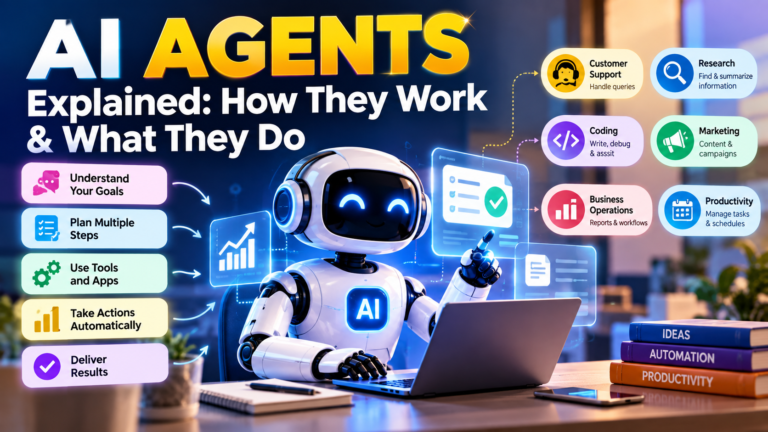
The next stage of AI is increasingly moving from systems that simply answer questions toward systems that can perform sequences of tasks.
These systems are commonly referred to as AI agents. Depending on their design, agents can interpret information, make plans, interact with software and carry out defined actions with varying levels of human supervision.
China has placed increasing policy attention on the development and standardisation of AI agents.
This could become an important area because agent-based systems have the potential to connect AI models with real business processes.
The technology is still developing, however. Reliability, security, accountability and human oversight remain important considerations whenever AI systems are allowed to perform actions rather than simply generate information.
Why AI Chips Matter So Much
Powerful AI models require enormous amounts of computing power. That makes advanced processors and data-centre infrastructure a strategic part of the AI ecosystem.
China therefore faces an important technological challenge: building enough domestic computing capacity while continuing to improve the performance and efficiency of its own AI hardware and software systems.
Chinese companies including Huawei and Alibaba are investing in AI computing platforms and chips, while the wider industry is also working on ways to connect large numbers of processors into powerful computing systems.
The semiconductor question is important because AI development is not determined by software alone. Access to computing resources, memory, networking and efficient infrastructure can influence how quickly models can be trained and deployed.
Domestic Technology Is Becoming More Important
China’s AI ecosystem is also closely connected to the country’s broader effort to strengthen domestic technology capabilities.
Restrictions on access to some advanced foreign semiconductor technologies have added pressure for Chinese companies to develop alternative hardware, software and computing architectures.
That does not mean domestic alternatives automatically match every capability available elsewhere. Building a complete technology stack is a difficult and expensive process.
But the pressure has encouraged investment across several layers of the ecosystem, including processors, cloud infrastructure, AI frameworks and software optimisation.
China’s AI Industry Is Getting Larger
China’s AI market has expanded beyond a small group of research projects and technology laboratories.
Official Chinese industry estimates put the country’s AI industry above 1.2 trillion yuan in 2025, with thousands of AI companies operating across the country.
The industry includes infrastructure providers, model developers, semiconductor companies, software businesses and firms applying AI to traditional industries.
One notable feature is the importance of application development. AI becomes economically meaningful when companies can turn models and computing resources into useful products and services.
That is why China’s AI story should not be judged only by the performance of a handful of headline models.
DeepSeek and the New Generation of Chinese AI Companies
DeepSeek has become one of the most widely discussed names in China’s artificial intelligence industry.
Its emergence helped draw international attention to China’s growing community of AI developers and researchers and to the possibility of building highly capable systems under different cost and infrastructure conditions.
DeepSeek is only one part of a much larger ecosystem. Other companies, including Alibaba, Huawei and a range of specialised AI startups, are developing models, computing systems and applications.
The significance of this ecosystem is not simply about competition between individual companies. It is about whether China can continue developing the talent, infrastructure and commercial applications required for sustained AI innovation.
Open Models and the Software Question
AI competition is not determined entirely by the size of a model. Developers also care about cost, speed, availability, software tools, compatibility and how easily a system can be integrated into existing applications.
Open-weight and developer-friendly models can therefore play an important role in building an ecosystem.
When developers have greater access to models and tools, they can create applications for specific industries and local requirements.
This is particularly relevant in a country with a huge manufacturing, technology and consumer market. A strong developer ecosystem can help convert advances in AI research into practical products.
AI Is Moving Into Traditional Industries
The most interesting part of China’s AI development may ultimately be what happens outside the technology sector.
Manufacturing is one obvious example. AI can potentially help companies inspect products, predict equipment problems, optimise production and manage complex supply chains.
Retail businesses can use intelligent systems for recommendations and customer service. Logistics companies can use AI for planning and optimisation. Software companies can automate parts of development.
These applications illustrate a broader idea: the economic impact of AI may come from thousands of smaller improvements rather than from one single breakthrough.
The Infrastructure Behind the AI Boom
AI requires more than algorithms.
It also needs data centres, electricity, networking, processors, storage, cooling systems and reliable software infrastructure.
As models become larger and AI applications become more widespread, computing efficiency becomes increasingly important.
China has therefore been investing in computing infrastructure and intelligent communications networks alongside AI research.
The long-term challenge is finding a sustainable balance between performance, cost, energy consumption and availability of computing resources.
Where China Still Faces Challenges
A balanced view of China’s AI development also needs to consider its constraints.
Advanced semiconductor access remains an important issue. Developing competitive chips and the software ecosystem around them takes years, while global supply chains remain interconnected.
China also faces the challenge of turning rapid experimentation into reliable commercial products. A promising AI model is not automatically a successful business.
There are additional questions around energy consumption, data governance, cybersecurity, intellectual property, AI safety and the responsible use of automated systems.
These challenges do not erase China’s progress, but they are important when evaluating the country’s long-term AI development.
China and the Global AI Economy
China’s AI development cannot be separated from the wider global technology market.
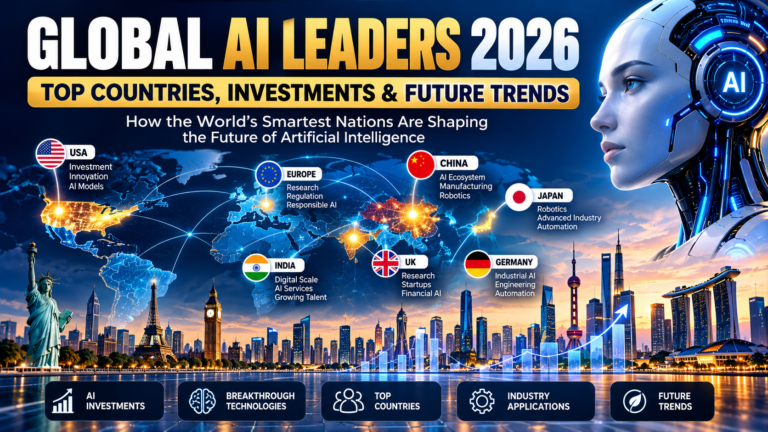
American technology companies remain major players in advanced AI models, cloud computing and semiconductor technology, while Chinese companies continue developing their own models, chips and applications.
At the same time, AI research and open-source development are increasingly international. Engineers, researchers and developers exchange ideas, publish research and build software across borders.
That makes the global AI landscape more complicated than a simple country-versus-country competition.
Different countries and companies may lead in different parts of the technology stack — from chips and models to applications, infrastructure and open-source ecosystems.
What China’s AI Strategy Could Mean for Businesses
For businesses, the biggest lesson is that AI is gradually becoming an infrastructure decision rather than simply a software experiment.
Companies may increasingly need to think about which models they use, where their data is processed, how AI connects to existing software and how much human oversight is required.
Smaller businesses can also benefit from AI without building their own models.
- Customer support can be partially automated.
- Marketing teams can use AI for content production.
- Developers can use coding assistants.
- Businesses can analyse large amounts of customer feedback.
- AI tools can help with research and document processing.
- Companies can build specialised workflows using AI agents.
The important question is not simply whether a business is using AI. It is whether the technology is solving a real problem efficiently and safely.
What Could the Next Few Years Look Like?
The next phase of China’s AI development is likely to focus increasingly on implementation.
Large language models will continue evolving, but attention is also shifting toward AI agents, multimodal systems, intelligent software, robotics and AI-enabled industrial infrastructure.
This could make artificial intelligence less visible as a separate technology and more deeply embedded in the products and services people already use.
The pace of change will depend on many factors, including computing availability, semiconductor development, investment, regulation, commercial demand and the ability of companies to turn research into reliable products.
Frequently Asked Questions About China’s AI Strategy
What is China’s AI strategy?
China’s AI strategy is a broad effort to develop artificial intelligence across research, computing infrastructure, chips, software and industrial applications while expanding the use of AI throughout the economy.
What does AI Plus mean in China?
AI Plus refers broadly to integrating artificial intelligence with existing industries, services and economic activities. The concept includes using AI to improve productivity, services, software, manufacturing and other applications.
Why are AI chips important to China?
AI chips provide the computing power required to train and run advanced artificial intelligence systems. Domestic chip development is therefore an important part of China’s effort to strengthen its AI technology ecosystem.
What role does DeepSeek play in China’s AI ecosystem?
DeepSeek is one of several Chinese AI companies developing advanced models. Its rise has attracted international attention to Chinese AI research, model development and the broader software ecosystem.
Is China leading the global AI race?
There is no single measure that can answer that question. Countries and companies can lead in different areas, including models, chips, infrastructure, applications, software and research. China’s AI ecosystem has expanded rapidly, while it also faces significant technological and infrastructure challenges.
Will AI change China’s economy?
AI has the potential to affect China’s economy through automation, software development, manufacturing, logistics, consumer services and other industries. The actual economic impact will depend on how successfully businesses deploy the technology and manage its risks.
Final Thoughts
China’s AI story is bigger than any single company, chatbot or headline. It is about building an ecosystem in which models, chips, software, computing infrastructure and industrial applications can work together.
The country’s continued focus on AI Plus, AI agents, domestic computing and industry adoption suggests that artificial intelligence is being treated as a long-term technology priority.
But the future is not guaranteed. Semiconductor constraints, infrastructure costs, software ecosystems, regulation, energy requirements and the difficulty of turning research into reliable products will all influence what happens next.
For businesses and investors watching the global technology landscape, China’s AI development is therefore worth following not simply as a competition between countries, but as a major experiment in how an entire technology ecosystem can evolve around artificial intelligence.
The next chapter of AI may not be defined by who builds the biggest model, but by who can turn artificial intelligence into useful, affordable and scalable technology.
Related Reading
Explore more Smart Paisa Bharat articles covering artificial intelligence, digital tools, emerging technology and the global economy.
Disclaimer: Technology developments, company plans, government policies and market conditions can change quickly. This article is intended for general information and should not be treated as investment, legal or technology procurement advice. Verify important information with primary or official sources before making decisions.