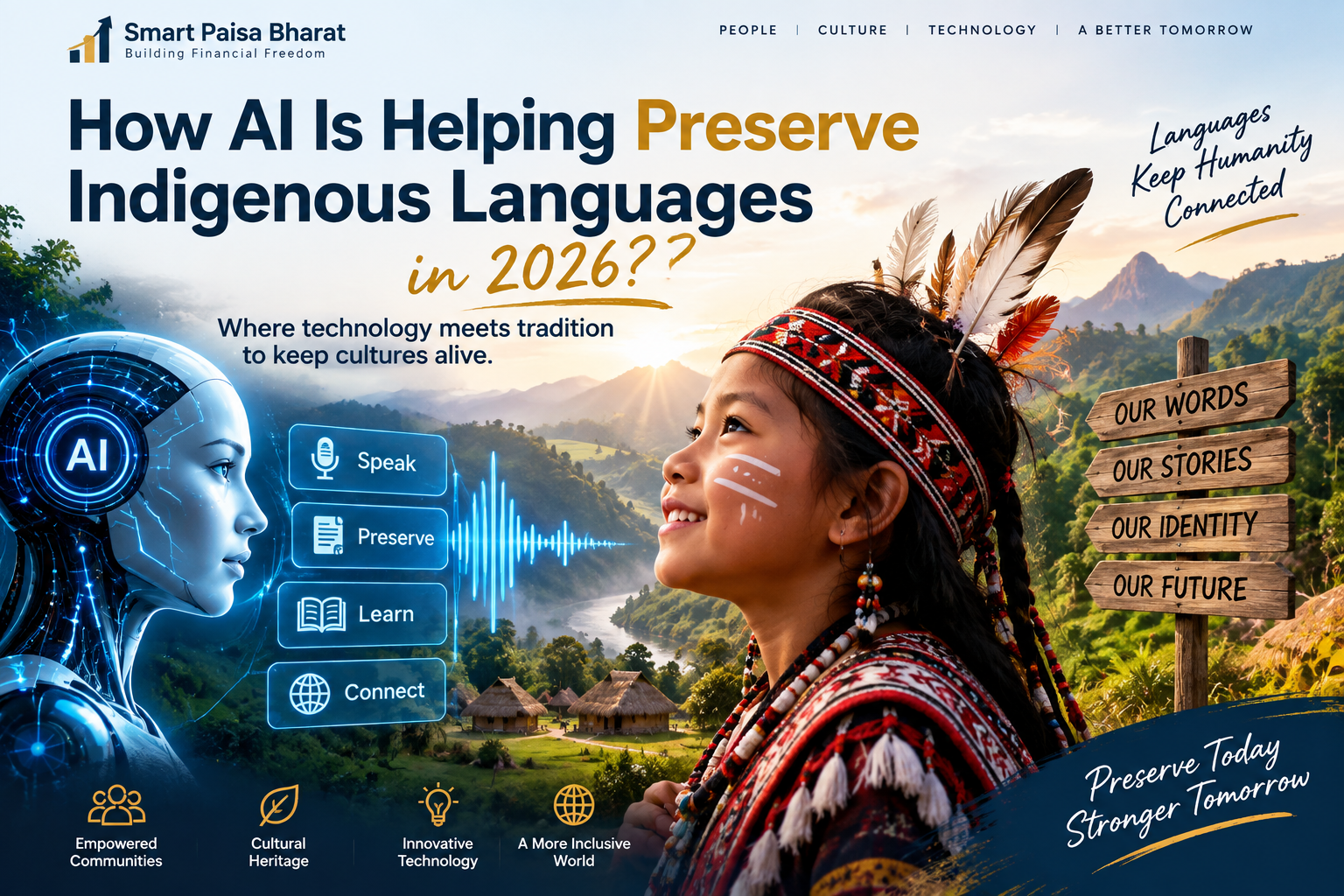
How Is AI Helping Preserve Indigenous Languages in 2026?
AI and Indigenous languages are opening new possibilities for language preservation. Language is more than a way to communicate—it carries stories, family memories, traditions, local knowledge and ways of understanding the world. When a language becomes less widely spoken, communities can lose an important connection between generations.
That is why the growing use of artificial intelligence (AI) and digital technology in language preservation is attracting attention in 2026. From speech recognition and digital archives to translation tools and community-built language resources, technology is creating new possibilities for languages that have historically received very little digital support.
But there is an important distinction: AI cannot preserve a language by itself. The people who speak, teach and carry that language must remain at the centre of the process.
Why Indigenous Language Preservation Matters
Thousands of languages are spoken around the world, but many face serious pressure from demographic change, migration, limited educational resources, reduced intergenerational transmission and the dominance of larger languages.
UNESCO says nearly 40% of the world’s languages are endangered, with many of those languages connected to Indigenous communities. The organisation’s International Decade of Indigenous Languages runs from 2022 to 2032 and focuses on preserving, revitalising and promoting Indigenous languages.
The issue is therefore much larger than vocabulary or grammar. A language can contain knowledge about local ecosystems, traditional practices, history, family relationships and community identity.
When younger generations stop using a language, that chain of knowledge can become harder to maintain.
What Has Changed in the Digital Age?
For many years, language documentation depended heavily on printed dictionaries, academic recordings and physical archives. These resources remain valuable, but modern technology offers additional ways to collect and use language materials.
Audio recordings can be digitised. Historical documents can be converted into searchable text. Speech can potentially be transcribed automatically. Educational resources can be distributed through smartphones and websites.
Artificial intelligence adds another layer to this process.
Modern AI systems can work with text, audio and images, opening possibilities for tools designed around languages that have limited digital resources. Researchers and communities are exploring applications such as speech recognition, translation assistance, optical character recognition and language-learning systems.
5 Ways AI Can Support Indigenous Languages
1. Turning Speech Into Digital Records
One of the most valuable resources for a language is the voice of its speakers.
AI-powered speech recognition can potentially help researchers and community organisations convert recorded conversations into searchable transcripts. This can make large collections of audio easier to organise and study.
For communities, searchable recordings may also become useful educational resources for younger speakers.
However, automated transcription is not automatically accurate. Pronunciation, dialect differences, background noise and limited training data can create errors. Human review remains important, particularly when recordings contain culturally significant material.
2. Building Better Translation Tools
Translation technology has traditionally performed best when large quantities of high-quality digital text are available.
Many Indigenous languages do not have the enormous datasets available for globally dominant languages. That creates a major technical challenge.
AI research is gradually exploring ways to build useful language technologies with smaller datasets. Community-created dictionaries, carefully documented recordings and verified translations can become valuable building blocks.
The goal should not simply be to make an AI translate words. It should be to develop technology that understands enough of the language’s structure and context to become genuinely useful to speakers and learners.
3. Creating Digital Learning Resources
Language learning can become more accessible when educational material is available online.
AI-assisted tools could help create pronunciation exercises, vocabulary practice, conversational simulations and personalised learning activities. Teachers may also be able to use technology to organise language materials more efficiently.
For young learners who already spend significant time on smartphones and digital platforms, this can create another pathway to engage with their heritage language.
Technology works best here as a supporting tool—not as a replacement for teachers, elders or community interaction.
4. Preserving Oral Histories
Some knowledge exists primarily through spoken stories, conversations, songs and community memories.
Digital recording can help preserve these materials for future generations. AI can potentially assist with transcription, indexing and searching large audio collections.
Imagine being able to search a community archive for a particular place name, traditional expression or historical story and quickly locate relevant recordings.
That kind of searchable archive could make cultural resources easier for authorised community members and educators to use.
5. Bringing Under-Resourced Languages Online
A language that is difficult to find online can become invisible to younger digital users.
Websites, keyboards, fonts, speech tools, digital dictionaries and online educational resources can help languages become more usable in everyday digital environments.
UNESCO has highlighted digital inclusion and language technologies as important parts of building a more multilingual digital world.
The long-term objective is not simply to put a language into a database. It is to create opportunities for people to use the language in real life and online.
AI Is Not a Magic Solution
The excitement surrounding AI can sometimes make technology appear more capable than it really is.
Indigenous-language AI systems face several difficult challenges.
- Limited data: Some languages have relatively small collections of digitised text and audio.
- Dialect diversity: One community’s version of a language may differ from another.
- Accuracy: AI systems can produce incorrect words, translations or interpretations.
- Digital access: Communities may not always have reliable connectivity or suitable technology.
- Cultural sensitivity: Some knowledge should not automatically be placed into public datasets.
- Data ownership: Communities need meaningful control over how recordings and cultural materials are collected and used.
These issues matter because a technically impressive AI system can still cause harm if it misunderstands a community or uses cultural material without appropriate consent.
Why Community Control Matters
The most important part of language technology may not be the algorithm. It may be who controls the data.
Indigenous communities have raised concerns about the use of cultural knowledge and language data without adequate consent, context or ownership protections.
That means responsible language technology should involve speakers and cultural knowledge holders from the beginning.
Communities should have a meaningful role in deciding:
- Which recordings should be digitised
- Who can access particular materials
- How language data can be used
- Which cultural information should remain restricted
- How AI-generated material should be reviewed
- How benefits from technology projects are shared
This approach is especially important because language is not simply raw data. It can represent identity, family history and cultural knowledge.
From Data Collection to Living Language
There is another important point that is easy to miss.
A language does not become healthy simply because thousands of recordings are stored on a server.
Preservation is only one part of the journey. Revitalisation means encouraging people to use the language again.
That can involve schools, families, community centres, cultural programmes, social media, music, storytelling and everyday conversation.
AI can support these activities by making learning materials easier to create and access. But the ultimate measure of success is not how much data an AI system contains. It is whether people are able and willing to use the language across generations.
Real-World Momentum Is Growing
The conversation around technology and Indigenous languages is no longer limited to experimental research.
UNESCO’s work during the International Decade of Indigenous Languages increasingly connects language preservation with digital inclusion, technology and community participation. UNESCO has also documented digital initiatives designed to help Indigenous language practitioners use online tools for preservation and revitalisation.
In 2025, UNESCO highlighted technologies such as machine translation, optical character recognition and spell-checking as potential tools for digitising and supporting under-resourced languages.
The United Nations has also highlighted both sides of the AI debate: artificial intelligence can help preserve endangered languages and oral histories, but poorly designed systems can reproduce exclusion, misrepresent cultures or create problems around data and intellectual property.
That balance is likely to become even more important as AI systems become more widespread.
What the Next Few Years Could Look Like
The next stage of language technology could move beyond simple translation.
Future systems may combine speech recognition, text generation, pronunciation analysis and educational tools into a single learning environment.
A student could potentially listen to a traditional phrase, see a verified transcription, hear its pronunciation and learn how the expression is used in context.
Teachers could use digital archives to build lessons. Community organisations could create searchable collections. Younger speakers could interact with language resources through mobile devices.
But these possibilities depend on careful development and community participation.
How AI Could Change Language Learning
One particularly interesting opportunity is personalised learning.
Instead of every student following exactly the same lesson, AI-assisted educational systems could potentially adapt vocabulary exercises and practice activities according to the learner’s level.
For example, a beginner could focus on everyday greetings and basic vocabulary, while an advanced learner could practise longer conversations and cultural expressions.
Such systems could make language learning more engaging—but only if the underlying content has been reviewed by qualified speakers and educators.
The Human Element Still Comes First
There is a temptation to describe AI as the hero of language preservation.
A more accurate way to look at it is this:
Communities preserve languages. Technology can help them do it at greater scale.
The people who speak a language understand its humour, history, cultural references and changing meaning in ways an algorithm may not.
AI can process information quickly, but it does not automatically understand the cultural significance behind every word.
That is why human expertise should remain central to the development and review of Indigenous-language technology.
What Individuals Can Do
Language preservation is not only the responsibility of governments, universities or technology companies.
Individuals can contribute in practical ways too.
- Learn and use Indigenous-language resources created by communities.
- Support community-led language programmes.
- Share verified educational resources responsibly.
- Respect restrictions around cultural and linguistic materials.
- Support digital projects that give communities meaningful control over their data.
- Encourage younger generations to use heritage languages in everyday life.
Even a small increase in everyday usage can be meaningful when it helps connect one generation with another.
AI and Indigenous Languages: The Bigger Picture
The story of AI and Indigenous languages is ultimately not about replacing traditional knowledge with technology.
It is about using modern tools to support knowledge that already exists.
Artificial intelligence can help organise recordings, assist with transcription, support translation research and create new learning experiences. Digital platforms can make resources easier to discover. Mobile technology can bring language learning into everyday life.
At the same time, technology must respect consent, cultural context, privacy, intellectual property and community ownership.
The most promising future is therefore not one where AI speaks instead of people.
It is one where technology helps more people listen, learn, speak and pass their languages forward.
Final Thoughts
Indigenous languages carry knowledge that cannot be fully replaced once lost. The current generation has an opportunity to combine cultural knowledge with digital innovation in a thoughtful way.
AI will not solve every challenge. It can make mistakes, require substantial data and create new questions around ownership and privacy.
But when technology is developed with communities rather than simply for them, it can become a powerful supporting tool.
The real goal should be simple: keep languages alive in homes, classrooms, communities and the digital world.
As the International Decade of Indigenous Languages continues through 2032, the intersection of culture and technology will remain an important part of that conversation.
Smart Paisa Bharat Insight
The future of AI should not only be about creating smarter machines. It can also be about giving more communities better digital tools to protect, teach and share the knowledge they already carry.
Frequently Asked Questions
Can AI really help preserve Indigenous languages?
Yes. AI can support tasks such as speech transcription, translation research, searchable archives and language-learning tools. However, it works best as a supporting technology alongside speakers, educators and cultural knowledge holders.
Why are Indigenous languages difficult for AI systems?
Many have limited digitised text and audio resources compared with widely used global languages. Dialect differences, limited training data and the need for culturally appropriate interpretation can also make development more challenging.
Can AI replace Indigenous language teachers?
No technology should be treated as a replacement for community speakers and teachers. AI can assist with exercises and digital resources, while human educators provide cultural context, accuracy and lived knowledge.
What is the International Decade of Indigenous Languages?
The International Decade of Indigenous Languages is a United Nations initiative covering 2022 to 2032. UNESCO leads its implementation, with a focus on preserving, revitalising and promoting Indigenous languages.
What is the biggest risk of using AI for cultural preservation?
One major concern is using language or cultural data without meaningful community participation, consent or appropriate control. Accuracy, privacy, intellectual property and data sovereignty also require careful attention.
What can ordinary people do to support language preservation?
People can learn from community-approved resources, support language programmes, share reliable educational material and respect restrictions placed on culturally sensitive information.