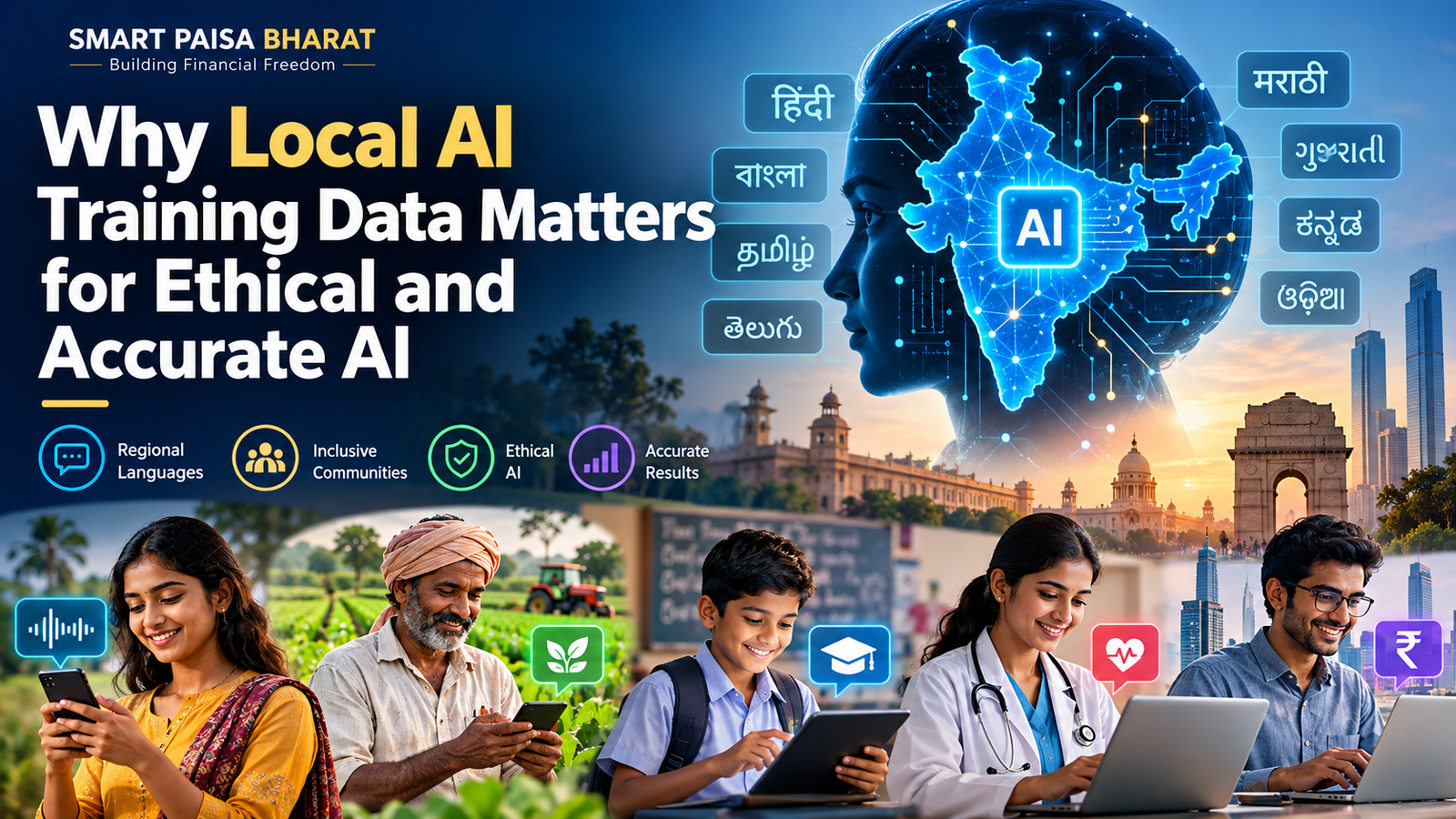
Why Local AI Training Data Matters for Ethical and Accurate AI
Artificial intelligence is becoming part of everyday life, from voice assistants and translation tools to education, healthcare, financial services, and customer support. But how well does AI understand the people who use it?
The answer depends partly on the information used to train and evaluate these systems. When AI learns mainly from data representing a limited range of languages, cultures, or communities, it may struggle to understand people whose experiences are different.
This is why local AI training data matters. Information that reflects regional languages, local expressions, cultural context, and real-world needs can help developers build AI applications that are more relevant, inclusive, and useful.
For a diverse country like India, this is especially important. Someone asking a question in Hindi, Tamil, Bengali, Marathi, or a regional dialect should be able to interact with technology in a language they understand.
In this guide, we explain what local AI training data is, how it can improve AI accuracy, why it matters for ethical AI, and how businesses and developers can use data responsibly.
1. What Is Local AI Training Data?
Local AI training data refers to information that reflects the language, culture, geography, social conditions, and practical needs of a particular community or region.
It can include text, speech recordings, images, videos, documents, and other information used to train, test, or evaluate artificial intelligence systems.
For example, an AI assistant designed for users in India may need to understand regional accents, local place names, common expressions, Indian number formats, and the way people naturally combine English with their native language.
Consider someone who asks a voice assistant, “Bhai, mera bank balance kaise check karun?” A system that understands both the Hindi words and the conversational context can provide a more relevant response than one that struggles with mixed-language speech.
The purpose of local data is not simply to add more information to an AI model. It is to provide information that better represents the environment in which the model will be used.
Examples of Local AI Training Data
- Language data: Text, conversations, translations, and speech recordings in regional languages and dialects.
- Healthcare data: Properly authorised and protected medical information that reflects local healthcare settings and terminology.
- Agricultural data: Relevant crop information, regional weather observations, soil conditions, and farming terminology.
- Financial data: Local financial terminology, payment-related questions, and appropriately anonymised examples of consumer needs.
- Geographical data: Local road names, landmarks, transport information, and place-specific descriptions.
Not every dataset needs to be collected from scratch. Publicly available, properly licensed, representative, and well-documented datasets can also be useful when they are suitable for the intended application.
2. Why Local Data Matters for Artificial Intelligence
AI models learn patterns from the examples available to them. If those examples fail to represent the people who will eventually use the system, the model may have difficulty understanding their needs.
2.1 Language Is More Than a Collection of Words
Language carries meaning through context, tone, pronunciation, and everyday usage. Two people may use different words to describe the same object, while the same expression can mean different things in different regions.
India’s linguistic diversity makes this particularly clear. Spoken language often differs from formal written language, and people regularly mix English with Hindi or other Indian languages.
Training and testing speech recognition systems on varied, representative language samples can help developers identify where a model misunderstands accents, pronunciations, or common expressions.
Local language data can therefore support more accessible voice interfaces, translation systems, educational applications, and digital public services.
2.2 Communities Have Different Needs
An AI tool developed for a large urban business may not automatically work well for a rural school, a small agricultural business, or a local healthcare centre.
These environments may have different internet access, terminology, user expectations, and available resources.
For example, a farming assistant needs to interpret local crop names and agricultural conditions. A financial education chatbot needs to explain unfamiliar terms in language that ordinary users can understand.
Local data helps developers understand these differences and design applications around real use cases rather than assumptions.
2.3 Better Representation Can Reveal Hidden Errors
A model may perform well on a standard benchmark while making mistakes for people whose language or circumstances are underrepresented in the test data.
Testing across different regions, accents, age groups, and usage conditions can expose errors that a narrow evaluation would miss.
This does not mean local data automatically removes bias. It means representative data gives developers a better opportunity to discover and address problems before and after deployment.
3. How Local Data Can Improve AI Accuracy
Accuracy depends on several factors, including model design, training methods, data quality, and the environment in which a system is used. Local data can contribute to accuracy when it reflects the actual tasks the model must perform.
3.1 It Helps AI Understand Local Language Patterns
Speech recognition systems convert spoken language into text. If the training and evaluation material contains limited examples of a particular accent or dialect, the system may misinterpret names, numbers, or everyday phrases.
Adding carefully reviewed examples from the intended user population can help developers identify and reduce these errors.
However, more data is not always better. Noisy recordings, inaccurate transcripts, duplicated material, or incorrect labels can reduce the usefulness of a dataset.
3.2 It Makes AI Applications More Context-Aware
Imagine an educational chatbot designed for Indian students. It may need to understand local examination terminology, school-related questions, and familiar examples from everyday life.
Training or adapting the system with appropriate local material may help it respond in a way that is easier for its intended audience to understand.
Likewise, an AI application for Indian financial education should understand terms such as UPI, recurring deposits, SIPs, and commonly used banking expressions.
Local context can improve relevance, but developers must still verify factual accuracy, especially when the application deals with financial, medical, legal, or other consequential information.
3.3 It Supports More Meaningful Testing
A dataset used for training should not be the only dataset used to judge a model’s performance.
Developers should evaluate their systems on separate examples that represent the people, languages, and situations in which the model will operate.
For example, a translation tool may be tested on formal text, informal conversations, regional expressions, and subject-specific terminology.
Results should be measured separately where possible. A strong overall score can hide weak performance for a particular language or group of users.
Evaluation should also include human review. Automated scores alone may not capture whether a translation is culturally appropriate, misleading, or confusing.
4. The Connection Between Local Data and Ethical AI
Ethical AI is not simply about creating a model that produces technically correct answers. It also involves fairness, transparency, privacy, accountability, and respect for the people affected by the technology.
The UNESCO Recommendation on the Ethics of Artificial Intelligence highlights human rights, diversity, inclusion, and the need to address discrimination and harmful outcomes associated with AI systems.
4.1 Reducing Unfair Representation
When some communities appear frequently in training data and others rarely appear, an AI system may learn patterns that do not represent everyone equally.
For example, a voice assistant trained predominantly on a limited range of accents may perform differently for speakers with other accents.
Similarly, a dataset that contains limited information about rural environments may be less suitable for applications intended to serve rural users.
Collecting representative data, evaluating performance across groups, and involving affected communities can help developers identify these gaps.
It is important to recognise that fairness is not achieved by simply including an equal number of records from every group. The quality, relevance, context, and consequences of the data also matter.
4.2 Protecting Privacy and Personal Information
Local data collection must respect individual privacy. Speech recordings, medical records, financial documents, and personal conversations can contain sensitive information.
Organisations should establish a clear and lawful basis for collecting and using data. They should explain the intended purpose, restrict access, apply appropriate security measures, and avoid collecting personal information that is not necessary.
Where appropriate, data should be anonymised or de-identified, while recognising that removing names alone may not prevent people from being identified through other details.
Consent, where required, should be meaningful and understandable. Contributors should know how their data may be used, whether it may be shared, and what choices are available to them.
4.3 Respecting Culture and Community Knowledge
Local communities are not merely sources of training material. They are participants whose knowledge, languages, and cultural practices deserve respect.
Some information may be culturally sensitive, restricted, or unsuitable for unrestricted public distribution. Developers should consult relevant communities before using such material and respect applicable permissions and restrictions.
For indigenous and minority languages, responsible development also means considering who controls the data, who benefits from the resulting technology, and whether community members have a meaningful voice in the process.
4.4 Keeping Humans Accountable
AI systems can make mistakes even when their training data is carefully selected.
Human oversight is particularly important when AI is used in healthcare, financial services, recruitment, education, public services, or other areas where an incorrect output can affect a person’s opportunities or well-being.
Developers and organisations should provide ways to report errors, review significant decisions, and correct problems when they occur.
5. India’s Growing Multilingual AI Ecosystem
India provides a useful example of why local AI data matters. The country has many languages, regional dialects, different writing systems, and a wide range of social and economic environments.
AI tools designed for Indian users need to work beyond a narrow set of English-language examples if they are to serve people who prefer other languages.
5.1 BHASHINI and Indian Language Technology
BHASHINI , under the Digital India initiative, works to make digital services more accessible through Indian language technology.
Its ecosystem includes language services and resources for applications such as speech recognition, machine translation, text-to-speech, and optical character recognition.
These technologies can help people interact with digital services in languages they understand, while also supporting developers who are building multilingual applications.
BHASHINI’s language resources and collaborative programmes illustrate how institutions, researchers, language experts, and contributors can work together to expand the availability of Indian language data.
5.2 AIKosh and Access to AI Resources
AIKosh is an IndiaAI platform that provides access to datasets, AI models, toolkits, and related development resources.
Its purpose includes improving access to AI resources for researchers, students, developers, and organisations working on AI applications.
Access to relevant datasets can reduce the difficulty of finding starting material for a project. However, users should still review each dataset’s documentation, licensing terms, quality, permitted uses, and suitability for their specific application.
5.3 Why Regional Languages Need Continued Attention
Language technology can work very differently across languages. Some languages have extensive digital text resources, while others have relatively limited amounts of digitised or annotated material.
Less-resourced languages may require additional work involving native speakers, language specialists, translators, and community contributors.
Accurate representation also requires more than translating English sentences word for word. Regional expressions, pronunciation, sentence structure, and cultural context must be considered.
For India, continued investment in multilingual datasets and careful evaluation can help expand access to AI-powered education, communication, and digital services.
6. Challenges in Collecting Local AI Training Data
Although local data can be valuable, building a reliable dataset requires time, expertise, resources, and appropriate safeguards.
6.1 Data Quality and Inconsistent Labelling
Data collected from different sources may contain spelling errors, incomplete information, inconsistent labels, background noise, or incorrect translations.
For example, two annotators may interpret the same regional expression differently. Without clear guidelines and quality checks, these disagreements can become part of the training material.
Organisations should establish annotation standards, review samples, resolve disagreements, and document known limitations.
6.2 Limited Data for Smaller Languages
Some languages and dialects have fewer digitised books, transcripts, and online resources than widely used languages.
Collecting material for these languages may require collaboration with speakers, universities, local organisations, and cultural institutions.
Community participation should be voluntary where appropriate, fairly managed, and supported by clear explanations of how contributions will be used.
6.3 Cost and Technical Infrastructure
Collecting, cleaning, annotating, storing, and maintaining high-quality data can be expensive.
Smaller businesses and research teams may lack the resources needed to build large datasets independently.
Shared resources, open datasets with suitable licences, research partnerships, and reusable tools can help reduce duplication of effort.
6.4 Legal and Licensing Uncertainty
Information being available on the internet does not automatically mean it can be copied, redistributed, or used to train a commercial AI model.
Developers should review copyright, contractual restrictions, privacy obligations, and other applicable legal requirements before using a dataset.
They should also maintain records of the data source, collection method, permissions, and any restrictions that apply.
6.5 Avoiding Overfitting to a Local Environment
Local data is not a replacement for broader knowledge or careful testing. A model trained too narrowly may perform well in one location but struggle when used elsewhere.
Developers should define the intended user population, test relevant variations, and clearly communicate where the system is expected to work and where its performance remains uncertain.
7. How to Build Responsible Local AI Training Datasets
Businesses, researchers, and developers can follow a structured process to improve the quality and responsible use of local data.
Step 1: Define the Purpose Before Collecting Data
Start with a specific problem. Determine whether the application needs to recognise speech, translate documents, answer questions, classify images, or support another task.
Identify the intended users, relevant languages, operating conditions, and the consequences of incorrect results.
Step 2: Identify Representative Data Sources
Use suitable sources that reflect the intended environment. These may include properly licensed public datasets, authorised institutional records, community contributions, and carefully collected samples.
Do not assume that a large dataset is automatically representative or suitable.
Step 3: Document the Dataset
Maintain clear documentation describing:
- Where the data came from and how it was collected.
- Which languages, regions, and populations it represents.
- How the information was reviewed, cleaned, and labelled.
- What permissions, licences, or usage restrictions apply.
- Known gaps, limitations, and potential sources of bias.
Good documentation helps future users understand what a dataset can and cannot support.
Step 4: Protect Privacy and Security
Collect only information that is necessary for the stated purpose. Apply suitable access controls, security practices, retention limits, and data-handling procedures.
Where personal or sensitive information is involved, obtain appropriate legal and privacy guidance before collecting or processing it.
Step 5: Separate Training Data From Evaluation Data
Keep an appropriate set of evaluation examples separate from the material used to train or adapt the model.
Where possible, evaluate performance across languages, regions, and relevant user groups. Check not only average performance but also the types of errors that could cause harm.
Step 6: Involve People With Local Expertise
Native speakers, subject-matter experts, and community representatives can help identify mistakes that automated systems may overlook.
For sensitive applications, include people who understand the local context and the potential consequences of incorrect outputs.
Step 7: Monitor Performance After Launch
Language changes, user behaviour evolves, and new situations appear over time.
Monitor errors, provide channels for feedback, review reported problems, and update datasets and models when appropriate.
Responsible AI development is an ongoing process rather than a one-time data collection exercise.
8. Why Local AI Training Data Matters for Businesses
For businesses, local data is not only a technical consideration. It can influence how customers interact with a product, how easily employees use a tool, and whether an application meets the needs of its intended market.
Better Customer Experiences
Customers may prefer to communicate in their own language or use familiar expressions. AI systems that understand these preferences can make digital services easier to navigate.
For example, a multilingual customer-support assistant may help users find information without requiring them to communicate entirely in English.
More Relevant Products and Services
Local context can help businesses identify the questions and challenges faced by their customers.
A regional education platform, for example, may need different terminology and learning examples from a product designed for an international audience.
Understanding these differences can help businesses design more appropriate products, although customer research and user testing remain essential.
Improved Trust and Transparency
People are more likely to understand a digital service when it communicates clearly about what it can do, what information it uses, and where its limitations lie.
Businesses should avoid promising perfect accuracy or claiming that local data eliminates all bias. They should explain relevant limitations and provide ways for users to report errors.
Responsible Innovation and Long-Term Value
High-quality local datasets can become useful resources for research, product development, and future applications when they are collected and maintained responsibly.
Organisations that invest in data governance, documentation, privacy, and evaluation are better positioned to understand the risks associated with their AI systems and make informed development decisions.
9. The Future of Local AI Training Data
The future of AI will involve more than building larger models. It will also depend on improving the quality, diversity, accessibility, and responsible use of the information that supports them.
Several developments are likely to remain important.
Multilingual and Voice-Based AI
Voice interfaces and multilingual applications can help people interact with technology in familiar languages. Continued work on regional speech data, translation quality, and language evaluation will be important for these systems.
Community Participation
Community-led data initiatives can help bring local knowledge and linguistic expertise into AI development.
Meaningful participation requires transparency, appropriate permissions, fair treatment of contributors, and respect for cultural and community interests.
Smaller and Specialised AI Models
Not every application requires a general-purpose model. In some situations, a smaller model adapted for a specific language, industry, or task may be more practical.
Its usefulness will still depend on appropriate training material, reliable evaluation, security, and the demands of the intended application.
Stronger Data Governance
As AI is used in more areas of daily life, organisations will need clear processes for data ownership, permissions, privacy, documentation, accountability, and model evaluation.
Local data can support inclusive innovation, but responsible governance is what helps ensure that innovation respects the people whose information and experiences make it possible.
Conclusion: Better AI Begins With Better Representation
Artificial intelligence does not operate independently of the information it learns from. The examples used to train and evaluate a model influence the patterns it recognises, the questions it understands, and the mistakes it may make.
Local AI training data can help bridge the gap between technology and real-world communities. It can improve language coverage, reveal hidden performance gaps, and support applications designed around local needs.
But data alone is not enough. Accuracy also depends on sound engineering and testing. Ethical AI requires privacy, transparency, human oversight, and accountability. Community participation must be meaningful, and sensitive information must be handled responsibly.
For India, investing in representative multilingual resources can help make digital technology more accessible across languages and regions.
The real goal is not simply to build AI that knows more. It is to build AI that understands its users more responsibly, communicates clearly, and serves people across different backgrounds.
10. Frequently Asked Questions (FAQs)
What Is Local AI Training Data?
Local AI training data is information that reflects the language, culture, geography, and practical needs of a particular community or region. It may include text, speech, images, and other data used to train, test, or evaluate AI systems.
Why Is Local Data Important for AI?
Local data can help AI systems better understand regional languages, accents, terminology, and real-world conditions. It can also help developers identify performance gaps affecting underrepresented communities.
Can Local AI Training Data Eliminate Bias?
No. Local data can help reveal and reduce certain forms of bias, but it does not guarantee fairness. Dataset quality, representation, model design, evaluation, human oversight, and ongoing monitoring also matter.
How Does Local Data Improve AI Accuracy?
When relevant and well-labelled local examples are included in training or adaptation, an AI system may become better at handling the languages, terminology, and situations it is designed for. Improvements should be verified through independent testing.
What Is the Role of BHASHINI in Indian AI?
BHASHINI is a Digital India initiative focused on Indian language technology. It supports language services and resources for applications such as translation, speech recognition, text-to-speech, and other multilingual technologies.
What Is AIKosh?
AIKosh is an IndiaAI platform that provides access to AI datasets, models, toolkits, and related development resources. Users should check each resource’s documentation, licence, and suitability before using it.
Is Publicly Available Data Always Safe to Use for AI Training?
No. Public availability does not automatically grant permission for every use. Developers should check applicable licences, privacy requirements, copyright restrictions, and terms of use before collecting or training on data.
How Can Small Businesses Use Local AI Data?
Small businesses can begin by defining a specific use case, exploring appropriately licensed datasets, testing AI tools with representative local examples, and seeking expert support for privacy, security, and high-risk applications.
References and Further Reading
The following official and institutional resources provide additional information about responsible AI, multilingual technology, and AI datasets.