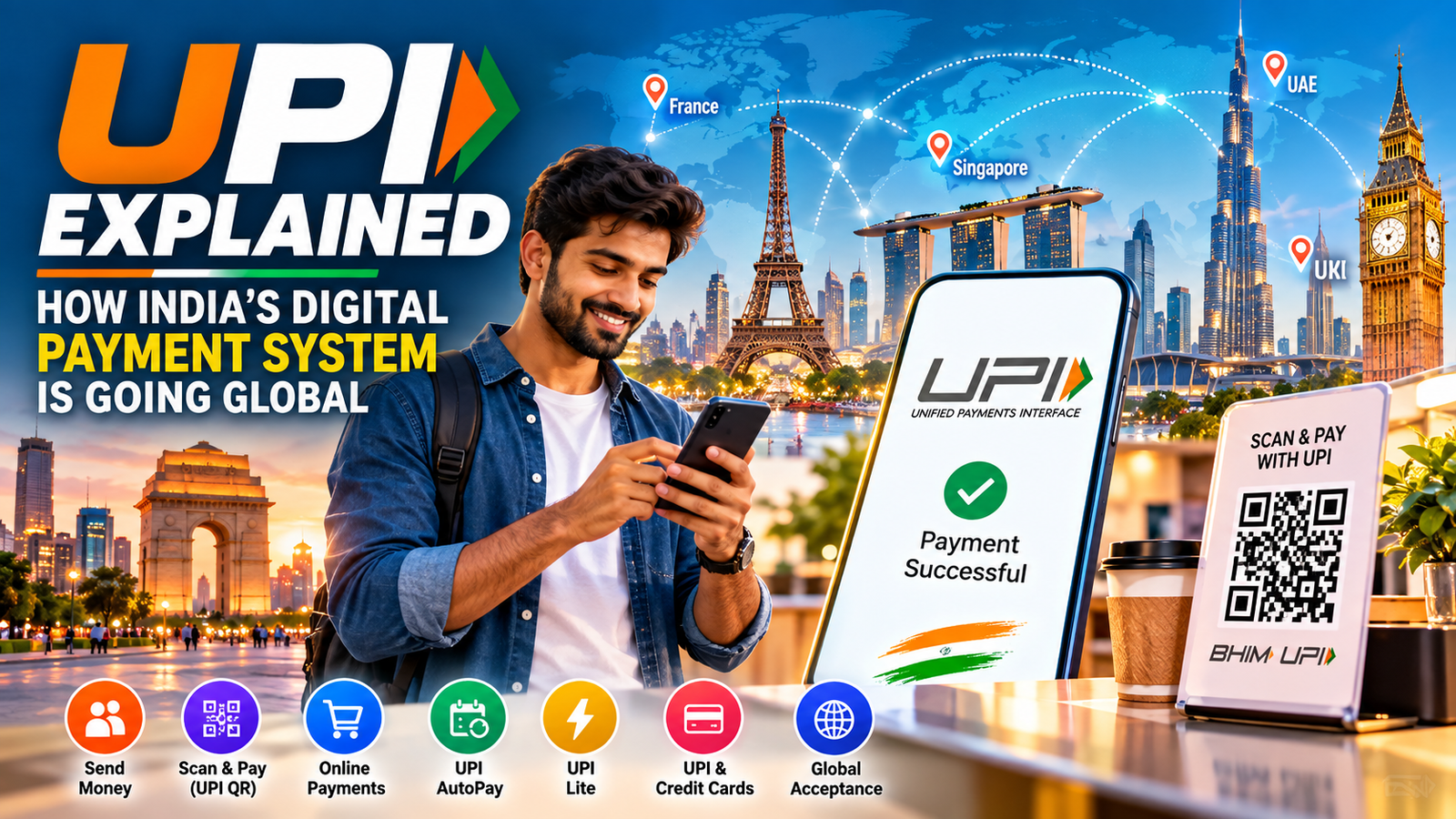
UPI Explained: How India’s Digital Payment System Is Going Global
Published by Smart Paisa Bharat | Updated: September 2026
Paying for tea, splitting a restaurant bill, sending money to family or checking out at an online store can now take only a few seconds. For millions of Indians, that simple experience is powered by the Unified Payments Interface (UPI).
What started as an Indian digital payment infrastructure in 2016 has developed into a large-scale payment ecosystem. UPI now handles billions of transactions every month, while its international acceptance is also expanding through participating banks, apps and merchant networks.
But what exactly is UPI? How does it work? What are the different ways you can use it, and what should you know before making a payment? This guide explains the UPI ecosystem in simple language.
What Is UPI?
UPI stands for Unified Payments Interface. It is a payment system developed by the National Payments Corporation of India (NPCI) that allows people to make bank-to-bank payments through participating UPI applications.
Instead of entering complete bank account details every time, a user can generally make a payment using a UPI ID, mobile number, QR code or another supported payment method.
The important idea behind UPI is interoperability. Different participating banks and payment applications can work within the same underlying payment ecosystem.
Quick Answer
UPI is a real-time digital payment system that allows participating bank accounts to send and receive money through supported UPI applications.
How Did UPI Start?
Before UPI became part of everyday life, India already had several electronic payment systems, including NEFT, RTGS and IMPS. UPI was designed to create a more unified and interoperable experience for everyday digital payments.
NPCI launched the UPI pilot with 21 member banks on 11 April 2016. UPI-enabled applications subsequently became available to customers, helping establish the foundation for the payment ecosystem that exists today.
The transformation did not happen overnight. UPI gradually expanded from person-to-person transfers into merchant payments, recurring payments, online commerce and several other use cases.
How Does UPI Work?
A UPI transaction may look extremely simple on a phone, but several systems work together in the background.
- Choose a UPI-enabled application: Open a participating bank or UPI payment application.
- Select the payment method: You may enter a UPI ID, scan a QR code or use another supported option.
- Enter the amount: Check the recipient and amount carefully before continuing.
- Authorise the payment: A UPI PIN or other supported authentication method may be required.
- Payment processing: The participating payment and banking systems process the transaction.
- Confirmation: The transaction status is displayed in the application.
This is one reason UPI feels different from older payment experiences: the user generally does not need to remember and manually enter long banking details for every everyday transaction.
Why Has UPI Become So Popular in India?
UPI’s growth is not based on one feature. Its adoption comes from a combination of convenience, interoperability, smartphone access, merchant acceptance and India’s broader digital infrastructure.
- Simple payments: Scan, enter or select the required payment details.
- Bank-to-bank transfers: Payments can move between participating bank accounts.
- QR payments: Small and large merchants can accept digital payments using QR-based systems.
- Multiple use cases: UPI supports more than simple person-to-person transfers.
- Interoperability: The ecosystem connects participating banks and applications.
- Digital convenience: Users can make payments without depending entirely on cash.
How Big Is UPI in 2026?
UPI is no longer a small digital-payment experiment. According to the latest monthly statistics published by NPCI, UPI processed 24,508.96 million transactions in August 2026. The reported transaction value was approximately ₹29.82 lakh crore, with 752 banks live on UPI.
These numbers show the scale of the ecosystem, although monthly figures naturally change over time. For readers tracking UPI statistics, the latest NPCI data should be preferred over old figures copied from earlier articles.
Different Types of UPI Payments
UPI is not just one type of payment. The ecosystem supports several payment experiences designed for different situations.
1. Person-to-Person UPI Payments
This is one of the most familiar uses of UPI. You can send money to another person using a supported UPI ID, mobile number or other available payment details.
2. UPI QR Code Payments
QR payments allow customers to scan a merchant’s supported QR code and complete the payment through their UPI application.
3. Online UPI Payments
Many digital businesses can provide UPI as a checkout option. Instead of entering card details, a customer can complete the payment through a supported UPI application.
4. UPI AutoPay
UPI AutoPay is designed for recurring payments. Depending on the service and mandate conditions, it can be used for subscriptions and other recurring payment arrangements.
5. UPI Lite
UPI Lite is designed for eligible small-value payments and provides a simplified payment experience under the applicable rules and limits.
6. UPI 123PAY
UPI 123PAY was introduced to make digital payments accessible to users who may not rely on a conventional smartphone-based payment experience. Its ecosystem includes voice and other supported methods.
7. UPI and Credit Products
The UPI ecosystem has also expanded to support certain credit-linked payment products, including eligible RuPay credit cards and other supported credit facilities.
8. IPO Payments Through UPI
UPI can also be used in the IPO application process through supported intermediaries and banks. The investor receives a payment request and, where applicable, authorises it using the UPI authentication process.
UPI Is Moving Beyond India
One of the more important developments in the UPI story is its international expansion.
NPCI’s UPI Global initiative enables eligible users to make QR-based payments at selected international merchant locations where UPI acceptance is supported.
This does not mean that every merchant or every country accepts UPI. Availability depends on participating banks, applications, payment networks and merchant acceptance.
For travellers, the practical benefit is straightforward: where UPI Global is supported, an eligible user can use a familiar UPI application to make a payment instead of relying exclusively on cash or a physical card.
Why UPI Matters for Small Businesses
UPI has also changed how many small merchants think about accepting payments.
A neighbourhood shop, food stall, service provider or independent professional can offer digital payment options without relying only on traditional card-payment infrastructure.
For customers, this can make everyday purchases more convenient. For businesses, digital payment records can also make it easier to track incoming transactions, although merchants should maintain proper accounting and tax records separately.
UPI and Financial Inclusion
Digital payments can be useful beyond large cities. UPI forms one part of India’s wider digital financial infrastructure, alongside other payment systems and banking services.
The development of products such as UPI 123PAY also shows how payment systems have been designed for people who may not have the same access to smartphones or conventional internet-based payment experiences.
However, digital inclusion is not only about technology. Reliable connectivity, access to banking services, financial literacy and protection from fraud remain important parts of the overall ecosystem.
Is UPI Safe?
UPI includes authentication mechanisms, but no digital payment system can remove the need for user caution.
Many payment frauds depend on social engineering rather than someone simply “hacking UPI.” A fraudster may try to convince a user to reveal a PIN, approve a request or scan a QR code under false pretences.
Follow These UPI Safety Rules
- Never share your UPI PIN with another person.
- Do not approve a payment request that you do not recognise.
- Remember that receiving money normally does not require you to enter your UPI PIN.
- Check the recipient’s name and amount before authorising a payment.
- Do not install payment applications from suspicious links.
- Avoid sharing OTPs, passwords or banking credentials.
- Be careful with remote-access or screen-sharing requests.
- If you suspect fraud, contact your bank and the relevant official reporting channel immediately.
UPI vs Traditional Cash Payments
| Feature | UPI | Cash |
|---|---|---|
| Physical money required | No | Yes |
| Digital transaction record | Generally available | Not automatically generated |
| QR-based payment | Supported | Not applicable |
| Bank account connection | Required for standard UPI bank payments | Not required |
| Internet/device dependence | Depends on the UPI method being used | Generally no |
Cash and digital payments can coexist. UPI has expanded the choices available to consumers rather than making every payment situation identical.
What Is the Future of UPI?
The next phase of UPI is likely to involve more than simply sending money from one bank account to another.
The ecosystem is already connected with merchant payments, recurring mandates, credit-linked products, IPO applications and international payment initiatives. Continued development could make digital payments increasingly integrated into shopping, travel, subscriptions and other financial services.
At the same time, growth brings responsibilities. Reliability, cybersecurity, consumer protection, privacy and fraud prevention will remain important as transaction volumes increase.
The bigger story is therefore not just about the number of transactions. It is about how payment infrastructure can become part of everyday economic activity without requiring users to understand the complicated technology operating behind the screen.
Frequently Asked Questions About UPI
What is UPI in simple words?
UPI is a digital payment system that allows users to send and receive money through participating bank accounts using supported UPI applications.
Who developed UPI?
UPI was developed by the National Payments Corporation of India (NPCI) as part of India’s retail digital payments infrastructure.
When was UPI launched?
The UPI pilot was launched in April 2016 with 21 member banks, followed by wider customer availability later in 2016.
Can UPI be used outside India?
Yes, UPI Global supports QR-based payments at selected international merchant locations where the service is enabled. Availability varies by country, bank, application and merchant.
Does UPI work without a bank account?
Standard UPI bank payments generally require a supported bank account. Some UPI-related products and payment methods have different requirements, so users should check the specific service they are using.
Is a UPI PIN required to receive money?
Normally, you do not need to enter your UPI PIN simply to receive money. Be cautious if someone asks you to enter your PIN to “receive” a payment.
What is UPI AutoPay?
UPI AutoPay is a recurring-payment facility that can be used for eligible recurring transactions and subscriptions under the applicable mandate rules.
What is UPI Lite?
UPI Lite is a UPI payment facility designed for eligible small-value transactions and offers a simplified payment experience subject to applicable limits and rules.
What is UPI 123PAY?
UPI 123PAY is designed to provide UPI payment functionality through supported methods for users who may not rely on a conventional smartphone-based experience.
Is UPI the same as a bank?
No. UPI is a payment infrastructure/interface. Your bank account remains with your bank, while UPI provides a way to initiate supported digital payment transactions.
Final Takeaway
UPI has changed the way many Indians think about everyday payments. What began as an interoperable payment initiative has developed into a broad digital ecosystem used for person-to-person transfers, merchant payments, recurring transactions and several other financial use cases.
Its international expansion adds another chapter to the story, but the most important part remains the everyday experience: making a digital payment can be quick, familiar and accessible from a mobile device.
As UPI continues to evolve, users should focus not only on convenience but also on understanding payment requests, checking transaction details and protecting their authentication credentials.
UPI is no longer just a way to send money. It has become an important part of India’s digital payment infrastructure.