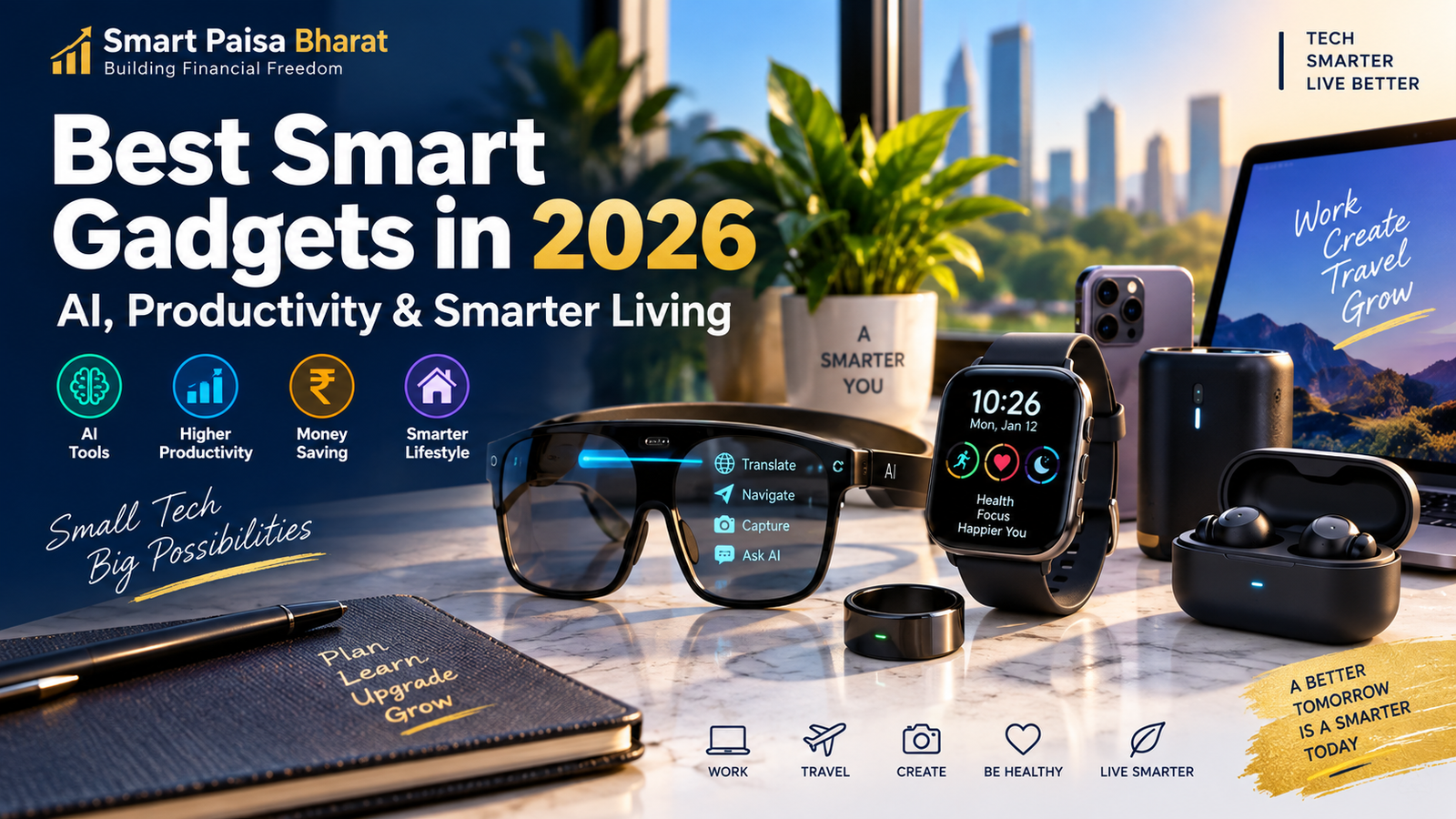
Best Smart Gadgets in 2026: AI, Productivity & Smarter Living
Technology has changed the way we work, travel, communicate and even manage small everyday tasks. But in 2026, the interesting part is not simply that gadgets are becoming more powerful. It is that many of them are becoming more useful.
AI is moving beyond the phone and laptop and into products such as smart glasses, watches, earbuds and other connected devices. At the same time, simple tools such as portable monitors, power banks and external SSDs continue to solve very practical problems.
So, what are the best smart gadgets in 2026 actually worth paying attention to?
This guide looks at the gadget categories that can genuinely make everyday life easier — whether your goal is to work more efficiently, create content, travel smarter, stay organized or simply get more value from your technology.
And there is one rule worth remembering before we begin: a smart gadget is only useful when it solves a real problem.
What Makes a Gadget Worth Buying in 2026?
The newest specification is not always the best reason to buy a device. A gadget becomes valuable when you actually use its features regularly.
Before spending money, ask yourself one simple question: What problem will this gadget solve for me?
A useful gadget should ideally do at least one of these things:
- Save time on repetitive tasks.
- Make work more convenient.
- Help you communicate more efficiently.
- Improve your productivity.
- Support content creation.
- Make travel easier.
- Help organize your digital life.
- Support a business, freelance or creator workflow.
- Reduce unnecessary friction in everyday routines.
The smartest purchase is often not the most expensive one. It is the device that you will still be using six months from now.
1. AI Smart Glasses — The Hands-Free Gadget to Watch in 2026
Smart glasses are entering a more interesting phase. Instead of being simply glasses with a camera and speakers, newer products are increasingly being designed around AI assistants and hands-free interaction.
Google announced Android XR intelligent eyewear for 2026, including audio glasses designed to provide hands-free access to Gemini. Google says the upcoming experience can support tasks such as asking questions about your surroundings, navigation, translation, calls, messaging and photography.
What could you use AI glasses for?
- Getting directions while walking or travelling.
- Taking hands-free photos and videos.
- Listening to music or calls.
- Asking an AI assistant about something you are looking at.
- Translation and language assistance.
- Quick communication while your hands are busy.
Meta is also expanding its AI-glasses ecosystem, with features including hands-free interaction, translation and AI assistance. Privacy is an important consideration because these products use cameras and microphones.
2. Smart Rings — Small Wearables, Less Screen Time
Smart rings are an interesting alternative for people who want wearable technology without wearing a large screen on their wrist.
Depending on the product, smart rings can track areas such as activity, sleep and other wellness-related measurements. Some ecosystems use AI to turn collected data into broader wellness insights.
Samsung’s Galaxy Ring, for example, works with Samsung Health and uses Galaxy AI-powered features to provide insights based on tracked data.
Why people are interested in smart rings
- Small and discreet design.
- Designed for continuous wear.
- Useful for sleep and activity tracking.
- Less distracting than a screen-based wearable.
- Can complement a smartphone or smartwatch ecosystem.
Remember that consumer wearable measurements are not a substitute for professional medical advice or diagnosis.
3. AI Earbuds — More Than Music
Wireless earbuds have already become everyday accessories. The next step is making them smarter.
Modern earbuds can combine music, calls, microphones, noise control, voice interaction and access to AI assistants. For people who spend a lot of time travelling or working remotely, that combination can be genuinely useful.
Where AI earbuds can help
- Online meetings.
- Voice commands.
- Learning and podcasts.
- Travel.
- Hands-free calls.
- Translation and language-related tasks where supported.
But there is no need to upgrade just because a newer model has an AI label. If your current earbuds already handle your calls, music and battery needs, keep using them until there is a real reason to change.
4. Smartwatches — Your Smallest Personal Dashboard
Smartwatches have become much more than notification screens. Depending on the model and ecosystem, they can handle calls, messages, navigation, payments, workouts, timers, music controls and various health-related measurements.
AI is also becoming more closely connected with wearable experiences. Google’s 2026 Android updates include deeper Gemini experiences across compatible devices, including watches and upcoming intelligent eyewear.
A quick glance at a notification can be enough to decide whether something requires immediate attention. That small interaction can help reduce unnecessary phone checking throughout the day.
5. Portable Monitors — A Simple Productivity Upgrade
Not every useful gadget needs artificial intelligence.
A portable monitor can be one of the most practical upgrades for remote workers, students, freelancers, developers, designers and business owners.
Instead of constantly switching between windows, you can keep research, email, spreadsheets, dashboards or reference material on a second screen.
Who can benefit?
- Remote workers.
- Freelancers.
- Developers.
- Designers.
- Students.
- Traders and market researchers.
- Small-business owners.
If you regularly work from different locations, pay attention to weight, connectivity, USB-C support and how easily the monitor fits into your bag.
6. Power Banks — The Gadget You Remember When You Need It
Smartphones, earbuds, cameras, watches and laptops all have one common weakness: they eventually need power.
That makes a reliable power bank one of the least glamorous but most useful pieces of technology you can carry.
Don’t look only at battery capacity
- USB-C input and output.
- Charging speed.
- Power delivery support.
- Size and weight.
- Number of charging ports.
- Safety protections.
- Compatibility with your devices.
A huge power bank that you never carry is less useful than a smaller one that is actually with you when you need it.
7. Smart Home Gadgets — Automate the Little Things
Smart-home technology does not need to be complicated. Sometimes the most useful automation is also the simplest.
Smart plugs, lights, sensors and connected appliances can help automate repetitive routines and provide remote control where supported.
Examples of practical automation
- Scheduling lights.
- Controlling selected appliances remotely.
- Creating simple daily routines.
- Monitoring selected sensors.
- Reducing repetitive manual tasks.
Before buying several smart-home products, make sure they work with the same ecosystem or standards you already use.
8. Creator Gadgets — Turn Your Phone Into a Mini Studio
You don’t necessarily need an expensive camera setup to start creating useful content.
A modern smartphone combined with a good microphone, tripod and compact light can be enough for many types of videos, tutorials, interviews, product demonstrations and social content.
A practical starter setup
- Good wireless or USB-C microphone.
- Compact tripod.
- Portable LED light.
- Fast external storage.
- Power bank.
- Reliable phone mount.
9. Portable SSDs — Protect and Move Your Digital Work
As videos, photographs, business files and documents become larger, portable storage remains extremely useful.
A portable SSD can make it easier to move large files between compatible devices and maintain an additional local copy of important work.
But remember an important rule: one external drive is not a complete backup strategy.
Important business documents and personal files should ideally have more than one reliable copy.
10. AI Productivity Tools — The Software Behind the Gadget
There is another important trend that is easy to overlook: the gadget is only one part of the experience.
The real productivity improvement often comes from the software running behind it.
AI tools can help with tasks such as research, summarization, drafting, organization, translation, brainstorming and repetitive workflows.
That means a familiar device can sometimes become more useful simply because its software becomes smarter.
Which Smart Gadget Should You Buy First?
There is no single best gadget for everyone. Your priorities should decide what comes first.
| Your Main Goal | Gadget Category to Consider | What It Can Help With |
|---|---|---|
| Hands-free AI | AI smart glasses | Voice assistance, navigation, communication and capture |
| Wellness tracking | Smart ring | Sleep, activity and selected wellness measurements |
| Remote work | Portable monitor | Multiple windows and better workspace organization |
| Calls and learning | AI-enabled earbuds | Audio, calls and hands-free interaction |
| Travel | Power bank | Keeping essential devices charged |
| Content creation | Microphone + tripod + light | Better audio, framing and lighting |
| Home convenience | Smart plugs and sensors | Simple automation and remote control |
| Large digital files | Portable SSD | File storage, transfer and additional backups |
Can Smart Gadgets Really Help You Make Money?
This is where it is important to separate marketing from reality.
A gadget does not guarantee income. What it can do is support a skill, business or workflow that already has economic value.
For example:
- A creator can use better audio equipment to improve videos.
- A freelancer can use a second monitor to manage several workspaces.
- A small business can automate repetitive digital tasks.
- A blogger can use technology to research and create content more efficiently.
- A remote professional can build a more productive mobile workstation.
- A salesperson can use hands-free tools while travelling.
The better way to think about it is:
Buying an expensive gadget without a clear use case can actually make your financial situation worse by adding another unnecessary expense.
What Should You Check Before Buying an AI Gadget?
AI features can look impressive in promotional videos. The real-world experience can be different depending on the device, country, language, software version and connected services.
- Compatibility: Check whether the device works with your phone and operating system.
- Battery life: Look beyond the headline specification and consider how you will actually use the device.
- Subscriptions: Some advanced services may require a paid plan.
- Privacy: Understand what data, audio, images or location information the device may process.
- Regional availability: AI features can differ between countries and languages.
- Warranty and support: Check local after-sales service before making an expensive purchase.
- Real usefulness: Ask yourself whether you will use the feature every week, not just on the first day.
Are Expensive Gadgets Always Better?
Not necessarily.
A premium device may offer better materials, sensors, cameras, displays, battery performance or software. But those advantages only matter when they match your needs.
A content creator may value better microphones and storage. A remote worker may get more value from a portable monitor. A frequent traveller may care more about battery life and portability.
Buy for your workflow, not for the specification sheet.
Smart Gadgets vs Smart Spending
Technology can make life easier, but it can also make spending easier.
New devices arrive constantly, and marketing can create the feeling that you are missing out if you don’t upgrade.
A better approach is to use a simple three-question test:
- What problem does this device solve?
- How often will I use it?
- Will the benefit justify the total cost?
If you cannot answer those questions clearly, waiting may be the smarter financial decision.
Frequently Asked Questions About Smart Gadgets in 2026
What are the best smart gadgets in 2026?
Useful categories include AI smart glasses, smart rings, smartwatches, AI-enabled earbuds, portable monitors, power banks, creator accessories, smart-home devices and portable SSDs. The right choice depends on your specific needs and budget.
Are AI smart glasses useful in 2026?
AI smart glasses are becoming more capable. Newer platforms are adding hands-free assistance, navigation, translation, photography, communication and contextual AI features. Availability and functionality vary by product, country and language.
Similar Posts
AI in Healthcare: Startups, Trends & Opportunities
AI in Healthcare: How AI Startups Are Transforming Medicine and Creating Business Opportunities Imagine a doctor reviewing hundreds of medical images, a researcher searching for a promising new drug, or a patient living far away from a specialist. What if intelligent software could help each of them work with better information and less wasted time?…
India AI Revolution 2030: Jobs, Economy & Investment
Updated: September 2026 Artificial intelligence is no longer a technology limited to research labs or large technology companies. AI is increasingly becoming part of everyday business, financial services, education, healthcare, agriculture, manufacturing and digital platforms. For India, this shift could become particularly important over the next few years. The country is building AI computing infrastructure,…
How Is AI Helping Preserve Indigenous Languages in 2026?
AI and Indigenous languages are opening new possibilities for language preservation. Language is more than a way to communicate—it carries stories, family memories, traditions, local knowledge and ways of understanding the world. When a language becomes less widely spoken, communities can lose an important connection between generations. That is why the growing use of artificial…
Why Local AI Training Data Matters for Ethical and Accurate AI
Artificial intelligence is becoming part of everyday life, from voice assistants and translation tools to education, healthcare, financial services, and customer support. But how well does AI understand the people who use it? The answer depends partly on the information used to train and evaluate these systems. When AI learns mainly from data representing…
Agricultural Drones in 2026: How AI Is Transforming Farming
How AI-Powered Drones Are Transforming Agriculture Farming is changing from the ground up — and increasingly, from the sky down. Walk through a modern farm today and you may notice something that would have looked unusual a few years ago: a compact drone flying above the crops, collecting information, mapping fields or applying agricultural inputs…
Post-Quantum Cryptography Explained: Quantum-Safe Encryption in 2026
Technology & Cybersecurity Guide | 2026 The way we protect passwords, financial transactions, private messages and business information is entering a new phase. Quantum computing could eventually challenge some of the mathematical foundations that protect today’s digital world. The solution is already taking shape: post-quantum cryptography. In this guide, we explain what post-quantum cryptography means,…