India AI Revolution 2030: Jobs, Economy & Investment
Updated: September 2026
Artificial intelligence is no longer a technology limited to research labs or large technology companies. AI is increasingly becoming part of everyday business, financial services, education, healthcare, agriculture, manufacturing and digital platforms.
For India, this shift could become particularly important over the next few years. The country is building AI computing infrastructure, supporting domestic AI models, expanding AI skills and encouraging startups to develop solutions for Indian markets.
That raises a bigger question:
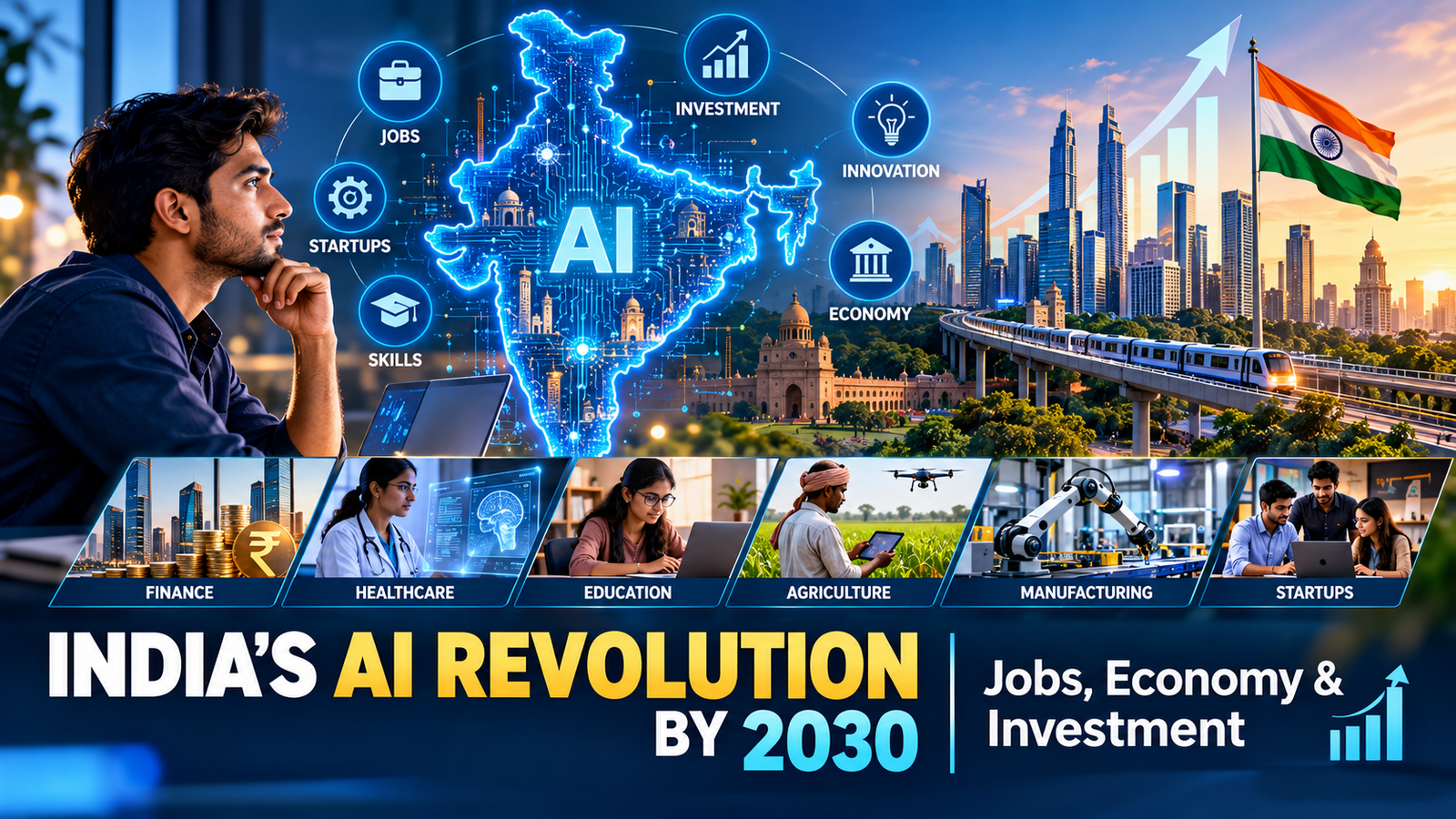
What Could India’s AI Revolution Mean for Jobs, Investment and the Economy by 2030?
The answer is unlikely to be as simple as “AI will take all the jobs” or “AI will solve every economic problem.” The impact will depend on how quickly businesses adopt the technology, how workers develop new skills, how infrastructure expands and how responsibly AI is deployed.
In this guide, we look at the major forces shaping India’s AI journey and what they could mean for businesses, professionals, investors and the wider economy.
India’s AI Story Is Moving From Experiments to Infrastructure
The first phase of generative AI created excitement around chatbots, image generation and AI assistants. The next phase is much broader.
Businesses are now looking at AI as a productivity tool that can be integrated into existing workflows. Governments and institutions are also exploring applications in areas such as healthcare, agriculture, education, public services and cybersecurity.
India’s strategy is therefore moving beyond simply using foreign AI products. There is increasing attention on building domestic computing capacity, datasets, AI models, talent and applications.
This infrastructure-first approach could become one of the most important parts of India’s AI story over the next decade.
What Is the IndiaAI Mission?
The IndiaAI Mission is a national programme designed to strengthen India’s artificial intelligence ecosystem.
Its major areas of focus include:
- AI computing infrastructure
- Indigenous foundation models
- Datasets and AIKosh
- AI applications
- AI education and skills
- Startup financing
- Safe and trusted AI
According to the Ministry of Electronics and Information Technology’s 2025–26 annual report, the mission had established access to more than 38,000 GPUs through 14 cloud partners. It had also onboarded 3,011 datasets and 243 AI models from organisations across multiple sectors.
These numbers are important because advanced AI development requires more than software. It also needs computing power, quality data, skilled people and access to suitable infrastructure.
Why AI Compute Matters for India
Training and running advanced AI models requires significant computing resources. High-performance GPUs can be expensive and difficult for smaller organisations to access.
IndiaAI Compute is intended to make AI compute resources available to eligible researchers, startups, MSMEs, students, academia and other users at more accessible rates.
This could reduce one of the barriers faced by smaller Indian companies that want to experiment with AI but cannot afford large-scale infrastructure from the beginning.
Over time, easier access to compute could encourage more experimentation, research and AI product development inside India.
Indian AI Models Could Become a Major Growth Area
India has a unique linguistic and cultural environment. A technology designed primarily around English-language data may not always perform equally well across India’s many languages and local contexts.
That is why multilingual AI models could become particularly important for India.
AI systems that understand Indian languages, local terminology and regional contexts could support applications in education, customer service, healthcare, agriculture, government services and financial technology.
The IndiaAI Mission is supporting the development of indigenous foundation models and multilingual large and small language models.
This area could eventually become important not only for Indian consumers but also for other markets with similar language and affordability challenges.
AI and Jobs in India: Replacement or Transformation?
One of the biggest questions surrounding AI is its impact on employment.
Some repetitive and predictable tasks can increasingly be automated with software and AI systems. At the same time, AI can also create demand for new technical and business roles.
The more useful way to look at the issue is not simply “jobs versus AI,” but tasks versus technology.
A job can contain several different tasks. AI may automate some of them while helping the same worker complete other tasks faster.
For example, AI can assist with:
- Customer support and ticket management
- Data analysis
- Document processing
- Fraud detection
- Software development
- Marketing research
- Financial reporting
- Content workflows
- Administrative work
This means the future workforce may need to learn how to work alongside AI rather than simply compete with it.
Which Skills Could Become More Valuable?
AI adoption is likely to increase the importance of both technical and non-technical skills.
Technical professionals may benefit from skills in areas such as:
- Artificial intelligence
- Machine learning
- Data science
- Cloud computing
- Cybersecurity
- Software engineering
- AI model development
But technical skills are only one part of the picture.
Professionals in finance, marketing, law, healthcare, sales, education and other fields can also benefit from understanding how AI can be applied to their specific work.
Skills such as critical thinking, communication, problem solving, domain expertise and responsible use of AI can become increasingly important.
India is already expanding AI-focused skilling initiatives. In August 2026, the Ministry of Skill Development and Entrepreneurship reported that the Skill India Digital Hub’s AI-related ecosystem included 119 NSQF-aligned and approved qualifications related to AI, machine learning and data science. The SOAR programme had also recorded more than 5.17 lakh learners enrolled and over 1 lakh successfully certified as of August 6, 2026.
AI Startups: A New Layer of India’s Startup Economy
India already has a large startup ecosystem. AI can add another layer of opportunity by allowing founders to build products around automation, intelligence and personalised services.
The biggest opportunities may not necessarily come from creating another general-purpose chatbot.
Industry-specific AI could be more useful for many businesses.
Examples include:
- AI tools for financial analysis
- Healthcare workflow automation
- AI-powered agricultural assistance
- Indian-language voice assistants
- AI cybersecurity platforms
- Education and tutoring systems
- Enterprise productivity software
- AI tools for small businesses
The competitive advantage for Indian startups could come from combining AI technology with deep knowledge of a specific industry and the needs of Indian users.
AI and India’s Investment Landscape
AI is not only a software story. Its expansion can influence several parts of the technology ecosystem.
Potentially connected areas include:
- Cloud computing
- Data centres
- Semiconductors
- Networking infrastructure
- Cybersecurity
- Enterprise software
- Power and digital infrastructure
- AI applications
This broader ecosystem matters because AI systems need computing infrastructure, electricity, storage, connectivity and specialised hardware in addition to software.
However, investors should not assume that every company associated with AI will automatically benefit financially.
Business models, valuations, competition, debt, cash flow, execution and actual demand still matter. A growing technology theme and a good individual investment are not necessarily the same thing.
AI Could Change Financial Services
India’s financial sector is already highly digital, making it an important area for AI adoption.
Financial institutions and fintech businesses can use AI for several purposes, including:
- Fraud detection
- Transaction monitoring
- Customer service
- Risk analysis
- Document processing
- Financial data analysis
- Cybersecurity
AI could also help financial businesses process large amounts of information more efficiently.
At the same time, financial AI requires strong controls around privacy, security, accuracy and human oversight. A fast automated decision is not necessarily a good decision if the underlying data or model is wrong.
AI in Agriculture: Taking Technology Beyond Big Cities
India’s AI opportunity is not limited to urban technology companies.
Agriculture could become an important application area for AI.
Potential use cases include:
- Crop monitoring
- Weather and risk analysis
- Plant disease detection
- Irrigation support
- Farm advisory services
- Supply-chain optimisation
- Market and demand analysis
The real value will depend on whether these technologies are affordable, reliable and easy for farmers and agricultural organisations to use.
AI and Healthcare
Healthcare is another sector where AI could provide significant assistance.
AI can support areas such as medical image analysis, research, documentation, administrative workflows and patient-data processing.
However, healthcare is also a sector where mistakes can have serious consequences.
AI should therefore be treated as a tool that can assist qualified professionals rather than an automatic replacement for medical expertise.
Data privacy, validation, transparency and human supervision will remain critical.
AI and Education
AI is also changing the way people learn.
Students can use AI tools for explanations, practice, brainstorming, language support and personalised learning. Teachers can use AI to assist with lesson planning, assessments and administrative tasks.
But there is an important limitation.
AI-generated answers can contain errors. Students therefore need to develop the ability to verify information rather than accepting every AI response as fact.
In the long run, education may place greater value on research skills, critical thinking, creativity and the ability to use technology responsibly.
The AI Infrastructure Opportunity
AI requires a physical infrastructure that is easy to overlook when people think only about chatbots.
Behind an AI application there may be:
- Data centres
- GPUs and specialised processors
- Cloud platforms
- High-speed networks
- Storage systems
- Cybersecurity infrastructure
- Electricity and cooling systems
This means India’s AI growth could create opportunities across a much wider technology supply chain.
The development of domestic capabilities in these areas may also become relevant to India’s long-term technology resilience.
What Could Slow India’s AI Growth?
AI has enormous potential, but there are several challenges that should not be ignored.
1. Skill Gaps
Technology can move faster than workforce training. If businesses adopt AI faster than workers can develop relevant skills, the transition could become difficult for some groups.
2. Access to Computing
Advanced AI development requires expensive infrastructure. Making compute accessible to startups, researchers and smaller businesses remains important.
3. Data Quality
AI systems depend heavily on data. Poor-quality, incomplete or biased datasets can reduce the usefulness of an AI model.
4. Cybersecurity
AI can improve cybersecurity, but it can also be misused to create more sophisticated scams, phishing campaigns, deepfakes and automated attacks.
5. Privacy
As AI systems process more information, responsible handling of personal and sensitive data becomes increasingly important.
6. Unequal Adoption
Large companies may have more resources to adopt AI than small businesses. Similarly, workers with better access to education and technology may adapt faster than others.
Will AI Make India More Competitive Globally?
AI could strengthen India’s global position if the country is able to combine its technology talent, startup ecosystem, digital infrastructure and large domestic market effectively.
India’s advantage may not come from trying to build every AI technology independently.
Instead, a combination of domestic capabilities, global partnerships, open innovation, skilled talent and strong applications could shape India’s position in the international AI ecosystem.
The government has described AI as an important part of India’s digital economy and innovation strategy, while the IndiaAI Mission is specifically focused on building domestic capabilities and improving access to AI infrastructure.
What Could India’s AI Economy Look Like by 2030?
No one can accurately predict the exact size or structure of India’s AI economy in 2030.
Technology adoption can change rapidly, while regulation, global competition, investment and consumer behaviour can influence the outcome.
However, several areas are likely to remain important themes:
- AI-powered businesses
- Indian-language AI
- Enterprise automation
- AI and financial services
- AI-powered healthcare
- AI in agriculture
- AI education platforms
- Cloud and data-centre infrastructure
- Semiconductor and computing ecosystems
- AI cybersecurity
- AI-focused workforce development
The biggest change may not be a single breakthrough technology. It could be the gradual integration of AI into thousands of existing businesses and everyday workflows.
What Should Students and Professionals Do Now?
There is no need for every professional to become an AI engineer.
A better starting point is to understand how AI can improve your existing field.
A finance professional can learn AI-assisted analysis. A marketer can learn AI-powered research and content workflows. A developer can use AI coding tools. A business owner can explore customer-service automation.
The important skill is learning how to combine AI with existing knowledge.
AI literacy plus domain expertise could become more useful than AI knowledge alone.
What Should Investors Watch in India’s AI Story?
Investors interested in the AI theme should look beyond headlines and examine the underlying business fundamentals.
Some useful questions include:
- Does the company have a real AI-related business use case?
- Is AI creating measurable revenue or productivity benefits?
- Does the company have sustainable competitive advantages?
- How expensive is the technology infrastructure?
- Is the business dependent on a single AI provider?
- How strong is the company’s cash flow and balance sheet?
- What regulatory and cybersecurity risks exist?
AI can create long-term economic opportunities without every AI-related company becoming a successful investment. Separating the technology trend from individual investment decisions is therefore important.
India’s AI Opportunity Is Bigger Than Chatbots
The most interesting part of India’s AI journey may not be the next chatbot.
It may be what happens when AI becomes an invisible layer inside banking systems, hospitals, factories, schools, farms, government platforms and small businesses.
That transition could improve productivity and create new products and services, but it could also create challenges around skills, privacy, cybersecurity and unequal access.
India’s success will therefore depend not only on how much AI the country adopts, but also on how responsibly and inclusively it is adopted.
Frequently Asked Questions About India’s AI Revolution
What is India’s AI revolution?
India’s AI revolution refers to the growing adoption and development of artificial intelligence across businesses, government services, education, healthcare, finance, agriculture and other sectors, supported by expanding computing infrastructure, skills and AI research.
What is the IndiaAI Mission?
The IndiaAI Mission is a national initiative focused on strengthening India’s AI ecosystem through computing infrastructure, datasets, indigenous AI models, applications, skills, startup support and safe and trusted AI.
How will AI affect jobs in India?
AI may automate some tasks while creating or expanding other types of work. The impact will vary by occupation and industry. Workers who develop AI-related and complementary skills may be better positioned to adapt to changing workflows.
Will AI create new jobs in India?
AI is already creating demand for roles connected with data, software, machine learning, AI deployment, cybersecurity and AI-enabled business operations. The exact number and type of future jobs cannot be known with certainty.
Which sectors could benefit from AI in India?
Potential areas include finance, healthcare, agriculture, education, manufacturing, cybersecurity, software, customer service, logistics and government services.
Is AI a good investment theme?
AI is an important technology trend, but that does not mean every AI-related investment will perform well. Investors should evaluate individual businesses, valuations, financial performance, competition and risks rather than investing solely because a company is associated with AI.
What AI skills should Indians learn?
Useful skills can include AI literacy, data analysis, machine learning, programming, cybersecurity, cloud computing and AI-assisted workflows. Non-technical skills such as communication, critical thinking and domain expertise are also important.
How many GPUs are part of the IndiaAI ecosystem?
According to MeitY’s 2025–26 annual report, more than 38,000 GPUs had been established through 14 cloud partners under the IndiaAI Mission.
Is India developing its own AI models?
Yes. The IndiaAI Mission is supporting the development of indigenous foundation models as well as multilingual large and small language models.
Final Takeaway
India’s AI journey is entering a more practical phase.
The focus is gradually moving from excitement around generative AI to the harder work of building infrastructure, developing skills, creating useful applications and integrating AI into real businesses.
By 2030, AI could have a meaningful influence on India’s jobs, investment landscape and economic productivity. But the outcome will depend on several factors, including workforce readiness, infrastructure, innovation, regulation, cybersecurity and responsible adoption.
For individuals and businesses, the most practical approach is not to treat AI as a temporary trend.
Learn it. Understand it. Use it where it creates real value — and keep the human judgment that technology cannot replace.
Disclaimer: This article is for educational and informational purposes only. It should not be considered financial, investment, employment or business advice.